
Better Money Conversations, Better Decisions
Sep 03, 2026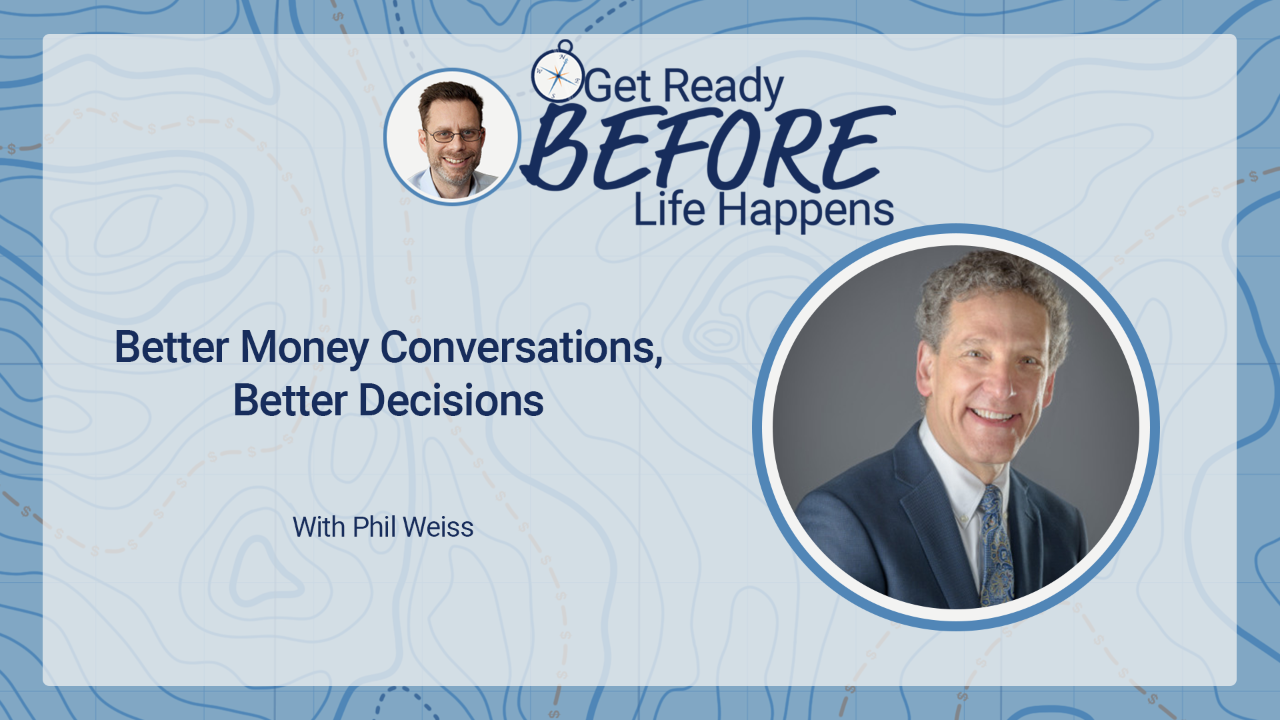
Better money decisions start with better conversations.
Phil Weiss, Founder of Apprise Wealth joined Tony on this episode of Get Ready Before Life Happens to talk about how understanding your financial situation, aligning your resources with your values, and having regular money conversations can help you navigate major life changes with more confidence and intention. Life transitions require clarity and confidence.
Key Takeaways
- Your money story shapes how you make financial decisions.
- Knowing your financial situation helps you see what’s possible.
- Moving from your accumulation (saving) phase to your spending (decumulation) phase requires a mindset shift.
- Align time, energy, attention, and money with what matters most.
- Regular “money dates” strengthen communication and clarity.
- During major transitions, pause and avoid rushed decisions.
- Asking questions builds confidence and better outcomes.
🧠 Tony’s Take: Financial confidence grows through clarity and conversation. When you understand where you stand, align your resources with your values, and stay engaged through regular discussions, you create the ability to navigate life’s transitions with confidence.
🎥 Watch this episode below:
🎧 Listen to the podcast below or on your favorite podcast app.
Connect with Philip H. Weiss, CFA, CPA, RLP®:
- Apprise Wealth Website: https://apprisewealth.com
- LinkedIn: https://www.linkedin.com/in/philip-weiss/
- Blog: https://apprisewealth.com/news/
- Facebook: https://www.facebook.com/phil.weiss.330 or https://www.facebook.com/AppriseWealth
- YouTube: https://www.youtube.com/channel/UCdxgFt2cD1r5WP0-Y6LqMDg/
- Instagram: https://www.instagram.com/stories/phweiss11/
Resources:
- Caring for aging parents checklist (here)
Bio:
Phil Weiss founded Apprise Wealth Management. He started his financial services career in 1987, working as a tax professional for Deloitte & Touche. For the past 25 years, he has worked extensively in the areas of personal finance and investment management. Phil is a CFA charter holder, a CPA, and an RLP®.
Phil launched his own Registered Investment Advisor (RIA) business to provide financial planning, personal finance, and investment management services, as well as education, to women facing new beginnings. He believes it is a privilege to help others plan for their financial future. Please read this blog if you would like to learn more about what drove Phil to start Apprise and why he works with women facing new beginnings.
👉 Start Your Financial Readiness Plan: A free, practical plan that helps you create your in-case-of-emergency Financial First Aid Kit, organize what matters, and prepare before life happens. Start Your Free Financial Readiness Plan https://www.tonysteuer.com
👉 Support Get Ready. Become a Get Ready Insider and help keep the Financial Readiness Plan free, support the podcast, trusted resources, and consumer-first financial education. You’ll receive access to the Get Ready Library. Support Get Ready here. www.tonysteuer.com/support
Transcript
Tony Steuer:
What would it be like to feel confident that we could have the life we want?
Welcome to Get Ready: Before Life Happens. Today, I’m joined by Phil Weiss.
Phil, welcome to the podcast.
Phil Weiss:
Thanks, Tony. I’m happy to be here today. I’m looking forward to a great conversation with you.
Tony:
I am as well. I’ve really been enjoying some of your writing.
So let’s jump in. Tell us a little bit about yourself. What is your origin story, and how did it lead you to focus on helping women?
Phil:
In my house, it was a typical thing. My father was responsible for the finances, and my mother was responsible for taking care of my sister and me.
But here’s the thing. When it came to finances, to say my father wasn’t good at it is putting it mildly.
We had unpaid bills. We had no savings. We had no credit.
When I was old enough to drive, I remember going down to pay the local utility to get services turned back on because they had been turned off for nonpayment.
When it was time for me to go to college, I was told, “Phil, you can go anywhere you want.”
I wanted to be a doctor, so I said, “I’m going to go to Duke.”
I went to Duke, and I was there for three years. My father wasn’t paying, and I had done a lot to stay in school. But at the end of my junior year, I was told, “You’re academically eligible to come back, but you’re not financially eligible. You have to pay off this debt, and then you can come back.”
So I was back home, and it was a toxic situation.
I decided to move across the country. I’m originally from New Jersey, and I moved to Arizona. I was working to get myself ready to go back to school.
But when it was time to go back, I was a psychology major. Psychology meant I would have to go to grad school, and that was more school and more expense than I could really afford.
So I decided I was going to study accounting.
Duke doesn’t offer undergraduate accounting degrees, which meant I wasn’t going to go back.
I had been in Arizona long enough to qualify for Arizona residency. Through my parents, I had New Jersey residency. I thought I would get a better job coming out of Rutgers, so I came back home, went to Rutgers, and graduated as an accountant.
After I finished school, I went to work for Deloitte.
At the end of my first year of work, I remember looking at how much interest I had paid on credit card bills.
When I was in college, I paid for tuition and rent with credit card checks because that was the only way I was going to get through school.
I had paid the school debt, but I was still not in the best financial shape.
I knew I had to get a degree and a profession to be able to make something of myself.
So I looked at what I owed, put a plan together to repay it, and fortunately paid it off even faster than I had originally planned.
But I was also living at home again.
One day I came home and opened the mail. I found credit card bills with my name on them, but there was only one thing: they weren’t mine.
My father had forged my name to open credit card accounts because he couldn’t get credit.
Tony:
Wow.
Phil:
I got one of the companies to send me a copy of the application, so I knew it was his writing. I waited until I had that before I confronted him.
While all this was going on, my mother had gone back to school. She became an occupational therapist and ultimately started her own business.
I know she did that so she could be on her own footing financially.
Unfortunately, while all this was going on, my mother was diagnosed with stage four breast cancer.
She asked me to help because we found out how bad the financial situation at home had really gotten.
The mortgage on my parents’ home was at way too high a rate, and they were in danger of being foreclosed on.
Those credit cards my father had opened in my name, when I contacted the companies, since he had been making at least the minimum payments, they moved them out of my name and put them in his.
But once they were in his name, he didn’t have the same compulsion to pay them off. They all went into collection.
I did what I could, but unfortunately, my mom didn’t make it.
Eighteen months after her diagnosis, her cancer metastasized to her brain, and she passed away.
So now I work with women facing new beginnings.
The reason behind that is I want to help keep other women from having the same experiences and going through the same kind of things my mother did.
That’s really why I work with who I work with now.
Tony:
That’s an amazing story. I’m so sorry you had to go through that. That is a rough beginning by any measure.
Phil:
It was.
But we learn from our experiences.
I look at it this way: you can have two types of role models. You can have good ones and bad ones. I had a really bad one, but I learned everything not to do.
I like to mentor younger kids. I went to a program where I was mentoring a couple of kids who were in college.
One of them asked me, “If you had to do it all over again, what would you do differently?”
I thought about it and said, “There are a lot of things I could have done differently, but I’m happy with where I am today. So I don’t think I would change any of it, because if I changed any of it, I might not have the family I have and everything else that has come with life.”
It got me to the right place.
Sometimes it’s about being able to handle it and figuring out how to get through it.
I think you can grow a lot from that.
Tony:
That’s important. You need to be able to figure out how to go through it because life is always going to throw you curveballs.
Phil:
Absolutely.
Tony:
That’s my whole thing: preparing for life’s what-ifs.
Even with the best of plans, those experiences are what led you to this place, and all the choices you made brought you here.
That applies to our whole financial life as well. The choices we make determine our financial futures, and we do have agency in that.
Phil:
Absolutely.
What’s interesting when I talk to people is that early on, when I’m working with somebody, I’ll ask questions like, “What are your earliest money memories?” or “What was money like growing up?”
It’s really interesting to see how many things we learn, see, and experience growing up carry forward into our lives today.
I can think of one couple where she is the financial person and he is not. He wants to pay off the mortgage. She says, “But the mortgage is around 3%. Why would we be in a hurry to pay it off? We can invest and do other things with that money.”
Then you ask about their early money stories.
You find out that when he was growing up, his family lived in one house, then moved into a nicer house, but kept the first house as a rental property.
Then his father lost his job. When that happened, they were able to move back into the first house. It gave them a place to live.
So he views paying off the mortgage as security. If something went wrong, they would have a place to go back to.
We talk a lot about that when we’re working together. It can be hard sometimes to overcome those things, but talking through those stories can make it easier to figure out how to manage them.
Tony:
That’s a really important point.
In my experience working with clients and advisors, these decisions are often not purely logical or based only on what the numbers say.
People make these decisions for a whole variety of reasons based on their perspective.
Let’s jump back to what you were saying about helping women.
This is so important because there are so many times where women haven’t participated, or don’t participate, in a family’s finances.
That comes with a whole myriad of issues, like the issues your parents experienced, but also what happens if they get divorced or widowed.
All of a sudden, they’re on their own and they don’t know anything about the money.
Why is it so important for women to be involved with their family money?
Phil:
When I work with a couple, there is almost always one person who is more knowledgeable than the other.
I want to make sure both of them are involved, whether she is the lead person or he is the lead person, because both people need to know what is going on.
If you become a widow or divorced and don’t have any knowledge or understanding of how the finances work, there are a lot more things you have to get over.
A lot of times, when women are going through divorce, they reach out and say, “I just want to know: can I get divorced? If I get divorced, will I be able to take care of the kids? Will I be able to have the life I want?”
They don’t have an understanding of what their financial situation looks like.
It’s easy sometimes to say, “I didn’t learn about finance in school.”
We don’t get a lot of financial education, so one person often takes the lead.
But when I talk to couples now, there are exercises I do where I ask questions like, “How were financial decisions made in your house when you were growing up?”
For a lot of people in our generation, the answer is that it was an autocratic process. Maybe the parents talked, but not very much.
Then I ask, “How is it now, or how do you want it to be?”
Many people want it to be a joint decision. They want discussion.
For me, I’ll even include the kids in some things because I want to help teach my kids so they are not without knowledge when the time comes for them to make their own decisions.
It is important to have those conversations with our kids too.
Having knowledge of your financial situation helps you figure out what’s possible.
That’s a big part of it.
When you think about a financial plan, a lot of times a couple hires a financial advisor because one person may have been doing all the financial stuff but may not know what the future can look like.
She may say, “I know we’ve been saving, but what does it mean? What can we do?”
And he may say, “I don’t know. I have no idea.”
The rules are one way when we’re in the accumulation phase, saving for retirement. But when we go into decumulation and start pulling money out, the rules are different, and we may have no experience with them.
That’s often why couples hire somebody.
One person wants to know what they can do, and the other may not really have an answer.
Then you can blend whatever financial knowledge the two of them have with a conversation around what they want to do.
Tony:
That accumulation-to-decumulation conversation is coming up more often because so many people are starting to move into that stage.
We’ve been conditioned for 40 years to save, and all of a sudden you have to switch gears. It’s tough mentally to make that change.
How do you help clients walk through that mindset change?
Phil:
I’m a CPA and a CFA, so I have the financial knowledge. But I also became a registered life planner.
That part of the work helps people explore what is important to them and what matters to them.
We go through a series of exercises.
If I narrowed it down to its finer points, it is about helping people align their capital with their values.
When I say capital, I don’t just mean money.
We have four sources of capital: money, time, energy, and attention.
I take those four together and say we have a team of capital: time, energy, attention, and money.
We want to try to align how we use that capital with our values.
The reason I say those are all sources of capital is because I can use money to buy more time. I can use money to free up or create energy. And the often-overlooked one is that I can use money to free up attention.
Carl Richards, a financial planner who now works with advisors and has a podcast, once said that attention is the currency of a meaningful financial life. I turned that idea into a blog.
Think about it.
If you go away with your family, that takes time. It takes money. It takes energy to do activities.
But there are two different ways you can be away with your family.
One is that you can just kind of be there while checking your phone, looking at email, or having your mind elsewhere.
The other is that you say, “I’m with my family. I’m not going to spend all this time on my phone. I’m going to devote my attention to them.”
When you do that, it is a very different experience.
Through life planning, we try to identify the things that really matter so people can do them now, before they get to the end of life and have regrets about the things they didn’t do.
For me, I mentioned my mom and that she went back to school. One element of my life plan is that I want to start a scholarship for women who go back to school later in life in honor of my mother.
Why not do that now instead of leaving it as a legacy thing?
If I can start it while I’m still alive, then I can help select the women. They get the scholarship. I can see what it does for them.
You could say that’s selfish because I get to see it, but why shouldn’t you let yourself get some joy out of what you’re doing?
Tony:
Yes, to see that impact.
Making an impact is positive for so many of us, and if that’s a value you hold dear, why not see it?
I want to jump back to having women involved in the marital conversation about money.
How do you suggest clients start doing that?
In a lot of couples, one person may naturally take on more of the money duties. I’m in the financial world, so I tend to do more of that. I try to have these conversations, but it can still be hard.
How do you get people to do that, especially when one person is the natural person to take care of money?
Phil:
I recommend having a money date.
Maybe it’s once a month, once a week, once a quarter, or whatever works for you.
Sit down with your spouse and talk through it.
You’re right. In my house, I take care of these things. When my wife and I got married, she said, “We’re going to do it together.” Then things changed, and I do more of it.
But she knows enough.
For us, usually once a quarter, we sit down and go through the balances. She knows some balances, but not all of them.
We make sure we both know where we stand, and we talk about some of the things we might want to do.
That’s what I usually recommend to couples: intentionally set aside time to talk with your spouse.
You can do it over a glass of wine. You can go out to dinner. You can go on a walk. Do whatever works for you.
It depends on how data-intensive you want to get.
If I’m going over balances with my wife, we need to be able to look at things, so we can’t really be out of the house for that.
But we do get together and talk about it.
Tony:
That’s so important.
Sometimes a spouse might not be quite ready to talk about money, but as you said, if it is regular and ongoing, it does not have to be a big deal.
Make it casual. Have a glass of wine or go out to dinner and talk about it.
It does not have to be a formal business presentation.
Phil:
No, it doesn’t.
The last time my wife and I did this, she was asking, “What does this mean?”
I said, “As a general rule, we can use the 4% rule. Here’s what our assets are worth. If we take 4% of that, we could spend about this much every year from what we have put away for retirement.”
It gives you something to work with.
It’s not exact, but it’s a good rule of thumb.
That can make things a little easier.
If you don’t like the answer, then it means you have to do something about it.
There are two ways to build funds. We can save more or spend less.
If you’re behind where you want to be, those kind of go hand in hand. Spend less and save more.
But at least you know.
Tony:
That’s so important.
It is a gift you give to the spouse or partner who is not as engaged with money, so they know what is happening if something happens.
One of the things you talk about is widowhood and divorce.
How do you help create clarity in moments that can feel overwhelming, such as widowhood and divorce?
Where should people start?
Phil:
It really starts with getting a handle on what you have and where you are.
In accounting terms, we think of net worth, which is what you own less what you owe.
You want to know what your assets are. That could be your house, financial accounts, car, or other things you own.
Then we want to know what you owe. How much do you owe on your mortgage, and what are the payments? Do you have a car loan? Do you have student loan debt?
We figure out where you stand.
Then we look at what comes in and what goes out.
I use the word budget. Some people hate that word and view it as a four-letter word.
But at its basic premise, you want to understand: here is what I take in every month, and here is what I spend every month.
You don’t have to break it down into 100 categories. You can look at it from a broad perspective.
Am I making more than I’m spending?
If so, that means I’m contributing to the future.
If not, something needs to change.
That is the starting point.
When you are widowed, there may be a lot to get a handle on because you might not know what is coming in or where things are.
You also want to avoid making decisions too fast, whether it is divorce or widowhood.
Do not make fast decisions.
And if you are unsure, it helps to have someone who understands, can be compassionate and empathetic, and can work with you to help you understand.
I have clients who are widows who had no understanding of any of it.
We sit down and talk. I’ll get on Zoom with somebody and say, “Share your screen. If you’re not sure how to find something or do something, I can talk you through the instructions.”
I’ve even helped clients make tax payments that way.
It is about spending the time to help them understand.
Tony:
That’s so important.
I love what you say about not making fast decisions.
Sometimes you do have to make a couple of decisions, but most decisions can be delayed.
The other thing is widowhood can happen a lot younger than we tend to think.
The average widow is not 80 years old. I can’t remember the age exactly, but I think it is in the 50s.
Phil:
It’s 59.
Tony:
So it’s young. Or I like to think that’s young.
Phil:
Yes.
Tony:
One of the other things you talk about is caregiving.
How can people protect their time, energy, and attention during caregiving?
Because that’s a tough time.
Phil:
It is.
And especially for women, it can be tougher because women are often the primary caregiver, whether for their children, their parents, or their spouse.
Remember that the average wife is younger than her spouse and has a longer lifespan, so she can often end up being the caregiver for her spouse as well.
It is important that you make time for yourself too.
You have to take care of yourself.
That gets back to the idea that we can exchange money for other things.
This was not a caregiving situation, but I have a story that illustrates it.
When I moved into the house I’m living in now, the woman who owned the house before us had a riding tractor to cut the grass.
I thought, “I’m going to buy the tractor, cut the grass, and save money.”
So I bought the tractor from her and found that I was spending three hours cutting the grass and not even finishing.
The only part I enjoyed was that my kids were really little, and one of them would sit on my lap and have fun riding with me on the tractor.
Then my wife found somebody in the neighborhood who would cut the grass for $40 or $45 a week.
I thought, “It’s taking me three hours. If I divide $45 by three hours, that’s $15 an hour. My time is worth way more than $15 an hour.”
I could still spend that time with my wife and kids, but we could do something much better than having somebody sit on my lap while I rode a lawnmower.
We hired him, I sold the tractor, and the guy who bought it told me, “That tractor was really too small for your yard. That’s part of the reason it took you so long.”
The point is that if you think of money as a medium of exchange, then as a caregiver, in addition to taking time for yourself, sometimes you may need to spend money to make that possible.
If you cannot afford it, that becomes harder. But you want to find ways to take care of yourself and avoid focusing only on the people you are caring for.
We always have to take care of ourselves too.
Tony:
That’s so important.
If you’re not taking care of yourself, it is hard to take care of others.
Especially for women, it can be a double squeeze because they may be taking care of a parent as well as a child.
I did an episode with someone who called it “Planet Squeeze,” being stuck between the two.
Phil, to close out, I have what’s called the Get Ready Hot Take Trio. These are three quick questions I ask all my guests.
The first one is: what’s one money myth you’re trying to break?
Phil:
That’s a good question.
I have a lot of conversations with clients about the point I brought up before: paying down the mortgage.
The myth is that all debt is bad.
I talked about my story with credit card debt to get through school. You could argue that was bad debt because it was a high rate, but I needed it to get through school. I needed to do that.
Some people simply do not like to have debt.
But if you have a low-rate mortgage, especially if you financed your house during COVID when rates were really low, there is no need to be in a hurry to pay it off because you may be able to do other things with that money.
There is good debt and bad debt.
If we go through somebody’s balance sheet and see a mortgage at 3%, that is pretty good debt because the rate is low.
If you have credit card debt at 18%, 21%, 28%, or whatever the rate is, that is debt you want to pay off as fast as you can.
A car loan could be good or bad. It depends on when you got it and what the terms are.
When you think about debt, think about the interest rate associated with it.
Some debt is okay to have. Some debt is not.
If you want to pay down debt, I like the idea of paying off your highest-rate debt first and working down from there.
But in general, not all debt is bad. You just have to understand the terms.
Tony:
That’s a great takeaway, not only for debt but for your overall financial life, and even outside your financial life.
Always understand the terms of whatever you are getting into.
Phil:
Yes.
Tony:
Phil, let’s get out the time machine for a minute.
If you could go back in time, knowing what you know now about money, what advice would you give your younger self?
Phil:
Even though I talked about not changing anything, the one thing I remember is when I first became eligible for a 401(k).
A good friend of mine said, “You have to do this. You have to fund this.”
I thought, “Yeah, okay, but I have time.”
The sooner you can start, the better.
That is something I tell my kids. I’ve helped my kids start Roth IRAs before they have even gone fully into the workforce because of all the years that money can compound tax-free.
That is the thing I would have done differently. I would have started saving earlier.
When I was going through school, no. But once I started working, I would have made a more concerted effort to start saving sooner.
Tony:
That is definitely the most popular answer to this question by far.
Phil:
Somehow I’m not surprised.
Tony:
That’s what happens when you get a bunch of financial people together.
Phil:
I have one client who had not been a saver until we started working together, and she has gotten much better.
One of her sons is 13, and we opened a brokerage account for him.
When we talked about it, she said her other son wasn’t as interested. Then he heard about his brother doing it, and now they both have custodial accounts.
I understand the stories about indexing, and I know the answers behind that.
But I think when you’re young and you want to learn, it helps to ask: what are their interests?
I bought them one or two shares of a few individual stocks so hopefully they start to think, “I own this company, and I use its products.”
That makes you more interested in following, learning, and starting to understand.
I love when clients tell me stories like that.
It is not even about fees. I’m happy to help somebody start a custodial account for their kids to get them interested.
Then I’ll ask what the kids are interested in, so hopefully we can find things they will want to follow.
Tony:
That’s a great idea.
Kids and adults learn better when it’s experiential, when they’re actually involved.
I can’t remember the teaching word for it, but it’s one of the best ways to teach somebody. They can hold it, think about it, and it becomes tangible.
That happens when you’re invested in a specific stock instead of an index.
I like indexing personally for my investments, but it can feel a little vague when you are teaching someone about investing.
Phil:
I had been an individual stockholder for a long time, and I still have some individual stocks. I index too, but I have some individual stocks.
My wife knows which companies we own, and she’ll say, “We have to go there because we own stock in that.”
Tony:
That makes me think of Peter Lynch and how he used to go visit companies and see what was out there.
Phil:
Yes.
Tony:
Phil, the last question is: what’s your number one tip to change the way we think about money?
Phil:
Don’t be afraid.
I always say to people, the only dumb questions are the ones we don’t ask.
If you don’t ask, you’re never going to know the answer.
Be okay with asking questions and not being afraid.
It’s interesting when we talk about women versus men in investing.
If they are given a quiz, men will usually score better than women. But if you break it down, one reason is that a lot of women answer, “I don’t know.”
Men often have more confidence, or think they know, and they are not always right, but they answer.
If you take “I don’t know” out as a choice, their scores are usually pretty even.
So I think it’s about having confidence and being okay with asking.
Do not think, “This is a dumb question. I shouldn’t ask it.”
If you don’t know the answer, ask. That is the only way you are going to learn.
Tony:
I’ve come to the conclusion that the best thing we can do in the financial services industry is help people ask better questions.
It protects you against frauds and scams. It helps you learn how to invest your money. It helps you learn how to manage your insurance.
The only way you get there is by asking questions and being curious.
Phil:
Yes. That’s a good way to think about it.
Tony:
That’s all I’ve learned after all these years: we need to ask more questions.
Phil, where can people learn more about you, your work, and subscribe to your newsletter?
Phil:
My firm is Apprise Wealth Management, and the website is apprisewealth.com. That is A-P-P-R-I-S-E, the word wealth, dot com.
If you go there, you can go to the blog page and read or subscribe to my blog. I blog every week.
If you ever want to talk to me, there is never any charge to talk.
If you have questions or want to see if it’s a fit, there is never any charge for that. You can go there and schedule a time to meet with me as well.
Tony:
Fantastic.
For everybody watching and listening, as always, there will be links to Phil’s social media profiles and website so you can check them out.
Phil, thanks for coming on Get Ready: Before Life Happens.
Phil:
Thanks so much for having me, Tony. I enjoyed it.
Tony:
This was fantastic.
Thank you, everyone, as always, for tuning in to this episode of Get Ready: Before Life Happens.
If you learned something today that changed the way you think about money, please be sure to subscribe and share this episode with a friend.
Start your free Financial Readiness Plan at tonysteuer.com. It is a practical way to begin building your in-case-of-emergency plan before life happens.
You can also help keep the Plan free and support this podcast by becoming a Get Ready Insider for $5 a month.
Because when life happens, the way you think about money matters.