
Do People Make Better Money Decisions With Logic or Emotion?
Aug 04, 2026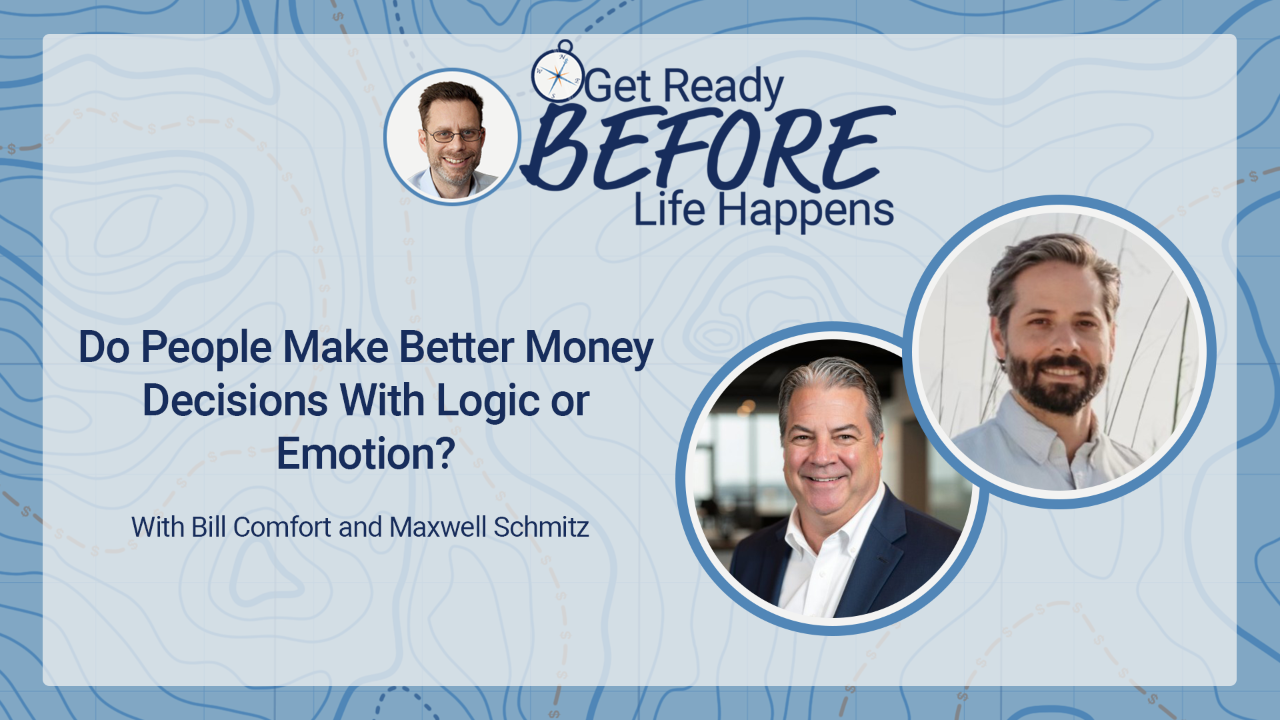
The best financial decisions happen when emotion opens the door and logic helps shape the plan.
Bill Comfort and Maxwell Schmitz joined Tony Steuer on this episode of Get Ready Before Life Happens for a lively debate about whether people make better insurance and financial decisions through numbers and probabilities, or through a clear understanding of the real-life impact on the people they love?
This conversation explores where emotion, logic, and lived experience intersect, and why the best planning conversations need all three.
Key Takeaways
- Emotion often helps clients engage with difficult financial decisions.
- Logic and data help quantify how much a risk truly matters.
- Insurance decisions are often driven by responsibility and love.
- Statistics should inform design, not drive fear.
- Lived experience often makes risk feel more real than probabilities alone.
- Risk protection must be part of every financial plan.
- The strongest decisions combine heart and numbers.
🧠 Tony’s Take: What stood out in this conversation is that this is not an either-or question. Emotion helps people connect with why a decision matters. Logic helps them understand what action to take. Financial readiness lives at the intersection of both.
🎥 Watch this episode below:
🎧 Listen to the podcast below or on your favorite podcast app.
Connect with Bill Comfort:
Connect with Maxwell Schmitz:
Resources mentioned:
- Why Disability Insurance Is the Foundation of a Real Financial Plan with Maxwell Schmitz and Tony Steuer on the Get Ready Before Life Happens Podcast (watch or listen)
Bios:
Bill Comfort is an independent LTC specialist agent with Comfort Long Term Care. Bill hosts the broadcast & podcast show: “Aging America Radio” with a focus on a wide range of topics supporting "successful aging".
Maxwell Schmitz, MSFS, CLTC is a third-generation DI specialist. He is co-founder of Dingo Technologies, Inc. and President of Yetworth Insurance Solutions, a disability-focused insurance agency. He also currently serves as President of the International DI Society, an association of the nation's top DI minds. Max also serves as the chair of his town's Bicycle and Pedestrian Advisory Committee. He is a sitting member on the board of The Plus Group, America's Premier Disability Insurance Marketing Organization. In his spare time he is also the father/coach of three energetic/athletic kids (ages 7, 5, and 3), husband to an amazing wife, and is a thru-hiking junkie.
👉 Start Your Financial Readiness Plan: A free, practical plan that helps you create your in-case-of-emergency Financial First Aid Kit, organize what matters, and prepare before life happens. Start Your Free Financial Readiness Plan
👉 Support Get Ready. Become a Get Ready Insider and help keep the Financial Readiness Plan free, support the podcast, trusted resources, and consumer-first financial education. You’ll receive access to the Get Ready Library. Support Get Ready here.
Episode Transcript
This transcript has been lightly edited for clarity.
Tony: What drives better financial and insurance decisions: numbers or real-life impact?
Welcome to Get Ready: Before Life Happens, helping you build clarity and confidence so you can make better decisions when it matters most.
Today’s episode is a little different.
We’re going to unpack a recent LinkedIn post from Maxwell Schmitz that sparked a debate around a core question in financial planning:
Do people make better decisions through logic and numbers, or through emotional understanding of real-life outcomes?
I’m joined today by Maxwell Schmitz and Bill Comfort to explore both perspectives, push back a little bit, and, most importantly, help you think about how you make decisions when it really counts.
Max and Bill, welcome to Get Ready: Before Life Happens.
Max: Thanks, Tony. Glad to be here.
Tony: Glad to have you both back.
Let’s jump in.
Max, give us the short version. What was the idea behind your post, and what were you reacting to?
Max: Bill and I became acquainted through our LinkedIn interactions.
I saw that he was coming to speak within about an hour’s drive of where I live, so I went over to say hi and hear his presentation.
It was phenomenal.
He made this really astute observation that he’s also mentioned throughout a lot of his content: insurance is often sold, or people are moved to purchase insurance, based on emotion.
I wanted to have some fun with that.
I don’t necessarily disagree, but I thought it would be interesting to play the heel a little bit and highlight the logic side too.
Bill, I’ll say it straight to you, buddy.
I remember thinking, “Man, he sounds like he’s really attacking logic and statistics from the stage.”
But I know how Bill operates, so I knew it wasn’t really that.
I thought it would be fun to explore the other side of the equation and why I still rely heavily on logic, principles, numbers, and analysis.
So we created this fake feud on LinkedIn between logic and emotion.
Bill could ride with emotion.
I’d play the heel and push the logic side.
And here we are.
Bill: The presentation Max is referring to, and really a theme of a lot of my posts and education, comes from a somewhat contrarian view.
What do we need to do better in financial services?
Whether it’s broad-based financial planning, wealth management, fee-based planning, or insurance sales, we’re numbers people.
We come naturally to calculations, data, and analysis.
That’s our comfort zone.
What we’re sometimes not as good at doing is touching the heart first.
I think we need to do a better job of that.
So I tend to come across as contrarian because I’m trying to drive that point home.
And one of the things I value professionally is having people like Max and you challenge me from the other direction.
I need someone saying:
“Hey, let’s not leave things off the table that should be there too.”
That’s really the foundation for how we got to this conversation.
Tony: It’s interesting because I think both play a role.
Something financial services has often overlooked is that clients usually come to us because they’re trying to solve a problem.
As you said, Bill, products and numbers are our comfort zone.
So we often default to those instead of first understanding what the client is actually trying to accomplish.
To me, that’s part emotion and part numbers.
I’m splitting the difference between both of you.
I’ve never had a client come in and say:
“I need a long-term care insurance policy structured with this particular type of inflation protection.”
They say:
“I want to make sure I’m covered if I need care at home.”
They’re trying to solve the real-life problem.
Max, back to you.
Numbers obviously play a huge role.
What do you think is missing when emotion leads the conversation?
Max: I don’t want to accuse anybody of anything, but to me it can start to feel manipulative.
That’s the part I have contention with.
We’re using emotion to stir something in people.
Maybe that’s just my idealistic millennialism coming through.
I prefer the idea that people are given a set of facts, outcomes, and perhaps probabilities.
There’s inherently emotion tied to those numbers because people can see the consequences.
I’m not saying statistics should be used as a scare tactic either.
Stats can be used manipulatively too.
What I’m advocating for is illuminating the situation and giving shape to the unknown.
Risk is inherently uncertain.
But we can look at probabilities and the direct impact on someone’s personal financial plan.
Then they can draw a straight line to the real-life consequences.
Maybe the numbers show:
“We’d have to sell the family lake house.”
“We’d have to restructure our investment strategy.”
There’s a lot more tied to that than just the number changing.
It ultimately affects someone’s lifestyle.
I think people can make their own conclusions from there.
I get uncomfortable when we push them into a mindset of fear.
Bill: That’s an interesting perspective.
And I think we’re more in agreement than the broad strokes of a LinkedIn post might suggest.
You’re absolutely right that we need to be careful and respectful with clients’ emotions.
It should not become fear-based or manipulative.
I also agree that leading with scary statistics can be manipulative.
“What’s the probability you’ll need care?”
If that becomes the centerpiece of the conversation, that can be another attempt to provoke fear.
What I advocate for is starting with the personal connection, responsibility, and providing for others.
Our financial lives are about our actual lives.
We earn income.
We pay bills.
We support spouses, partners, children, and other people we love.
We buy life insurance for the same reason.
There’s an industry cliché that the driving emotion behind life insurance is love rather than fear of dying.
It’s a cliché because there’s truth in it.
We buy life insurance because we care about people.
If we aren’t there to keep providing, the life insurance can continue that provision.
Then the numbers come in.
What’s the income?
What’s the lifestyle?
How much insurance supports that?
That’s the connection.
For long-term care, I’d put it this way:
A plan for extended care isn’t only about making sure the person who needs care is taken care of.
It’s also about protecting the other people they love from the personal consequences of caregiving.
What does it take to do that?
Money.
If you don’t want your spouse or children to carry 100% of the caregiving responsibility, you may need to pay for professional care.
Now we’re back in the realm where financial services is comfortable operating.
How much money does that take?
When we buy long-term care insurance, it can pay for care.
But it can also protect the people we love from both the caregiving burden and the financial consequences of paying for care out of the estate or portfolio.
Tony: That makes me think about estate planning.
We do estate planning because we know it’s ultimately for the people we leave behind.
We’re getting our affairs in order for them.
Long-term care planning has a similar dimension.
It isn’t only about the person receiving care.
It can affect the spouse doing the caregiving, the family, and the assets.
Something I’ve always found interesting is the contrast between property and casualty insurance and life, disability, or long-term care insurance.
They’re all protecting against risks.
Yet people think about them very differently.
Most homeowners understand that if their house burns down, there could be a major financial loss.
Most people are comfortable buying homeowners insurance.
People insure their cars too.
But the value of our income or the potential cost of long-term care can be hundreds of thousands or even millions of dollars.
And people put those protections off.
Why are we often quicker to protect inanimate objects than ourselves, our income, or the people we love?
Max: I love bringing property and casualty into the conversation.
If you use the same logic that says long-term care insurance protects loved ones from becoming caregivers, you could jokingly say homeowners insurance protects you and your family from having to get out the hammer and nails and rebuild the house yourselves.
Obviously, that’s a little contrived.
Most people don’t have the skills to rebuild a house.
But most people also don’t necessarily have the skills to become full-time caregivers.
There are real physical demands involved in caregiving that can get overlooked.
There are real parallels.
At the same time, life and health insurance are intrinsically more human and emotionally connected.
They involve higher stakes tied directly to people rather than property.
Bill: And we also can’t overlook the fact that the bank requires homeowners insurance if you have a mortgage.
The state requires a certain level of auto liability insurance.
If you lease or finance a car, the lender generally requires collision coverage.
People are being required to buy those protections.
They’re also protecting tangible objects.
You can look at your car and imagine what happens if it gets wrecked.
You can look at your house.
There are memories tied to it.
And if you’re wealthier, the biggest value of auto insurance may not even be replacing the $50,000 car.
It could be the liability coverage if you seriously injure someone.
Nobody requires you to buy life insurance.
Nobody makes you buy long-term care insurance.
Nobody makes you buy disability insurance.
You have to step up and do it yourself.
Max, let me throw a question back to you from the logic standpoint.
I think one of the biggest reasons people don’t buy long-term care or disability insurance, or even engage in the planning conversation, is the belief:
“It’s never going to happen to me.”
That belief is emotional and, in some ways, irrational.
How do logic, facts, and numbers help us get past that?
Max: One thing numbers can do is help people understand the unknown.
For disability insurance, for example, there are statistics showing that a meaningful percentage of people entering the workforce today will experience a long-term disability at some point during their careers.
If someone says:
“I don’t know anybody who’s been disabled.”
You can use data to give them some context.
But I’ve also always thought one reason people don’t purchase these products is because nobody ever brings them up.
Nobody asks them.
That’s certainly true with disability insurance and probably long-term care too.
Many financial advisors and wealth managers aren’t fully addressing the risk side of financial planning.
The investments may be taken care of.
Maybe the wills, trusts, and powers of attorney are done.
But a lot of people in the financial planning world seem allergic to the word “insurance.”
So there’s more going on than simply:
“It won’t happen to me.”
A lot of clients haven’t heard the issue raised by an authoritative source.
Often that authority is their financial advisor.
They need to hear from somebody who understands the financial consequences and has seen what happens when families are left unprotected.
We shouldn’t run from those conversations.
Sometimes we sanitize financial conversations too much.
And here I am arguing the other side now.
Clients do need to understand the real consequences beyond just the numbers.
Bill: And that’s exactly where respecting the emotional line becomes important.
There are a lot of facts and numbers involved.
But I think we may give people too much credit if we assume they simply don’t know the risks exist.
Successful, intelligent people know they could become disabled.
They know they could die during their working years.
They know they might need care if they live into their 80s or 90s.
Most people aren’t completely unaware.
Emotionally, the response is:
“Yes, but it isn’t going to happen to me.”
And frankly, that’s healthy and normal to some degree.
We can’t go through life constantly fearing the worst.
So the challenge becomes:
How do we raise the subject without triggering a wall that says:
“I don’t want to think about this, so I don’t want to talk about it”?
I think we sometimes need to touch the heart to get access to the logical brain.
That’s why I lead with emotion.
Not to manipulate a sale.
It’s to make the issue personally relevant enough that the logical side of the brain is willing to engage with the problem.
Max: That’s fair.
I like the way you bring those together.
And I think there’s another dynamic.
A lot of people who come to long-term care or disability planning already have some lived experience.
Maybe they’ve known somebody who needed care.
Maybe they became a caregiver.
Maybe they saw someone become disabled.
So the lived experience and the numbers can reinforce one another.
That creates congruence.
The statistics aren’t necessarily there to predict someone’s future.
They’re there to help somebody avoid being surprised by a possible future.
Bill: Exactly.
Sometimes you don’t have to do much more than ask:
“What’s your experience with long-term care?”
“Have you known someone who needed care?”
“Have you been a caregiver?”
If they say yes, then:
“Tell me what happened.”
“How did it work?”
“Is that what you would want for yourself and your family?”
If they say no, then you can ask:
“What would you want to be different?”
Now we’re talking about where the money comes from to pay for professional care and mitigate the consequences they want to avoid.
Max: And that’s where I think the numbers become really useful.
Emotion tells you that something matters.
The numbers can tell you how much it matters.
For example, rather than focusing only on:
“What’s the probability I’ll need long-term care?”
You can look at:
“What happens if the care lasts significantly longer than average?”
“What would that do to the financial plan?”
That’s where the logic and data can shape the design of the solution.
The probability isn’t there to tell you exactly what will happen.
It helps you understand the potential magnitude.
Bill: Exactly.
Data can inform design.
Do I buy a three- or four-year benefit period?
Do I buy six or eight years?
Do I want lifetime protection if that’s available and appropriate?
What is the financial impact if care extends beyond a certain point?
That’s where data becomes incredibly useful.
Insurance is often best deployed against a relatively low-probability but very high-cost event.
That’s true in auto liability.
It’s true in homeowners liability.
And it can be true with long-term care too.
Max: I like that.
Data informs design.
There’s our new alliteration.
Tony: I love it.
This is a great conversation, and we could probably go for hours.
One point I want to add for listeners around the world is that caregiving is a global issue.
The exact structure differs by country and culture.
In some places, family members provide more of the care.
But there is still an impact.
If you’re caregiving, you may be taking time away from work, reducing your income, or changing your own life.
The other thing I want to emphasize is that insurance and risk protection need to be part of financial education.
Whether you’re creating a financial wellness app, running a financial literacy program, advising clients, or selling products, risk protection belongs in the conversation.
It is just as important as budgeting, saving, investing, or paying down debt.
Because if a major risk occurs and you haven’t planned for it, it can undermine everything else.
Max and I have also done an episode on why a financial plan isn’t really complete without disability insurance.
To start wrapping up, has this conversation changed the way either of you were thinking when you came into it?
Max?
Max: I think I’ve probably been a little afraid of using emotion in discovery and analysis.
Engaging with people around this debate has helped me realize that emotion can be used appropriately and professionally.
I’ve been quick to sanitize these conversations.
But this is part of what clients are really asking:
“What are the consequences beyond the numbers?”
It’s important to acknowledge that.
I’d venture to say more professionals avoid those conversations than embrace them.
That may be especially true among people with more technical planning backgrounds, but I see it with insurance professionals too.
A lot of disability or long-term care work can become an addendum to someone’s primary business rather than something they’re deeply comfortable discussing.
Fortunately, with long-term care, more people are now coming to advisors asking about it because they’re seeing the issue firsthand.
With disability insurance, we’re seeing more of that too.
But when advisors or producers pull specialists into these conversations, they may not be equipped to handle the emotional side.
So I think the takeaway for me is that we shouldn’t be afraid of emotion.
We can handle it with tact and sensitivity.
But if you’re going to have an emotional conversation, you need enough emotional intelligence to understand the client and the boundaries.
Bill: My takeaway comes from these ongoing conversations with colleagues I respect, including both of you.
Because I’m intentionally contrarian, I sometimes push the emotional side hard to move people who are doing none of it toward a more balanced place.
My takeaway is to make sure people hear the other half too:
The data has to follow.
Data informs design.
I’m probably going to talk more about that.
The goal is to touch the heart, not manipulate the heart.
You touch the heart so the emotional side of the person gives the logical side permission to engage with the data.
The other thing I’m taking away is that there may be a generational aspect here.
Max mentioned his millennial perspective and his nervousness around overusing emotion.
I think that’s worth exploring.
Different generations may approach these conversations differently.
And I’m seeing younger people come to long-term care planning on their own, sometimes even before they’ve personally experienced caregiving.
So there’s something there about generational attitudes that deserves more attention.
Tony: Those are great takeaways.
Bill and Max, to wrap up, where can people learn more about you and your work?
Bill?
Bill: Probably the best way is through my website.
There’s a contact form that comes directly to me.
The website is ComfortLTC.com.
Tony: Fantastic.
Max?
Max: You can learn more about my agency at Yetworth.com, Y-E-T-W-O-R-T-H.
The idea behind the name is future net worth, or “yet worth.”
A lot of what we do is help people understand what their future financial picture could look like with or without different risk-management tools in place.
For conversation and engagement, LinkedIn is probably the best place.
All three of us are active there.
Tony: Fantastic.
For everybody watching and listening, there will be links to Max and Bill’s websites and social profiles in the show notes.
Bill and Max, thanks for joining me today on Get Ready: Before Life Happens.
Max: Super fun. Thanks, Tony.
Bill: Thank you.
Tony: I appreciate your insights.
And thank you, everyone, as always, for tuning in to this episode of Get Ready: Before Life Happens.
If you learned something today that changed the way you think about money, please subscribe and share this episode.
You can also go to TonySteuer.com to join the Get Ready Movement and receive my newsletter and free resources.
Because when life happens, the way you think about money matters.