
Financial Capability Starts With Curiosity
Oct 30, 2026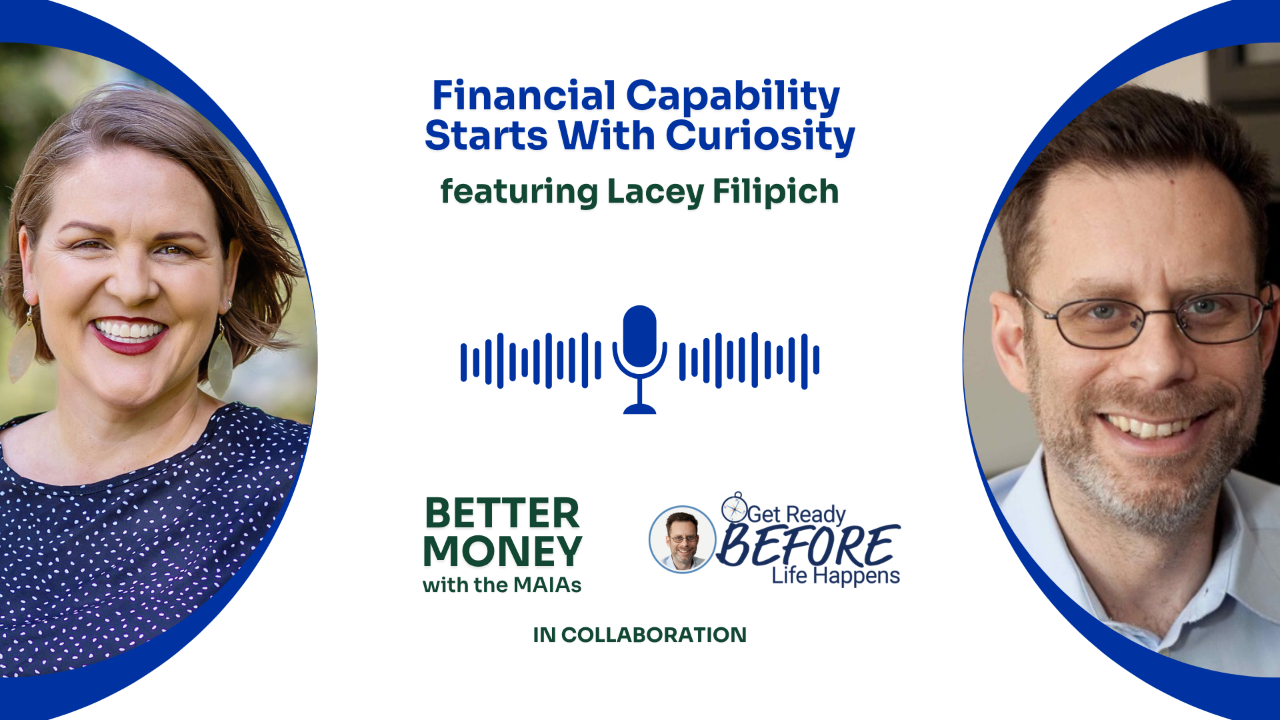
Money makes more sense when you know what questions to ask.
Lacey Filipich, co-founder of Money School and co-author of the FinCap for All white paper, joined me to talk about how curiosity and understanding financial basics can help people turn financial knowledge into action.
What Stood Out
- Early money conversations help people develop lifelong financial habits.
- Understanding first principles helps people evaluate financial decisions.
- Curiosity helps uncover the reasons behind financial information and advice.
- Simple systems, including automated savings, help turn financial knowledge into action.
The Bottom Line: Financial capability begins with understanding how money works and using that knowledge to make informed decisions.
🎥 Watch this episode below:
🎧 Listen to the podcast below or on your favorite podcast app.
Connect with Lacey Filipich:
- Instagram: https://www.instagram.com/moneyschoolorg/
- Facebook: https://www.facebook.com/moneyschoolorg
- LinkedIn: https://www.linkedin.com/in/laceyjfilipich/
- Money School Website: https://www.moneyschool.net.au
White papers:
- Climate change and personal finance intersection project, Get Future Rich: https://www.futurerich.com.au/
- White paper on adult personal finance support in Australia, Fin Cap for All: https://fincapforall.com.au/
Books:
- Money School: Become financially independent and reclaim your life: https://amzn.to/3Sxd984
Mentioned:
- Money Equals Time with Ben Miller on the Get Ready Before Life Happens Podcast (here)
Bio:
Lacey Filipich is an international award-winning financial educator, best-selling author, TEDx speaker and - plot twist - a chemical engineer.
She founded Money School in 2010 to help Australians master money and has been teaching personal finance skills ever since. Lacey learned about money from her accountant mum and by making lots of mistakes. She teaches adults what they wish they’d learned in school and parents how to teach their kids the way her mum taught her.
Prior to her career in personal finance and publishing Money School, Lacey worked in the mining industry as an engineer and consultant across Australia and the US. Her most recent focus is the impact of climate disruption on wealth, which she believes is the greatest threat to our financial futures.
In collaboration with The Money Awareness and Inclusion Awards (the MAIAs) which celebrate the increasingly important work being done to help people understand money better. Learn more: https://www.maiawards.org.
👉 Start Your Financial Readiness Plan: A free, practical plan that helps you create your in-case-of-emergency Financial First Aid Kit, organize what matters, and prepare before life happens. Start Your Free Financial Readiness Plan https://www.tonysteuer.com
👉 Support Get Ready. Become a Get Ready Insider and help keep the Financial Readiness Plan free, support the podcast, trusted resources, and consumer-first financial education. You’ll receive access to the Get Ready Library. Support Get Ready here. www.tonysteuer.com/support
Transcript
Tony Steuer: Adults need practical money support that helps them build capability, confidence, and choice.
Welcome to Get Ready: Before Life Happens. I'm your host, Tony Steuer.
Today, I'm joined by Lacey Filipich.
Lacey, welcome to Get Ready: Before Life Happens.
Lacey Filipich: Thanks so much for having me, Tony.
Tony: I'm excited to get into this.
Let's talk about Money School. What inspired you to create it?
Lacey: I had this realization in my late 20s that I'd won the ovarian lottery.
I'd been lucky enough to have a mum who taught me about money.
We didn't have much, but she'd studied accounting while I was in primary school. We learned together, and we started investing together.
I started saving when I was 10 and investing when I was 19.
I was well on my way to financial independence when I burned out at work.
I took a three-month career break, and all my friends were asking, "How come you can take time off work, Lacey? That's not fair. If I took time off work, I'd be homeless. I'd have to live with my parents."
And I was thinking, "What have you all been doing? Where's your money been going? Haven't you been saving and investing?"
They were saying, "No, we've got car loans and other debts. We've probably got about a month before we'd be in trouble."
And I realized their parents hadn't had those money conversations with them.
That's when I understood how lucky I'd been.
I grew up in Australia in the 1990s, and we didn't teach much about money in schools back then. Financial education was incorporated into the curriculum in 2011, so we do teach some of it now.
But at the time, I thought, "That's not fair. We need to teach people about this."
It's not necessarily complicated. People just need to understand some of the basics.
That's where Money School came from.
I co-founded it with my mum, and we ran it together. It was a lot of fun.
Sadly, she passed away in 2020, but I carry it on as part of her legacy.
It was wonderful having her technical expertise. She was also much more interested in risky investments than I was, which was pretty funny considering she was 32 years older.
When she passed away, I had to wind up her foreign exchange trading account, Bitcoin holdings, and other cryptocurrency investments.
We had very different investment styles, but that made running the business together a lot of fun.
Tony: That's fantastic.
Tell us a little more about Money School. What does it do, and who does it serve?
Lacey: When we started, the idea was to teach parents how to teach their children about money, the way my mum had taught me.
But after a couple of years, our most common client became a woman in her 40s who would say, "That's lovely. It's great for the kids, but can you just teach me? I never learned this."
I'd assumed we'd teach families, the kids would learn, and the parents would learn alongside them.
But we ended up going directly to adults, and that's where Money School has mostly focused ever since.
We started in 2010, so it's been quite a while.
We've taught all kinds of people, but mostly adults.
Companies often hire me to teach groups of graduates or apprentices. I also work with local governments, councils, and schools that want to provide financial education.
One thing that makes my approach a little different is that my background is in chemical engineering, not finance.
Tony: Oh, boy!
Lacey: Yes, completely different!
When people talk about nonlinear careers, I'm a pretty good example.
But my engineering background has been useful because I approach things from first principles.
I try to break concepts down into simple terms while helping people understand the mechanics behind them.
That's become increasingly important as financial products and services continue to change.
If you don't understand the first principles, it's difficult to reason through whether a particular product or decision is right for you.
I focus on three rules, just six words:
Save. Buy assets. Avoid bad debt.
That's it.
I try to make things simple and avoid jargon.
I remember my mum, as an accountant, using words like forecast or industry acronyms that made perfect sense to her but turned other people off.
So avoiding jargon has become a really important part of what I teach.
Another consideration is understanding the motives of the organizations providing financial education.
We've had some controversy here in Australia.
Our largest school-based financial education program operated for about 90 years and was run by a bank.
For the first 60 years, it was a government-owned bank. Later, it became a private bank.
In 2020, research from our regulator found that the program hadn't improved savings behaviors, but children had been exposed to sophisticated marketing techniques.
That raised important questions.
Where is the education coming from?
What are the organization's commercial interests?
We've relied heavily on private organizations with vested interests to deliver financial education in Australia.
I think it's important for people to understand those relationships.
Tony: You've raised several important points.
The last one, understanding the potential bias of whoever provides financial education, is particularly important.
We see the same thing in the United States and other countries.
Banks and credit card companies sponsor financial literacy programs.
School districts are often short of money, so a free educational program can sound attractive.
But it's important to recognize that the organization providing it may have commercial interests.
The other thing you said that really struck me is the first-principles approach.
People need to understand the mechanics of money.
I sometimes compare financial education to playing a game.
If you and I were going to play chess, we'd learn the rules before we started.
We wouldn't begin by trying to copy a sophisticated strategy.
We'd start with the basics.
Money is the same way.
For people running financial literacy initiatives, how can they use a first-principles approach and make their programs easier to understand?
Lacey: My engineering background really helped me with that.
In engineering, we use root-cause analysis.
One common technique is called the five whys.
You keep asking why until you get to the underlying reason something happens.
For example, I put money in the bank and get paid interest.
Great. Why?
Well, the bank wants my money because it can lend that money to other people.
Why does it do that?
You keep asking questions until you understand how the system works.
Once people understand the first principles and the reasons behind something, their understanding accelerates.
They can see the bigger picture.
I'd encourage educators to test their explanations on someone who isn't familiar with the subject.
A teenager can be particularly good at this.
They'll say, "But why is that?"
There are things we take for granted because we're adults or because we've worked in an industry for a long time.
We assume certain things are obvious.
But someone encountering the subject for the first time won't necessarily see it that way.
When they keep asking why, you're forced to go back to those first principles.
I've always been naturally inquisitive.
And because I'm not a financial professional by background, I've had to learn much of this myself.
For probably the first 10 years, whenever I read an article or learned about something new, I was constantly asking questions.
Why is that?
That doesn't make sense.
How did someone decide to do it that way?
Let's take banks and credit card companies as an example.
When I look at those organizations, I start with their business models.
They're businesses that sell financial products, including debt.
In Australia, we have the Corporations Act and a concept called shareholder primacy.
The idea is that company directors have responsibilities to act in the interests of the company and its shareholders.
That creates strong incentives around profitability.
There can be tensions between those incentives and the interests of customers, employees, and other stakeholders.
When I explain that to people, they begin asking more questions.
Why did we design the system this way?
What are the consequences?
Could we do things differently?
That's what happens when you start digging into first principles.
Tony: It's interesting how corporations are structured.
And I agree that understanding the incentives is important.
Corporations have shareholders who own the company, and directors have responsibilities to the organization.
How they fulfill those responsibilities raises questions about ethics and business practices.
But it helps consumers understand why companies behave the way they do.
Your point about asking why connects to something I've been thinking about throughout my career.
In my work involving elder financial abuse, fraud, and litigation consulting, I've found that curiosity is one of our best defenses.
Think about young children.
They're constantly asking why.
Why is the sky blue?
Why am I paying for ice cream?
Why can't I have more ice cream?
They keep asking because they're learning.
Somewhere along the way, adults sometimes stop asking those questions.
We assume we understand things.
And those of us who've spent our careers in finance can become caught up in our own jargon.
I think we need to approach financial decisions with that same childlike curiosity.
We don't need to act like children, but we can learn from the way they ask questions.
Lacey: I love that line.
Curiosity is your best defense.
That's such a good way of putting it.
Tony: I've been thinking about it a lot because scams and fraud are becoming increasingly sophisticated.
It's impossible to keep up with every new scam.
But we can ask questions.
If someone is pressuring you or providing information that doesn't make sense, ask why.
Scammers often aren't interested in answering detailed questions or providing information that satisfies your concerns.
That's an important warning sign.
And it connects directly to your first-principles approach.
You mentioned your mum investing in Bitcoin.
That's a sophisticated asset.
She had an accounting background and took the time to understand what she was doing.
For someone who hasn't learned the basics, a first step might be as simple as opening a savings account.
Lacey: Exactly.
When I talk to people about cryptocurrency, I often start by explaining blockchain technology.
We look at its origins in earlier approaches to digitally recording and verifying information.
Then we discuss how blocks and chains work together.
When people understand those building blocks, they start to understand the technology.
And that curiosity can also help protect people from scams.
I love watching those comedy sketches where people ask scammers so many questions that the scammers eventually give up.
Tony: Although I'd caution people against deliberately engaging with scammers.
Some scams are run by organized criminal groups.
Those videos may be entertaining, but there can be real risks involved.
A little public service announcement there!
Lacey: That's important.
And it demonstrates your point about curiosity.
You've thought deeply about the issue and can explain the risk in a simple way.
That's part of what financial educators do.
We share those little pieces of knowledge that help people recognize something they might not have considered.
Someone listening might remember what you said the next time they encounter a suspicious situation.
Tony: Exactly.
And going back to your six words, save, buy assets, avoid bad debt, those three principles can take people a long way toward building a solid financial foundation.
They're simple ideas, although putting them into practice can be challenging.
If you're feeling overwhelmed by money, returning to those first principles can be a useful place to start.
Let's talk about your white paper, FinCap for All.
What's it about, and what surprised you most as you worked on it?
Lacey: Over 16 years, I've learned a lot about how financial education works.
You know that expression about seeing how the sausage is made?
Once you've seen the process, sometimes you think, "I'm not sure I want to eat that sausage!"
It's a bit like that.
When I started Money School, financial education wasn't part of the Australian school curriculum, and I often had to explain what a financial educator actually did.
Now people generally understand the role.
But over the years, I've learned a lot about the relationship between financial education and financial capability.
That's why we call the paper FinCap for All.
It's about financial capability.
Knowing something isn't enough. You need to be able to do something with what you know.
And I've become increasingly concerned about gaps in how we support people.
In Australia, we have a regulated service called financial counselling.
It's designed to support people who are experiencing serious financial difficulties, such as debt problems or an inability to meet basic expenses.
It's delivered through the nonprofit sector and provided free of charge.
Financial counsellors do incredibly valuable work.
At the other end of the spectrum, we have financial advice.
That's where someone sits down with a professional and gets personalized guidance about questions such as retirement planning or investing.
The cost of financial advice has risen significantly in Australia.
We had the Banking Royal Commission, which began in 2017 and examined widespread misconduct in financial services.
One of the major problems was the incentive structures within the industry.
The system itself encouraged some problematic behavior.
Now the average cost of ongoing financial advice is around $4,800 a year, with another $3,000 in the first year, based on figures we've been examining.
That's expensive.
Between financial counselling and financial advice, we have money coaches and financial educators.
Money coaches often work with people one-on-one.
Financial educators, like me, focus on teaching people how financial systems and products work rather than providing personalized advice.
But in Australia, titles such as financial educator and money coach aren't regulated professional designations.
There's no single prescribed training pathway.
Someone with an engineering background, like me, can become a financial educator.
You need to learn the subject and understand the regulatory boundaries.
In Australia, the general principle is that education should be balanced, fair, and factual.
You need to explain the advantages and disadvantages of different options.
You need to explain how products work without directing someone toward a particular provider or investment.
That distinction between education and regulated advice matters.
But I've met many people who don't fully understand it.
They have excellent intentions.
They want to help others learn about money.
Yet they may inadvertently cross the line into personalized financial advice.
For example, someone might say, "I put all my money into my retirement fund, and it's been fantastic. You should do the same."
But that approach won't necessarily suit everyone.
You need to explain the considerations on both sides.
Otherwise, you may be creating regulatory risks and, more importantly, risks for the people you're teaching.
That's one of the reasons we wrote the paper.
There's been a lot of attention on financial education in Australian schools.
Financial literacy entered the curriculum in 2011, but subsequent international testing showed disappointing results.
Our financial literacy performance declined on the PISA assessment.
That's concerning.
And we've since stopped participating in some of that testing.
But the larger point is that we focus heavily on educating children.
That's important.
Yet there are millions of adults who never learned these things at school.
They need support too.
And that support needs to be high quality.
I worked on the paper with Dr. Tracy West and Jenny Ralph Wallace.
Both have been involved with the MAIAs.
Jenny received recognition as an influencer, and Tracy worked with the Ecstra Foundation's Talk Money program for schools.
We've been discussing these issues since 2019.
Eventually, I said, "That's it. We're writing this down and sharing it."
There's growing discussion about financial capability in Australia.
RMIT University and the Ecstra Foundation have also released research on financial wellbeing.
We wanted to contribute to that conversation and make sure adults weren't overlooked.
Tony: That's fantastic.
Unfortunately, we're seeing some concerning results in the United States too.
Recent financial literacy research has shown declining levels of financial knowledge.
And for everyone watching and listening, Tracy West and I are working on scheduling a conversation for the podcast.
I'm looking forward to having her on as well.
As we talk about financial capability, where do you see adults needing the most practical support with everyday money decisions?
Lacey: One of the most influential pieces of research for me was a 2013 study out of Princeton University about financial stress and cognitive capacity.
It showed how financial stress can affect people's ability to make decisions.
When you're constantly worried about money, those concerns consume mental resources.
The researchers compared the effects with other forms of cognitive impairment, such as sleep deprivation.
That's been a major learning experience for me as a financial educator.
I think it's unfair to expect people who are under serious financial stress to solve everything through better individual decisions.
We need systemic changes in Australia so people have a fair opportunity to make good financial decisions.
And as a financial educator, I'm saying that financial education might not be the first thing someone needs.
Sometimes the underlying circumstances have to be addressed first.
I often use an analogy.
You don't teach someone who's drowning how to swim.
You save them first.
Once they're safely out of the water, you can teach them to swim.
It's the same with financial education.
Once someone's immediate needs are addressed, there are valuable opportunities to help them understand money and build practical skills.
One important area is automation.
Money is different from things like diet and exercise.
If I want to stay healthy, I need to eat well regularly and exercise consistently.
But many financial behaviors can be automated.
Take saving, for example.
If you automate your savings, you're not constantly fighting your natural impulses.
Our brains can be very good at finding reasons to spend money.
Some people have more discipline than others, but for many of us, seeing money available creates a temptation to spend it.
If you create a system where money automatically goes into savings before you see it, you have a much better chance of reaching your goal.
You're saving first rather than trying to save whatever is left at the end of the month.
That may sound simple, but it isn't necessarily intuitive.
People often talk about discipline in personal finance.
I think systems and automation are just as important.
You can automate contributions to retirement savings.
You can automate transfers to savings accounts.
And increasingly, you can automate investments.
The cost of investing has fallen significantly with online platforms.
You no longer necessarily have to call a broker and pay substantial fees for every transaction.
The more you can set up systems that move you toward your goals automatically, the less you need to rely on willpower.
That's a really valuable capability for people to develop.
Another area I'm focusing on more recently is property and housing.
Housing affordability is a major issue in Australia, and I know it's also a concern in the United States.
One emerging problem is the increasing difficulty of insuring some properties.
I've seen projections suggesting that one in 11 Australian properties could be uninsurable by 2030, largely because of climate-related risks.
That's an extraordinary figure.
And it changes how people need to think about purchasing property.
It's not something I was thinking about nearly as much five years ago.
But these risks are becoming increasingly relevant to everyday financial decisions.
That's another reason financial education needs to keep evolving.
Tony: You've raised two important points.
The first is automation.
I think the order in which we handle money matters.
A lot of people think they'll save whatever is left at the end of the month.
But if you reverse that order and save first, you can then spend what's left knowing you've already taken care of your savings goal.
It's a simple change that can make a significant difference.
The second issue is insurance.
This is a huge concern in the United States and around the world.
I've talked about insurance on other episodes, and one of the important things to understand is that insurance companies have to manage risk and remain financially sustainable.
They have to collect enough in premiums, along with investment income and reserves, to pay claims and meet their other obligations over time.
And as climate-related risks become more significant, insurers have to account for those risks in their pricing and underwriting decisions.
Whatever someone's personal views about climate change, insurance companies are making financial decisions based on their assessments of the risks.
In some areas, they're deciding that certain properties are becoming too expensive or difficult to insure.
It's an enormous challenge.
We could spend an entire episode discussing what this means for the future of property insurance.
But your point is important because understanding insurance availability is becoming an essential part of financial capability.
Lacey: Absolutely.
It's taken up a lot of my attention over the past 18 months.
And again, it comes back to first principles.
Someone might ask, "Why does it matter whether my house is insurable?"
Well, if you can't insure your house, you may need enough financial resources to absorb a very large loss yourself.
And obtaining a mortgage generally requires property insurance.
So if your property becomes difficult to insure, that can affect who can buy it and how much they're willing to pay.
Suddenly, people begin to understand the broader consequences.
That's why I like talking about what I call the sleep-well test.
Sometimes there's a mathematically optimal financial decision.
But you also need to consider whether you'll feel comfortable living with that decision.
Personally, I wouldn't sleep particularly well if I couldn't insure my house.
For me, that would be a major financial concern.
Tony: I love that.
Will this help you sleep well?
That's a useful question for people to ask.
I also want to come back to something you said earlier about financial stress.
It's an incredibly important topic.
I've had Julia Chin on the podcast, and we're planning another conversation about financial crime and scams.
One of the issues we've discussed is how financial stress can increase vulnerability to scams.
Someone who's struggling financially may feel desperate for a solution.
They may be more willing to take a chance they wouldn't ordinarily consider.
That's not necessarily because they're making bad decisions.
It's because they're dealing with significant stress and limited options.
All these issues are interconnected.
Lacey: Exactly.
And I think it's becoming increasingly complicated.
There are so many pressures affecting people's financial lives.
For someone who's just trying to get through the week and figure out how to feed their family, it's difficult to focus on saving or investing.
Then we add increasingly sophisticated scams and the growing complexity of financial products.
It's a lot to expect people to manage on their own.
That's why I keep coming back to systemic change.
We need better ways to protect people who are facing those pressures.
Financial education has a role, but it can't solve every underlying problem.
Tony: Definitely.
And I think we can't emphasize first principles enough.
When you're considering a financial decision, take the time to understand what you're doing and why.
Money is one area where people sometimes make decisions without understanding the underlying product or strategy.
Think about healthcare.
If a doctor recommended a procedure, most of us would want to understand why it was necessary.
We might not understand all the medical details, but we'd want to understand the purpose and the expected outcome.
We should bring that same curiosity to financial decisions.
Ask questions until you understand what you're being asked to do.
Lacey, let's wrap up with the Get Ready Hot Take Trio.
These are three quick questions I ask all my guests.
What's one myth about financial education or financial capability that you'd like to break?
Lacey: The myth I'd like to break is "I'm not capable."
I want people to understand that being financially capable doesn't mean you have to be great at mathematics.
I still meet people who believe they can't manage money because they're not good at maths.
But most everyday financial decisions don't require advanced mathematics.
If you managed the maths you learned when you were around 10 years old, you have the mathematical foundation for most of what you need to do with personal finance.
It's much more important to focus on your values and behaviors.
That's what I want people to understand.
Tony: I love that.
Anybody can learn how to manage money.
And that's one reason I have guests like you on the podcast, to help people understand their options and develop practical financial skills.
Let's get out the time machine for a minute.
If you could go back in time, knowing what you know now about money, what advice would you give your younger self?
Lacey: I think the biggest lesson is that mistakes can actually be useful.
Sometimes they're worth what they cost you.
Now, that may not apply to something like falling victim to a scam.
But when I've made financial decisions that weren't optimal, I've often learned something valuable.
Maybe I lost money.
Maybe a decision cost me more than it should have.
But the lesson was powerful enough that I didn't make the same mistake again.
So although mistakes can feel expensive at the time, they can also be valuable learning experiences.
That's one reason I encourage parents to let their children make manageable financial mistakes.
For some people, that's the most effective way to learn.
Tony: That's true.
We all make mistakes.
And learning from those experiences is part of making progress.
I've actually been thinking about adding another question to the podcast.
What's your biggest money mistake?
I won't put you on the spot with that one today, but I think it could lead to some interesting conversations.
So here's the last question.
What's your number-one tip to change the way we think about money?
Lacey: For me, the most powerful change came when I connected money with time.
You can always earn more money.
But you can't get back the time you've already spent.
Whether you've spent half an hour listening to this podcast, preparing for an interview, or doing something else, that time is gone.
Time is our most precious nonrenewable resource.
And most of us exchange a significant amount of our time to earn money.
So when you spend money, you're also spending some of the time it took to earn it.
When I was younger, I thought I had forever.
I think it's harder to appreciate the value of time when you're young.
But as I've gotten older, I've started evaluating my spending differently.
How many hours did I have to work to earn this money?
What is that purchase worth to me?
Could I use that money to create more time for myself?
My goal isn't to be money rich.
My goal is to be time rich.
That resonates with a lot of people because they understand the value of having choices about how they spend their time.
It doesn't mean you have to stop working.
It means you can choose the kind of work you do.
You can choose who you work for or with.
You can choose the projects you take on.
You can decide how you want to spend your days.
That's what money can help you achieve.
And I think that's a powerful motivation.
Tony: That's fantastic, and I completely agree.
I've had another guest on the podcast where the entire conversation focused on the relationship between time and money.
And your point comes up in everyday decisions.
For example, someone might wonder whether they should hire help around the house.
On one level, they're paying someone to complete a task.
But they're also buying back some of their time.
They're deciding that the time they recover is worth the money they spend.
And as you said, we can't get this time back.
Hopefully, the half hour people have spent listening to our conversation has been worth their time.
Unfortunately, we can't give them a refund!
Lacey, where can people learn more about you and Money School?
Lacey: I'm a bit of a nerd when it comes to social media.
I mostly spend my time on LinkedIn.
And because my name is Lacey Filipich, I'm pretty easy to find there.
My website is moneyschool.net.au .
I also have a book published through Penguin that's available online and through bookstores.
And I'd encourage people to borrow it from their library.
In Australia, authors receive payments associated with library lending, so please don't feel bad about borrowing a copy.
You're not taking anything away from me by using the library.
I also write a lot online, and there are plenty of free articles and resources on my website.
So LinkedIn and the Money School website are probably the best places to find me.
Tony: Fantastic.
For everyone watching and listening, we'll include links to Lacey's website, book, and social media profiles in the show notes.
We'll also include a link to the FinCap for All white paper we discussed.
Lacey, thank you for joining me on Get Ready: Before Life Happens.
Lacey: Thanks so much for having me, Tony.
It's been a delight.
Tony: And thank you, everyone, for tuning in to Get Ready: Before Life Happens.
If something today changed the way you think about money and financial capability, please share this episode with a friend and subscribe.
You can also visit tonysteuer.com to learn more about the Get Ready Method and Financial Readiness Plan.
Because when life happens, the way you think about money matters.