
Generational Wealth Is More Than Money
Oct 29, 2026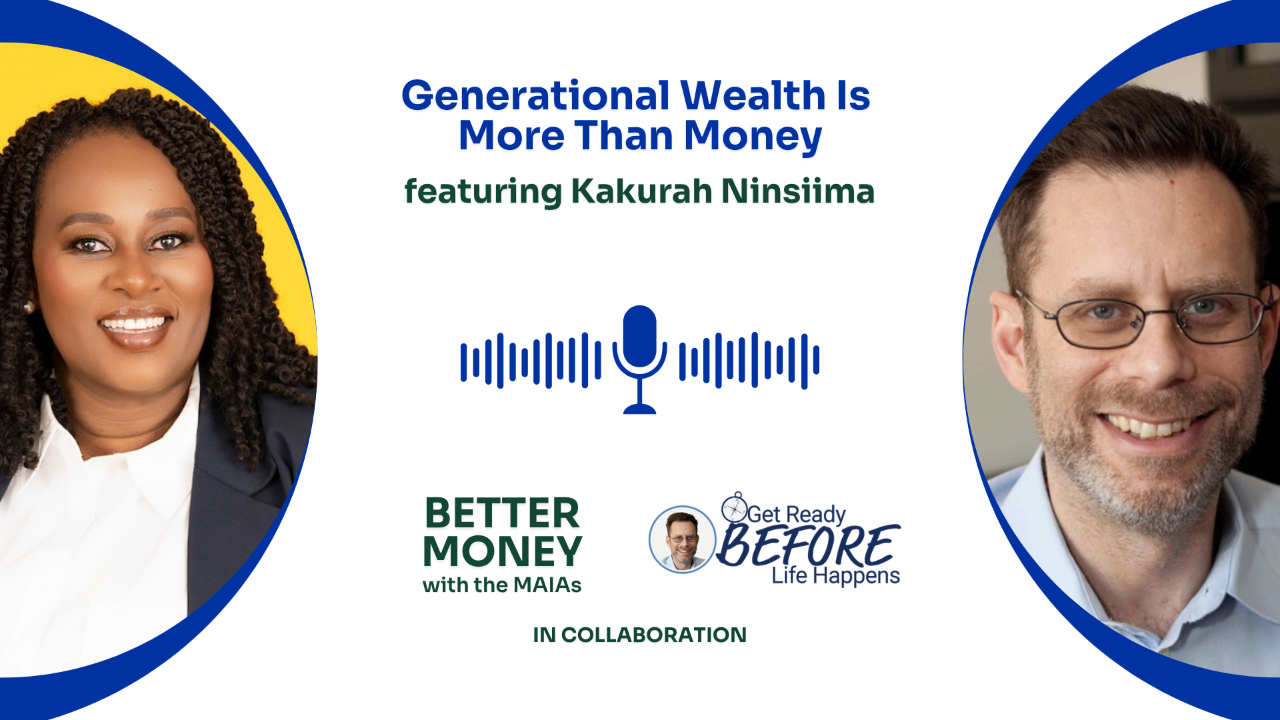
Building generational wealth starts with understanding the values and responsibilities families share.
Kakurah Ninsiima, author of A Guide to Building Generational Wealth in East African Families, joined me to talk about how culture and family expectations shape financial decisions and what families can do to build lasting wealth.
What Stood Out
- Culture shapes how families think about money and responsibility.
- Family money conversations are more productive when they focus on shared goals.
- Financial systems help families support loved ones while protecting their own stability.
- Generational wealth requires passing along financial knowledge and decision-making skills.
The Bottom Line: Lasting generational wealth begins with shared values and a plan for putting them into practice. People can support others while setting healthy financial boundaries.
🎥 Watch this episode below:
🎧 Listen to the podcast below or on your favorite podcast app.
Connect with Kakurah Ninsiima:
- LinkedIn: www.linkedin.com/in/kakurah-ninsiima-2b41044b
- Website: www.noveterrapublishing.com
- Amazon Author Page: https://shorturl.at/AiNzu
- Tertulia Author Page: tertulia.com/author/kakurah-ninsiima
- Newsletter: Subscribe on LinkedIn https://www.linkedin.com/build-relation/newsletter-follow?entityUrn=7097913990978170880
Book:
A Guide to Building Generational Wealth in East African Families: Cultural Strategies, Practical Tools, and Legacy system for Financial Freedom: https://amzn.to/4vOF2qj
The Woman Who Carries Too Much
Bio: Kakurah Ninsiima is a writer, keynote speaker, and founder of Diamonds Consulting Inc. She is the author of A Guide to Building Generational Wealth in East African Families and the forthcoming The Woman Who Carries Too Much. Her work explores how families experience money—not simply through individual choices, but through relationships, responsibility, caregiving, inheritance, and the often-unspoken financial arrangements that shape life across generations. Based in Alberta, Canada, Kakurah writes and speaks internationally on the conversations families need to have before life makes those conversations unavoidable.
In collaboration with The Money Awareness and Inclusion Awards (the MAIAs) which celebrate the increasingly important work being done to help people understand money better. Learn more: https://www.maiawards.org.
👉 Start Your Financial Readiness Plan: A free, practical plan that helps you create your in-case-of-emergency Financial First Aid Kit, organize what matters, and prepare before life happens. Start Your Free Financial Readiness Plan https://www.tonysteuer.com
👉 Support Get Ready. Become a Get Ready Insider and help keep the Financial Readiness Plan free, support the podcast, trusted resources, and consumer-first financial education. You’ll receive access to the Get Ready Library. Support Get Ready here. www.tonysteuer.com/support
Transcript
Tony Steuer: Sustainable generational wealth begins with the values, relationships, and responsibilities families pass forward.
Welcome to Get Ready: Before Life Happens. I'm your host, Tony Steuer.
Today, I'm joined by Kakurah Ninsiima.
Kakurah, welcome to Get Ready: Before Life Happens.
Kakurah Ninsiima: Thank you for hosting me today.
Tony: I'm excited to have you here and share what you've been working on.
What led you to write your first book, A Guide to Building Generational Wealth in East African Families?
Kakurah: What made me write my first book was recognizing that most financial advice is written for Western family structures.
But many East African immigrant families have different responsibilities.
We support extended family.
We send money home through remittances.
We may have land and informal businesses.
And there are cultural expectations that come with success, particularly around supporting family members.
I wanted to write something practical that reflected how our families actually experience money.
One of the biggest lessons is that you cannot build generational wealth without understanding the culture around it.
That's one of the reasons I wrote the book.
Tony: I love that.
You can't build generational wealth without understanding the cultural values around it.
I want to repeat that because it's such an important takeaway.
And I think this conversation is relevant to everyone, regardless of their background.
Every culture approaches money differently.
Even within a country as diverse as the United States, people have different experiences, expectations, and values around money.
What's striking about your work is that you decided to write something specifically relevant to East African families rather than another general book about generational wealth.
How did your work evolve into a broader exploration of how families experience money across cultures?
Kakurah: I started with East African families, but I quickly realized the issue was much bigger.
Money is connected to relationships.
It's connected to expectations and responsibilities.
There's also guilt associated with money and family obligations.
You see similar issues across immigrant families and diaspora communities.
In many cultures, financial success comes with greater responsibility for others.
So the bigger question for me became:
How do we build wealth while still caring for the people we love?
Tony: I think that's a really important question.
In many cultures, there's a strong sense of responsibility for elders and extended family members.
And for immigrants, there are additional challenges because they're navigating expectations from their culture of origin while adapting to a new country.
You also mentioned guilt.
I'd like to explore that a little more.
How does guilt affect people's financial decisions, particularly when they're expected to support family members?
Kakurah: Guilt comes into play when you're one of the successful people in your family.
There's often an expectation that you're supposed to take care of everybody.
That creates a lot of pressure.
You start asking yourself questions.
Should I say yes or no?
Can I help with this family emergency?
Can I pay someone's school fees?
Am I supposed to take care of myself first, or should I always help others?
Those expectations create guilt.
You may want to help your family, but you also have your own responsibilities.
And sometimes those two things conflict.
Tony: That makes sense.
It reminds me of the instructions we hear on an airplane.
Put on your own oxygen mask before helping someone else.
I think money works similarly.
You need to make sure you're financially secure enough to help others.
How do you recommend families begin reconciling those responsibilities?
Kakurah: I think the first step is for families to have conversations about money.
But those conversations shouldn't begin with questions like, "How much money do you make?" or "Where are you spending your money?"
Instead, start by talking about the future.
What kind of future do we want for our family?
What do we want to own?
Which emergencies should we prepare for?
What do we want the next generation to inherit?
When families begin with a shared vision for the future, the conversation becomes easier.
Otherwise, we're constantly reacting to immediate needs.
Someone needs school fees.
There's a funeral.
There's another emergency.
And we're always sending money to handle the situation in front of us.
But we're not necessarily building something for the future.
If we start talking about our long-term goals, we can begin creating generational wealth instead of only reacting to emergencies.
Tony: That's a really important distinction.
When we're focused only on what's happening today, we may never develop a long-term plan.
And that applies to financial decisions generally.
We can become so focused on an individual decision, like whether to buy a particular stock, that we forget to ask where we're trying to go.
The same is true for estate planning and caregiving.
For immigrant families, I imagine caregiving can be especially challenging.
In one culture, families may traditionally care for older relatives at home.
In another country, there may be different expectations or resources.
How can families navigate those differences?
Kakurah: I think it begins with knowledge.
You have to educate yourself about the culture and systems in your new country without forgetting where you came from.
Back home in Africa, taking care of older family members often means bringing them into your home.
But in other countries, there may be different ways of providing care.
Some families bring their parents into their homes.
Others use assisted living or other eldercare facilities.
You need to learn about the options available.
And you need to start planning with your children.
Ask them questions.
Would you want to care for me in your home?
Would assisted living be an option?
Should we consider building an extra apartment or living space for an older family member?
These are conversations families should have as parents age.
It's also important when you're helping other older relatives.
The key is learning about your options and talking about them together.
Tony: I completely agree.
I particularly like your point about honoring where you come from while recognizing that circumstances may be different in a new country.
It's a balancing act.
And communication is essential.
As people age, they need to share their wishes with their adult children.
Sometimes the children may not be able to provide exactly what their parents want.
But that's something they need to discuss.
Having the conversation is the first step toward finding a realistic plan.
Kakurah: Yes, exactly. It's very important.
Tony: Let's go a little further with that.
How can families have more productive conversations about money?
Kakurah: I think every family needs a financial system.
One of the first questions I encourage families to ask is:
Is our family money system creating dependence, or is it building capacity?
Many of us send money back home.
But we don't always know what happens to that money.
Is it simply being spent every month?
Or is it helping people build something?
Could the money support education?
Could it help start a business?
Could it be used to buy property or other assets?
Could it be invested in something that grows over time?
Those are the conversations we need to have.
Instead of sending money without a plan, families can discuss shared goals.
For example, a family might decide to purchase property that can eventually generate income.
Or they might invest in land, stocks, bonds, or a family business.
The important thing is creating a structure and working toward something.
We also need to begin these conversations earlier.
In many African families, we wait until there's an emergency or a funeral before discussing money.
But we should be talking about it when our children are young.
Even when they're five, six, or ten years old, we can begin talking about the family's future.
What are we building?
What is our plan?
How can we create independence for the next generation?
These conversations can strengthen families and communities.
Tony: I love that.
And I think it's relevant across cultures because money is often treated as a taboo subject.
Parents may not discuss finances with their children.
Even adults within families may avoid talking about money.
Yet money is part of nearly everything we do.
As you've pointed out, those conversations become more productive when we focus on the future.
Where do we want to go?
What do we want our family to accomplish?
What are we working toward?
Let's switch gears for a minute.
You have another book, The Woman Who Carries Too Much.
Tell us about that.
Kakurah: The book is about building structures in our personal and financial lives.
It focuses particularly on women, although some of the lessons apply to men too.
Think about how we operate in the corporate world.
At work, we follow systems.
There are policies and procedures.
If money is going to be spent on a project or an asset, it may have to go through an approval process.
But when we come home, we often don't use those same structures.
Money comes in, and we don't always know where it's going.
An emergency happens, and suddenly we're expected to pay for it.
We may send money without even asking how it will be used.
That's how people can find themselves living paycheck to paycheck.
But imagine if we applied some of the same systems we use at work to our personal finances.
Before contributing to a family project, we could ask questions.
What is the money for?
How much is needed?
Is this something we should support?
Does it fit into our financial plan?
Women, in particular, can become the people everyone depends on.
The book is about creating structures that allow us to support our families without carrying every responsibility ourselves.
When expectations are clear, it also becomes easier to say no without feeling guilty.
Some people may not understand at first.
But when you've established a system, family members can better understand how decisions are being made.
Tony: That's such an important point.
It's easy to approach money without much structure.
Yet when we're managing a project at work, we have deadlines, measurable goals, approval processes, and responsibilities.
Why shouldn't we use some of those same principles in our personal financial lives?
Having a plan can help people make better use of the money they have.
Of course, someone can still struggle financially because their income isn't enough to meet their needs.
But even then, having a plan can help them make the most of their available resources.
When you talk about creating a structure, do you mean having a budget, or is there more to it?
Kakurah: A budget is part of it.
But it's also about recognizing that you don't have to be an ATM for everyone.
I love that expression because there are emergencies you may choose to help with, and others you may decide not to support.
For example, I've personally decided that I won't contribute to certain wedding expenses.
If someone can't afford a large wedding, I believe they should wait or plan something within their means.
In many African communities, families contribute money for weddings and other celebrations.
But I've decided that those aren't expenses I want to take on.
If someone has a serious health emergency and needs medication, that's different.
I'll do what I can to help.
So it's about identifying your priorities.
What is important?
What can you afford?
What kinds of expenses are you willing to support?
That's part of having a budget and a financial structure.
And it's a major theme of my book.
Tony: That's a valuable distinction.
It goes back to the guilt you mentioned earlier.
People can feel obligated to contribute even when they really can't afford it.
We sometimes hear about this with professional athletes.
Someone may earn millions of dollars, but they're also buying houses for family members and giving money to friends.
Without boundaries and a plan, even a very high income can disappear.
That's why I like your expression about not being an ATM for everyone.
Let's return to the title of your book, The Woman Who Carries Too Much.
Do you believe women generally carry a greater burden of family responsibilities than men?
Kakurah: Yes, I do.
Women often take care of the children and the extended family.
They may work a full day and then come home and still be expected to cook dinner, help with homework, prepare lunches, and manage the household.
In some families, the husband has also worked all day, but the woman is still expected to handle most of those responsibilities.
Of course, there are men who share those responsibilities.
But I think women often carry a much larger burden.
And when you add extended family expectations, it can become overwhelming.
Tony: We've seen similar patterns in caregiving.
Women often shoulder a substantial amount of the responsibility for aging parents, particularly daughters.
And that has a financial impact.
Taking time away from work can affect earnings, promotions, retirement savings, and career opportunities.
What advice would you give women who feel overwhelmed by those responsibilities?
How can they begin creating more room for themselves?
Kakurah: I think it starts with building a system.
If you're working full time and can afford to hire someone to help clean your house, do that.
Maybe someone can come twice a week.
If you can afford help with childcare, consider that too.
The point is that you don't have to do everything yourself.
When you create more time, you can take better care of yourself.
You may have time to learn another skill.
You may have opportunities to increase your income or build your financial independence.
You can also ask your husband or partner to share more of the household responsibilities.
And that begins with communication.
You need to explain how you're feeling and what kind of help you need.
Everything begins with communication.
Tony: I love that.
You've raised several important points.
First, women need time to take care of themselves.
And sometimes hiring help is a smart use of money.
People may say, "I don't want to pay someone to clean my house."
But you're not only paying for a cleaning service.
You're also buying back some of your time.
And time is one of our most valuable resources.
The other point I want to emphasize is financial independence.
Women should be actively involved in managing their finances, even when they're in a relationship.
Would you agree?
Kakurah: Absolutely.
You never know what might happen tomorrow.
Even if you have a husband or partner who is providing financial support, you should still have your own savings and some financial independence.
It's important for women to be able to take care of their own financial needs.
Tony: That's a message I've heard from many guests on this podcast.
Women should have access to money and understand how their finances work.
We know that women often outlive men.
So in a marriage, there's a reasonable possibility that a woman will eventually be managing the finances on her own.
And there's also the possibility of divorce or another major change in the relationship.
If someone doesn't have access to money or experience managing finances, that can make an already difficult transition even harder.
Kakurah: That's true.
I think women need some financial independence for their own peace of mind and security.
Tony: Exactly.
It's about safety and having choices.
And it's better to develop those skills before an emergency happens.
If someone loses a spouse, they're already dealing with so much emotionally.
Having to learn everything about the household finances at the same time can make things even more difficult.
That's why preparation matters.
Kakurah, let's wrap up with the Get Ready Hot Take Trio.
These are three quick questions I ask all my guests.
What's one myth about generational wealth that you'd like to break?
Kakurah: The biggest myth is that generational wealth simply means leaving your children a lot of money.
Money alone isn't enough.
You also have to transfer knowledge.
You have to transfer values.
You have to teach decision-making.
And you have to prepare the next generation to take responsibility for the assets they inherit.
If you leave your children money or property without teaching them how to manage it, those assets can disappear.
That's something we see in many families.
Wealth may be accumulated by one generation, but it doesn't necessarily continue through the next.
That's why financial literacy is so important.
We need to teach the next generation how to protect assets, make decisions, and manage what they receive.
Generational wealth requires transferring both assets and the ability to manage them.
Tony: That's an important distinction.
We've all heard examples of families that accumulated substantial wealth only to see it disappear in later generations.
It's not enough to pass along money.
You also need to pass along the knowledge, values, and judgment needed to manage it.
Let's get out the time machine for a minute.
If you could go back in time, knowing what you know now about money, what advice would you give your younger self?
Kakurah: I would tell myself not to focus only on earning money.
Learn how to recognize opportunities.
Learn how to protect your money.
Learn how to invest it.
And learn how to transfer it.
Earning income is only the beginning.
The systems you build around that income determine whether your wealth lasts.
So many of us focus on working and earning more.
But we also need to understand how to manage what we earn.
Tony: I love that.
And it connects with what we discussed earlier.
Someone can earn a very high income and still live paycheck to paycheck.
Learning how to manage money is just as important as earning it.
So here's the last question.
What's your number-one tip to change the way families talk about money?
Kakurah: I would encourage families to pick one project.
Start with one practical goal.
Maybe it's creating an education fund.
Maybe it's purchasing income-producing property.
Maybe it's documenting the family's assets.
Choose something specific that everyone can understand and work toward.
That gives the family a practical reason to begin having conversations about money.
Tony: That's excellent advice.
One clear project.
I think people sometimes feel overwhelmed because they imagine they have to discuss every financial issue at once.
But that's difficult.
And if you try to cover everything, you may end up accomplishing very little.
Choosing one practical project makes the conversation more manageable.
Kakurah, where can people learn more about you and find your books, A Guide to Building Generational Wealth in East African Families and The Woman Who Carries Too Much?
Kakurah: My books are available through retailers such as Amazon and Barnes & Noble, as well as other online bookstores.
The Woman Who Carries Too Much will also be available through those retailers.
Tony: Fantastic.
Are you active on social media?
Kakurah: Yes. I'm on TikTok, LinkedIn, X, Instagram, and Facebook.
Tony: Great.
For everyone watching and listening, we'll include links to Kakurah's books and social media profiles in the show notes.
Kakurah, thank you for joining me on Get Ready: Before Life Happens.
Kakurah: Thank you so much.
Tony: And thank you, everyone, for tuning in to Get Ready: Before Life Happens.
If something today changed the way you think about money and generational wealth, please share this episode with a friend and subscribe.
You can also visit tonysteuer.com to learn more about the Get Ready Method and Financial Readiness Plan.
And if you'd like to support the podcast, you can become a Get Ready Insider.
Because when life happens, the way you think about money matters.