
How Do You Know Who to Trust for Financial Advice?
Jul 28, 2026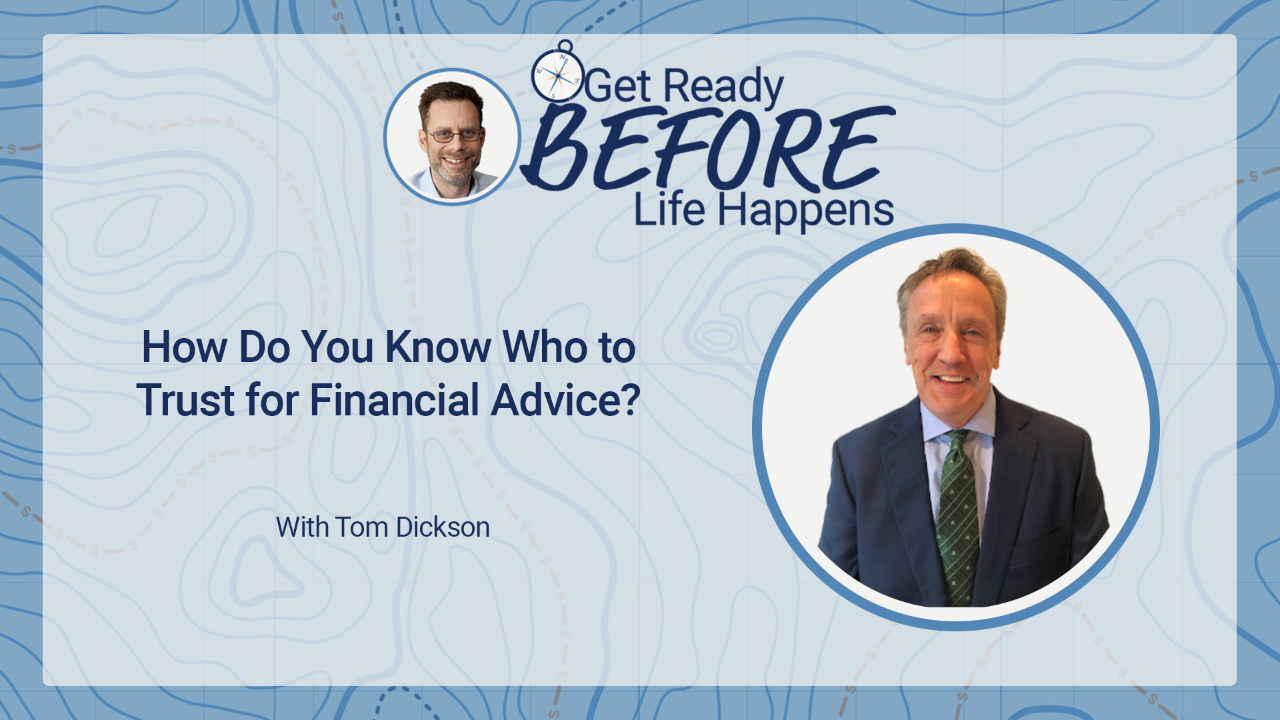
Financial decisions are becoming more complex every year. This episode explores how to find trusted expertise, ask better questions, and build confidence in the advice you follow.
Tom Dickson, founder of the Financial Experts Network joined me on this episode of Get Ready Before Life Happens to explore why trusted expertise matters in today’s complex financial world, how advisors can better serve clients through collaboration and lifelong learning, and why understanding a person’s background and credentials is essential before following financial advice.
Key Takeaways
- Financial planning requires expertise across many different and evolving areas
- Understanding a professional’s credentials and background helps build confidence in financial advice
- Lifelong learning is essential in a rapidly changing financial landscape
- Specialized expertise can help people navigate complex financial decisions more effectively
- Consumers should research financial professionals and understand the source of advice before acting
- Trusted advisors often work collaboratively with specialists to better serve clients
In a world full of information, trusted expertise becomes even more valuable. The right guidance usually comes from people who understand their specialty deeply and continue learning as the world changes. Asking better questions about credentials, experience, and expertise helps people make more confident financial decisions.
🎥 Watch this episode below:
🎧 Listen to the podcast below or on your favorite podcast app.
Connect with Tom Dickson:
- Financial Experts Network Website: www.financialexpertsnetwork.com
- Financial Experts Network YouTube: https://www.youtube.com/@financialexpertsnetwork6827
- Tom Dickson - LinkedIn: https://www.linkedin.com/in/financialexpertsnetwork/
Bio:
Tom Dickson has over 40 years of experience in many sectors of the financial services industry, including asset management, brokerage, custody, trust, mortgage and fintech.
It’s Tom passion for personal finance education that led to the development of the Financial Experts platform. Launched in 2008, Financial Experts has educated tens of thousands of Financial Planners with LIVE webinars that feature true subject matter experts.
👉 Start Your Financial Readiness Plan: A free, practical plan that helps you create your in-case-of-emergency Financial First Aid Kit, organize what matters, and prepare before life happens. Start Your Free Financial Readiness Plan https://www.tonysteuer.com
👉 Support the Mission: Become a Get Ready Insider and receive access to the Get Ready Library while helping support my mission to help people prepare before life happens. Become a Get Ready Insider https://www.tonysteuer.com/get-ready-insider
Episode Transcript
This transcript has been lightly edited for clarity.
Tony: What changes when you learn from people with real experience and proven expertise?
Welcome to Get Ready: Before Life Happens. I’m your host, Tony Steuer.
Today, I’m pleased to be joined by Tom Dickson.
Tom, welcome to Get Ready: Before Life Happens.
Tom: Thank you, Tony. It’s wonderful to be here.
Tony: I’m excited to share what you’re doing because I think the point of your work is so important.
It’s about getting information from people who actually know what they’re talking about.
I think that’s a real struggle in the personal finance world. There are lots of people talking about money, and far fewer who truly have deep expertise.
Tell us a little bit about yourself. What is your origin story, and how did it lead you to create the Financial Experts Network?
Tom: I’d start with my background.
I’ve been in the financial services industry for over 40 years, which means that, yes, I tend to be a little older.
I’ve had the good fortune to work in many different parts of the industry, from the mutual fund business to helping set up one of the early online brokerage firms.
I’ve had a wide range of opportunities to learn different parts of the financial industry, including mortgage and other areas.
The mortgage part actually ties into the origin story of what I’m doing today.
At the same time, I’ve always been interested in money and what we now know as personal finance.
I’ve always been curious about the markets and how all of that works, from a fairly early age.
It’s been something that has interested me for a very long time.
Going back to your comment about how many supposed experts are out there, at the risk of being a little controversial, I think it’s really important when you are listening to someone, especially if you think you want to follow their advice, to understand their credentials and background in whatever area they’re talking about.
Whether it’s investing, student loans, college planning, or anything else, I think that matters.
I won’t get on my high horse too soon, but that ties into what we’re doing today.
Tony: I think you bring up a really interesting point.
Credentials, background, and experience matter when somebody is talking about a specific subject.
Hopefully, most of us think about that when we hear medical advice on the internet.
If the person is not a doctor, we know we need to be a little more skeptical.
People can make their own choices, of course, but taking into account someone’s background and expertise helps determine whether they are qualified to give advice in a particular area.
What did you see in the financial services industry that made you realize there needed to be a stronger focus on real expertise?
Tom: A couple of things come to mind.
Financial advisors and financial planners have to be knowledgeable about such a wide range of issues.
Whether it’s investments and understanding which mutual funds or ETFs to choose for clients, investment theory, tax planning, estate planning, college planning, student loans, buying a first house, Medicare, Social Security, and so much more.
It’s a lot.
I felt there was an opportunity to educate financial advisors, particularly those serving in a trusted-advisor role, so they could become better advisors for their clients.
That is really what drives us now.
What I set out to do around 2018 or 2019 was reconstitute an educational platform that I had started years earlier, with a deeper and more comprehensive focus on finding true experts to educate financial advisors across this wide range of topics and issues.
It may sound trite, but the goal really is to help them better serve their clients.
There are certainly other educational platforms in the financial advice industry available to financial advisors, CPAs, and others who serve clients.
A lot of them do great work, and I’m not here to disparage them.
But some models focus on having a few very smart people try to educate their listeners or followers.
I just don’t think it’s possible for one, two, or three people to be true experts in every part of such a complicated field.
To give you an example, last year on our platform, Financial Experts Network, we had more than 100 different subject-matter experts educate our listeners.
We serve thousands of financial advisors and tax professionals who attend our webinars.
That’s more than 100 different people.
We spend a lot of time identifying and cultivating those experts.
That’s really what makes what we do different.
Tony: I think that’s interesting and important.
People may look at a financial planner and assume they know everything.
CFPs, for example, have multiple areas of knowledge they need to cover: insurance, estate planning, investments, taxes, and others.
You didn’t even mention insurance, and that’s a huge area.
That’s not a gotcha. It reinforces the point.
There is so much to cover in financial services that expecting one person to know everything isn’t realistic.
From both a consumer standpoint and an expert standpoint, I think it’s important for advisors to know the limits of their expertise.
The best advisors I’ve ever met know exactly where the limits of their knowledge are and when it’s time to bring in another expert as part of a collaborative team.
If you’re watching your favorite personal finance content creator, that’s something to consider too.
If trained experts struggle to know everything they need to know, can someone without much formal training really speak authoritatively about every area of personal finance?
Do they have the background?
Do they have the expertise?
And do they have the ability to keep learning?
You mentioned having more than 100 experts across many areas.
Do members of the Financial Experts Network ever come away thinking, “I thought I understood this topic, but I didn’t know nearly as much as I thought”?
Tom: Absolutely.
Let me add to what you said about financial advisors knowing their limits and knowing their domains of expertise.
I’ve worked with financial advisors for 25 years.
I’ve worked with thousands of them and educated close to 100,000 financial advisors who have signed up for one of our webinars over time.
I’ve studied them over the years, much like you have.
The most successful financial advisors I’ve worked with typically introduce their services as a team effort.
They talk about their team.
That doesn’t necessarily mean all those people work at the same company.
Successful advisors serving very wealthy households may say, “We’re here to be your quarterback,” or whatever term they prefer.
But when it comes to taxes, they use a CPA.
When it comes to estate planning, they use an estate planning attorney.
Those may be outside firms and outside professionals.
I couldn’t agree more with what you said.
If you’re listening to people on YouTube and thinking, “I’m not a millionaire, but I like this person,” that’s great.
You’re trying to educate yourself.
But be mindful that people often have a limited amount of real experience with some of the topics they’re trying to teach.
Back to your question: yes, our listeners absolutely have those moments.
I have thousands of financial planners who listen to our webinars frequently.
Many of them will email me.
We have testimonials on our website where they say, “Tom, you helped me become a better advisor because I had no idea about this,” or, “I learned something important about that.”
They also give high praise to our experts.
Each session and expert is rated by our listeners.
On average, about 87% of listeners rate our experts and programs as excellent.
I’m pretty happy with that, although I’d love for it to be 100%.
Most of our listeners understand why they’re there.
They know they need to keep deepening their learning and knowledge.
Tony: I want to get into something you said because I think it’s really important.
When we talk about wealthy people, one of the most common approaches for the wealthiest families is the family office.
A family office consists of a variety of practitioners.
There may be an insurance professional, an investment professional, an estate planning professional, and perhaps a philanthropic advisor as part of the team.
The takeaway is that the wealthiest people understand they need a team of experts.
They’re not relying on just one person.
As an individual professional, you’re stronger when you’re part of a team.
I also think about the medical world.
When you see your general practitioner for a physical and something comes up with your knee, your GP is going to send you to somebody who specializes in knees.
That’s a way to think about this.
If you’re an expert, you need to know when it’s time to call on another expert.
I think that’s the mark of somebody who is mature in their profession.
They know when to bring somebody else in, and they’re secure enough to know that doing so is a strength.
The same thing applies to financial coaches.
Financial coaches are doing wonderful work.
I’ve had many amazing financial coaches on this podcast.
They can help people with debt reduction, budgeting, money habits, and other important areas.
It’s about understanding everybody’s role.
When something becomes more complex, you match that complexity with someone who has the appropriate expertise.
You can change your oil at home.
But if something complicated happens with your car, you may need an experienced mechanic.
Tom, tell us a little bit more about the Financial Experts Network.
Who can attend the webinars?
Is it just financial advisors?
Can insurance agents join?
Can financial coaches join?
Tom: Great question.
Our focus is broadcasting live webinars featuring true subject-matter experts.
To give you a sense of the scale, in 2025 we broadcast 125 live webinars.
We typically run two or three each week.
We cover a wide range of topics.
I’m essentially the editor of the platform.
I’m constantly looking for ideas and strategies that I think will be of interest to our audience.
Roughly 90% of our audience is financial planners, particularly holistic financial planners who are interested in many different aspects of a client’s life.
Insurance is part of that, but we cover a wide range of subjects.
Approximately 8% of the audience is tax professionals, including CPAs and enrolled agents.
Then there’s another small group that includes lawyers, financial coaches, and even people who have retired from working as financial planners or tax professionals but still sign up.
It is professionals only.
We also have insurance agents, including people from State Farm and other agencies.
But our largest group is financial planners.
Anyone who is a professional can sign up and try one of our webinars for free.
That’s probably the best way to see and hear what we do.
You can look at upcoming webinars on our website.
If you do consider subscribing, there are additional benefits.
Those include continuing education credits, access to presenter materials, webinar replays, and written summaries.
Tony: Fantastic.
There are a lot of people in the audience who work in financial services, so they’ll be able to connect with the Financial Experts Network.
There will be a link where you can find out more.
For people who are not professionals, Tom and I are also exploring ways to bring some of the experts from the Financial Experts Network onto the podcast or collaborate in other ways.
That way consumers can learn from those experts as well.
We both feel it is important for consumers to have access to true expertise.
On that note, Tom, how can people distinguish between real expertise and surface-level information?
There is a lot of noise out there.
How can people start to tell the difference?
Tom: I’ll answer that in two ways.
If you’re a consumer watching people on YouTube, Facebook, TikTok, or anywhere else, I think you want to dig deeper.
You really want to understand their background.
I’ve seen influencers who say they went from Wall Street to now helping thousands or tens of thousands of people.
Not everyone who says they were “on Wall Street” actually had deep experience in the areas they’re now talking about.
And what does “Wall Street” really mean?
You want to understand whether they have a meaningful background in the area they’re discussing, whether that’s investing, budgeting, saving, or anything else.
Do they have education in the area?
Did they work in the area?
How many clients have they actually helped?
Having followers is different from having experience.
If someone is giving specific investment advice, they generally need to be appropriately licensed or registered to do so.
If you’re evaluating a financial advisor, one thing you can and absolutely should do is go to FINRA.org.
FINRA has a BrokerCheck function that allows you to review the background of many licensed financial professionals.
You may find they have a spotless record, or you may find they don’t.
That can be an important part of your due diligence.
There is also a separate database for professionals who are registered with the SEC.
The point is that there are resources available to help you investigate someone’s background before hiring them.
Tony: I think that’s so important.
There are also professionals who may not show up in the same way depending on how they practice.
If someone is a CFP professional, you can check with the CFP Board to see whether there is a disciplinary record.
And with the internet, there are many ways to research someone’s background.
You can search their name, look at their credentials, and see what comes up.
Tom: Great point.
Especially if someone is a financial influencer and has a large social media following, you can often find feedback about them online.
You should absolutely take that step.
For the professional side of what we do at Financial Experts Network, part of our value is that I’m constantly researching the topics and the speakers we bring onto our webinar series.
We vet them fairly intensely behind the scenes.
That’s my job.
I do the due diligence to make sure that whoever is coming on to speak about retirement, Medicare, Social Security, estate planning, or another subject is truly an expert in that area.
That is what we do day in and day out for the webinars we broadcast.
Tony: You brought something to mind when you mentioned somebody saying they worked on Wall Street.
If somebody worked for J.P. Morgan, for example, that alone doesn’t tell you very much.
Someone managing the company’s social media feed has very different expertise from someone who served as a portfolio manager.
It’s not necessarily where somebody worked.
It’s what they actually did.
Can you go a little more into what you look for when you’re vetting an expert?
I think that would be helpful for people thinking, “Is this somebody I should be listening to?”
Tom: It’s interesting because, for me, it largely starts with the topic or the idea.
I read multiple publications every day.
I’m constantly looking for ideas and stories that I think will be of interest to our listeners.
Once something piques my curiosity, I start researching the expert.
What background does he or she have in this particular topic?
For example, earlier this week we had Derek Horstmeyer, a professor of finance at George Mason University, on the platform.
He also writes a monthly column for The Wall Street Journal.
I’ve had Derek on several times in the past.
I saw a recent column he had written about whether young people should save more in a traditional IRA or a Roth IRA.
He had a team of PhD students do research on the question.
I thought that would be fascinating.
That’s one example.
We have a decent number of academics who are continuously conducting research on topics and issues that would be of interest to our audience.
That’s one group.
Another group is practitioners who are actually working in the business.
There are financial planners, advisors, insurance professionals, and others who are doing deep thinking and research.
Many of them are generous about sharing their work.
In those cases, I’m researching how much expertise and experience they have with the subject.
There are also people from larger firms who may be part of advanced planning teams.
We may have estate planning attorneys or CPAs.
One question I ask any potential speaker is, “How much experience do you have with this topic? How many times have you done this with clients? What have you actually done in this area?”
I want to make sure we don’t have somebody coming on and saying, “I just came up with this idea yesterday. Let me share it with the world.”
That doesn’t work well for us.
It’s a fairly intensive process.
Tony: I think the important takeaway for everybody is that it’s about research and matching the expertise to the topic.
If people take away one thing from this episode, I would say: match the expertise to the topic.
That’s where you want to pay attention.
When we did our own estate planning, for example, I wanted an estate planning attorney who also had a degree in taxation.
That was an important distinction for me.
If I were researching estate planning more broadly, I might ask: Do I want an estate planning attorney who is especially familiar with family law? Do I want one who has a strong taxation background?
Different situations require different expertise.
If you’re 70 years old, you may want an estate planning attorney who regularly works with issues affecting older adults rather than somebody whose practice primarily focuses on young families.
That’s another consideration when you see influencers with millions of followers talking to everybody.
They may be a jack of all trades but a master of none.
Your personal financial situation is always unique.
People who watch and listen to this show know that I bring on experts in very specific areas for that reason.
Tom, as we start to close out, how does FEN actually work?
Can you give us a quick overview of the benefits?
Tom: Absolutely.
If you’re listening as a professional and haven’t tried one of our webinars, you can go to FinancialExpertsNetwork.com, look under upcoming webinars, and pick one or more that interest you.
Try us out.
That’s how we get the majority of our subscribers.
On one hand, you can listen to a webinar for free.
On the other hand, we have more than 1,500 paying subscribers and offer monthly and annual plans.
As a subscriber, you get access to things such as presenter materials and slides from our experts.
You also get access to more than 700 webinar replays on our website, and that number grows every week.
We provide written summaries as well.
If you miss a webinar, you can go to the website and download a written summary.
It’s essentially a condensed reference guide to a complex topic.
Subscribers can also receive continuing education credits where applicable.
That includes CFP continuing education, investment adviser representative education, American College programs, CDFA, CPA CPE, and enrolled agent education.
Our focus is really on the live webinars, roughly 125 a year, along with all the replays.
We also have masterclasses.
I started the masterclass program in the spring of 2024.
Our experts do a phenomenal job educating listeners in roughly an hour, sometimes 60 to 90 minutes with Q&A.
But there’s only so much they can cover in that amount of time.
With the masterclasses, we can go deeper.
We now have four- or five-session programs on topics such as Medicare, college planning, and estate planning.
These may total nine or 10 hours of education.
We’re also working with you, Tony, around podcasts and repurposing some of what we broadcast into shorter audio formats that listeners can use on the go.
We’re constantly looking to improve the subscriber and member experience.
One other thing we’re working on is an AI chatbot.
We have a tremendous amount of knowledge from all these experts.
We’re looking at ways to make that available so someone can go to a replay page, ask questions, and receive answers based on what the expert actually delivered in the transcript and other trusted sources.
That’s what we do in a nutshell.
Tony: Fantastic.
For people watching and listening, we’ll wrap up with a link to Tom’s website so you can check it out.
But I think the important point for everybody, even if you’re not a professional, is this:
Even pros are learning from other pros.
That’s the important takeaway.
Tom, what are three things people should know about the value of learning from real experts?
Tom: One is that many of these topics and issues are extremely complex.
The knowledge that our experts have acquired over years, and often decades, of working in a narrow field is tremendously valuable.
You’re as good as the people around you.
That’s one of the biggest benefits our listeners receive.
They get knowledge in a condensed fashion from experts, including ideas and strategies they can take back and apply with clients.
That’s one of the biggest value points we deliver.
After every webinar, my goal is that you learn something that changes how you advise your clients in whatever topic area we are covering.
It’s about education and knowledge.
I would say our best member is somebody dedicated to lifelong learning.
If that’s what you’re interested in, and you genuinely want to enhance your knowledge, there is a real benefit.
Beyond that, we aspire to build a community.
We have more than 1,500 professional subscribers today, including more than 1,000 CFP professionals and roughly 700 investment adviser representatives.
We’ll continue to grow that organically.
Within that community, I get requests from listeners saying, “I need an estate planning attorney,” or, “I have a client case like this. Do you know somebody?”
I think we’re still in the early innings of what that community can become.
There is a real opportunity to empower the community and give people access to trusted resources.
I have a lot of hope for what we can build there.
Tony: I think the three takeaways are really clear.
First, these topics and issues are complex.
Experts may spend their entire careers working in one narrow area.
Think about something like day trading.
You’re trying to compete against professional investors who may have advanced degrees, years of experience, and sophisticated technology behind them.
It would be like playing one-on-one basketball against an NBA professional when you’re someone who goes out and shoots baskets on the weekend.
That’s the difference expertise can bring.
Second, you mentioned being dedicated to lifelong learning.
The best professionals I know in any field, inside or outside the money world, are continuously learning.
And third, you want trusted resources, even if you yourself are an expert.
That team approach is so important.
Tom, to close out, where can people learn more about you and find the Financial Experts Network?
Tom: Our website is FinancialExpertsNetwork.com.
You can go there and look under upcoming webinars.
There are also sections under continuing education if you’re a CFP professional, investment adviser representative, or have other specific requirements.
You can also find me on LinkedIn.
If you search Financial Experts Network on LinkedIn, you’ll find my profile associated with it.
The website is probably the best place to start.
We also have a Contact Us form.
If you have questions, you can fill that out and we generally respond within one or two hours.
You’re also welcome to message me or send me a connection request on LinkedIn.
I’d be happy to connect.
Tony: Fantastic.
Tom, thanks for coming on the show.
For everybody watching and listening, as always, you’ll find links to Tom, the Financial Experts Network website, and Tom’s LinkedIn profile in the show notes.
Tom, thanks again for a great conversation.
Tom: Thank you, Tony. I really appreciate the opportunity.
Tony: And thank you, everyone, for tuning in.
I hope this gave you a different perspective on learning and the value of learning from true experts.
If you learned something today that helps you think differently and grow, please be sure to share this episode with a friend and subscribe.
You can also go to my website at TonySteuer.com to join the Get Ready Movement and receive my newsletter and the Financial Readiness Quick Start Checklist.
Because when life happens, the way you think about money matters.