
How Financial Infrastructure Turns Income Into Empowerment
money mindset podcast episode Sep 17, 2026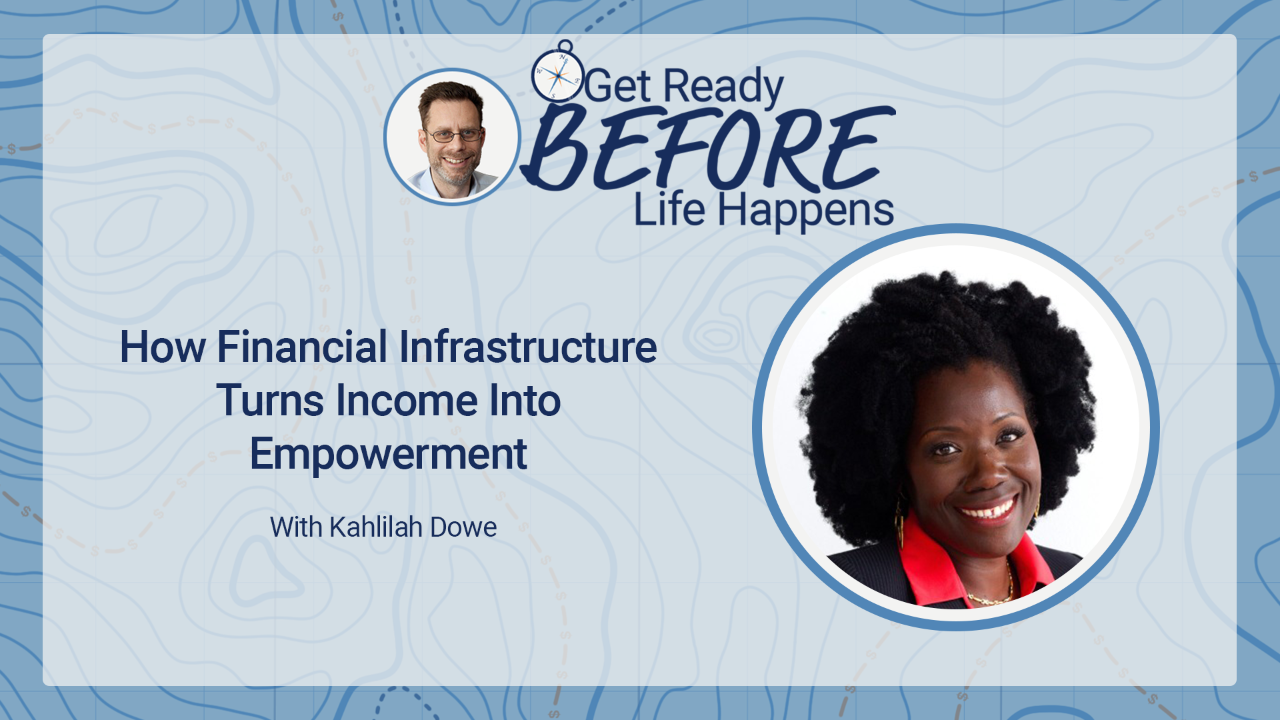
Income creates options when it is supported by strong financial systems.
Kahlilah Dowe, CFP®, founder of TrueWealth Solutions, joined me on Get Ready: Before Life Happens to talk about how education, structure, goals, and values can build confidence and economic empowerment.
Key Takeaways
- Financial education builds confidence and expands opportunity.
- Strong systems help income support long-term goals.
- Knowing your numbers creates financial peace.
- Liquidity, goals and systems create stability.
- A financial do-over can begin with one courageous step.
- Your money should support what brings you peace and purpose.
- Economic empowerment grows when money is used to create impact.
Tony’s Take: Strong financial infrastructure helps turn income into confidence, choices, and impact.
🎥 Watch this episode below:
🎧 Listen to the podcast below or on your favorite podcast app.
Connect with Kahlilah Dowe, CFP®:
- LinkedIn: https://www.linkedin.com/in/kahlilahdowe/
- True Wealth Solutions Website: https://truewealthsolutionstws.com
- YouTube True Wealth Channel: https://www.youtube.com/@TrueWealthSolutionstws
Resources mentioned:
- The Financial Do-Over Series by Kahlilah Dowe, CFP
- How to Stop Worrying and Start Living by Dale Carnegie (Amazon)
Bio:
Kahlilah Dowe is a Certified Financial Planner™ with more than 15 years of experience helping families build financial freedom through personal financial planning and coaching. She began her career at Vanguard, one of the world’s largest financial institutions, where she developed financial strategies for high net worth families. Today, she is the founder of TrueWealth Solutions, a financial planning and coaching firm based in the Philadelphia area, where she helps clients strengthen the financial infrastructure that supports their lives.
Kahlilah’s passion for financial planning is deeply personal. Growing up in Brooklyn, New York, in a family where resources were limited, she became focused early on creating financial security for herself and her family. That experience shaped her belief that financial success is not simply about making great money, but about using money in ways that create stability, freedom, and long term economic empowerment. She lives in the Philadelphia area with her husband, their three children, and two grandchildren, and loves loud, joyful Friday nights spent with five generations of family.
👉 Start Your Financial Readiness Plan: A free, practical plan that helps you create your in-case-of-emergency Financial First Aid Kit, organize what matters, and prepare before life happens. Start Your Free Financial Readiness Plan https://www.tonysteuer.com
👉 Support Get Ready. Become a Get Ready Insider and help keep the Financial Readiness Plan free, support the podcast, trusted resources, and consumer-first financial education. You’ll receive access to the Get Ready Library. Support Get Ready here. www.tonysteuer.com/support
Transcript
Tony Steuer:
More money doesn’t fix the problems if the financial infrastructure isn’t there.
Welcome to Get Ready: Before Life Happens. I’m your host, Tony Steuer.
Today, I’m joined by Kahlilah Dowe.
Kahlilah, welcome to Get Ready: Before Life Happens.
Kahlilah Dowe:
Thank you. Thank you for having me, Tony.
Tony:
I was really impressed with that series you did a while back on LinkedIn. I couldn’t wait to have you on the podcast to talk about it and share it with everybody else.
Tell us a little bit about yourself. What is your origin story, and how did it lead you to focus on helping people build their financial infrastructure?
Kahlilah:
I live in the Philadelphia area now, and I’m originally from New York, from Coney Island in Brooklyn.
I grew up there without a lot of resources. It wasn’t just me. When I think about the people around me, there simply weren’t a lot of resources in our community.
But I had aspirations.
From a very young age, I remember watching the ’80s sitcom The Cosby Show and being keenly aware of how different their lives were from the life I lived.
It wasn’t so much that they had a lot of money. Money just didn’t seem to be an issue.
I always had this thought that there was something I was missing.
At a very young age, I thought that if I could just go to college, that would be the missing link.
The way I describe it is that I grew up on the outside of money.
I grew up seeing what money was, but not from the inside.
In Coney Island, there’s an area called Sea Gate, probably a mile or two from where I lived, with these elaborate houses.
My friends and I would run down there, and there was literally a gate we couldn’t get through.
We would look through that gate and say, “That’s my house. That’s my car.”
It stirred something in me at a very young age to go get the things neither I nor anyone in my area had.
I was also a young parent.
I became pregnant at 16 and had my first child when I was 16.
But I had a mother who, even though she didn’t have what I wanted, knew I had a vision.
She pressed me and said, “You’re having a baby at a young age. That doesn’t mean you have to be a statistic. You’re going to finish school.”
That was her mandate to me.
“You’re going to finish school, and you’re going to work.”
I always say I understood the assignment.
Even though I was a young parent and knew the odds were stacked against me, I knew I had to graduate, go to college, finish, do well, and have a career.
My thought was that if I could just do all of that, financial success would be imminent.
Of course, that wasn’t the case, but that was my starting point.
Tony:
That’s an amazing story.
We don’t all start from the same place, and opportunity can be much more challenging for some people.
I think it’s important for people to know that if you start from a place that isn’t as advantageous, you can still build a full life.
For any young moms listening who may feel a little helpless, what pulled you through?
What story did you tell yourself?
Kahlilah:
I knew that being pregnant at a young age wasn’t who I was.
I had always envisioned going away to college and living on campus.
I knew that wasn’t going to be an option anymore.
But I had a vision of what life could be for me, and I never let that go.
I keep going back to The Cosby Show.
I know these were fictitious people and a fictitious family, but there was something about the kids in that family talking about going to college like it wasn’t even an option.
That appealed to me.
When I speak to young people who have the odds against them, whatever that is, whether they have young children or parents who aren’t involved, knowledgeable, or present, I always say education goes such a long way.
I know we’re living in a time when people say, “You could start a business,” or, “You could be an influencer. You don’t have to go to school.”
Maybe I’m old school, but I believe that, especially if you come from a background where the deck may already be stacked against you, education is still the great equalizer in so many ways.
By any means necessary, to borrow a phrase from Malcolm X, education.
Education opens doors.
No matter what doors are closed for you right now, education still opens doors.
That’s my number one piece of advice.
Tony:
I love that.
You said two things that are extremely powerful.
One is having a vision of what life could be.
It sounds like those pictures from Sea Gate and The Cosby Show were what you held in your head.
Having goals and visions of what life could be can drive us forward.
And then there’s education and knowledge.
Knowledge is power.
If you and I were going to play chess, the more you know about chess, the better your game would be.
If you don’t know how to play chess and you’re playing against somebody who’s really knowledgeable, you’re probably going to struggle.
That’s an easy way to see how powerful knowledge can be.
Kahlilah:
I agree 100%.
There’s also something to be said for gaining knowledge that you can then use in the world and use to command a certain level of pay or a certain position.
One of the things I found when I went to college, and it took me a while to finish, was that above the knowledge, I gained a level of confidence in myself.
This is going to sound really simple, but I remember when I first walked through the doors thinking, “Wait a minute. I’m going to go into this classroom and have a seat, and this professor is going to teach me everything they know. I just have to absorb it.”
I felt insanely privileged.
It also builds confidence when someone is depositing into you and takes that seriously.
That experience of professors depositing something into you with the expectation that you’re going to go out and change the world changes the game in terms of how you see yourself.
Especially if you come from a community like mine, where there wasn’t a lot of expectation.
That was one of my biggest takeaways.
Tony:
I think that’s really powerful.
We sometimes take it for granted when we’re presented with information and knowledge.
The smartest people are always learning.
We can learn from people in our lives too.
Maybe it’s a grandparent who has some great advice and we think, “You don’t know my life. You’re living in a different world.”
There’s still something we can learn.
One of the things you talk about is how more money can lead to the same problems.
Or, as the song goes, “More money, more problems.”
Why doesn’t more money automatically change things and make everything better?
Kahlilah:
I go back to my perception when I was younger.
I thought that if I did all the right things, went to school, built a career, and did everything I was supposed to do, I could have all the things I saw as representing money.
I don’t say that from a shallow perspective.
I wasn’t just trying to get a bunch of stuff out of materialism.
I genuinely saw these things as signs of success.
They lived in a great neighborhood.
It was peaceful.
There wasn’t violence around.
There were great schools.
The kids looked happy.
The car looked reliable.
Those were the things downloaded into me as what success looked like.
What I realized through my own journey is that just because you have those things doesn’t mean you have what it takes to support all of those things.
I’ve seen this so many times, especially with really high earners and even physicians.
Someone comes out of school making a good deal of money, and the first thought is, “I’m going to buy a house. I’m going to buy a car. My kids can go to this school and that school.”
I get it.
What did you go to school for?
You wanted to be able to have this life.
But what I’ve realized through my own experience and through working with clients is that if you go straight to that without first building the infrastructure that supports those things, you can end up with the same problems.
People say, “I make great money, and I still worry about money. I still don’t have financial peace. I still check my bank account first thing in the morning. I’m still thinking about whether I need to move money from here to there. Did this hit? Did this check come?”
The peace we assume is associated with the life doesn’t actually show up.
It feels like the same problems, even though there’s significantly more money.
Tony:
Sometimes it’s just more zeros.
I think about professional athletes.
I’ve had Jed Collins on this podcast a couple of times.
He’s a former NFL player who works with other professional athletes.
It’s the same idea.
Some players come from backgrounds where they’ve never had much money.
Then suddenly they have an extraordinary amount of money.
They may buy their mom a house, buy themselves a nice car, and do all these things they’ve dreamed about.
Without the structure underneath it, the money can disappear.
Kahlilah:
Exactly.
A lot of times, we don’t necessarily know there is a structure behind all of this.
That’s why I have a name for people like me.
I call us the outsiders.
We’ve seen it from the outside, but we don’t necessarily know there’s a structure holding all of it up.
It isn’t just that someone has great income.
And no one necessarily tells you, “This is how you build the structure to support this life.”
That’s what separates people who can get there from people who can afford to be there.
If I think about a new home I want to purchase in a great neighborhood, I may look at my income and say, “I can afford the monthly payment.”
For me, that means I can afford to get there.
But I’m looking at whether you can afford the purchase.
What is the impact of that payment on your life for the next five years or 15 years?
You may be able to afford the monthly payment.
But if you can’t do the other things that are really important to you, like saving for your child’s education or helping a parent who may need you, then you have to ask whether you can actually afford to be there.
One of the exercises I go through with clients is figuring out all the things that are really important to them.
What are all the goals you have?
Let’s get all of that out.
There’s no other way to know what you can afford unless you have tangible goals you’re working toward and can compare the trade-offs.
Without that, and I’ve been guilty of this, you can end up with a lot of emotional assets masquerading as financial assets.
They’re emotional assets.
They may actually be financial liabilities.
Tony:
Let’s explore that a little more.
What do you mean by an emotional asset?
Kahlilah:
Almost anything can be an emotional asset.
It’s something that brings something to you emotionally, sometimes at the expense of you financially.
It may add to your identity.
It may help you feel good or help you feel like the person you want to be.
I’ve seen emotional assets be sending children to private school because someone always wanted that.
I’ve seen it be having a second home or having a really large home in a neighborhood they always wanted to live in.
It can be more of an emotional asset than anything else because financially, it doesn’t work.
It may actually be draining you.
And you might not even be aware of how much it’s draining you or how much of a liability it is because you’re so locked in on the emotional aspect.
That’s an emotional asset.
Tony:
I think it’s important to look beyond the emotional aspect, even though it’s easy to get pulled into it.
It’s tied to who we are, and many of our decisions are emotionally driven, even in the financial world.
Let’s switch gears because your series was about the financial do-over.
What is a financial do-over?
Kahlilah:
That idea came to me during a client call.
My mission when I started doing this work was always about reducing the pain people experience.
Yes, financial pain.
But in my experience, when someone is struggling financially and having a really hard time, it bleeds into so many aspects of life.
I was drawn to helping reduce pain in people’s lives.
I remember being on a call with someone who had great income, a phenomenal career, and great achievements.
But for one reason or another, they were in a financial predicament where they couldn’t see their way out.
I remember thinking, “What they’re describing feels like a financial do-over.”
They wanted to be able to start fresh.
“If I could start from the beginning, if I could get another shot at deciding which house to purchase, which school to go to, who to marry, if I could do all of that over, maybe that would put me on the right track.”
That started me thinking about how people can do it over without completely starting over.
I began to realize a financial do-over doesn’t necessarily have to mean tearing everything down and rebuilding it.
For many people, it’s that one hard decision that changes the trajectory of their financial life.
It could be downsizing.
And I don’t say that casually because this is hard.
Take someone like me.
After becoming a young parent, I was on a mission to create the life I wanted.
Some people told me I was going to be a statistic, and I was determined to prove them wrong.
Building that life became part of me proving them wrong.
Then you get to a point where you realize you didn’t build it in the way you now know it should have been built, and you’re suffering because of it.
It takes a lot to pause and walk that back publicly.
Maybe you sell the house and downsize.
Maybe you move in with parents.
Maybe the kids stay with their grandmother instead of going to summer camp.
Those are very public decisions.
They rub up against our identity.
They can deconstruct everything we prided ourselves on building.
Regardless of whether the change is needed, it can be very hard to do.
Initially, I was thinking about how to make the idea of a do-over more palatable.
How do we stop the bleeding and address what’s happening at the root?
I’ll be honest, Tony.
I haven’t gotten a lot of takers on that.
You can describe what’s needed in great detail, and there still may not be many takers because it can be terribly disruptive.
One of the reasons I wrote the article was to help people see it as an option.
Maybe you have to say, “I had to sell this house. I couldn’t afford it.”
We often think people are looking at us.
But for the most part, people are looking at their own lives and their own finances.
I want to encourage people to be courageous and take bold steps to change the trajectory of their lives when something isn’t working.
And I also realized the change doesn’t have to be huge.
It could be something small that you know is holding you back.
It may still take a lot of courage to make the adjustment.
But that one small thing could address a significant portion of the financial issues you’re having.
That’s how I want people to look at it.
Tony:
I love that.
It does take courage to make the change.
And we tend to think people are looking at us and thinking about us much more than they actually are.
If you’re downsizing, your real friends aren’t going to judge you.
They’re probably just going to say, “My friend moved.”
The important part is your goals.
Are you on the trajectory to meet your goals?
I remember when I played basketball, one of my coaches always said, “Focus on your own game. Don’t focus on the other player’s game.”
You can only control the game you’re playing.
You can’t control someone else’s game.
I think the same idea applies here.
You can control your own life, not somebody else’s perception.
Kahlilah:
I will say that, in my experience, most people aren’t necessarily driven by what other people are going to think.
They’re holding themselves to a much higher standard than anyone else possibly could.
For a long time, I was the high earner in my family.
I was the one who graduated from college.
I was responsible.
That’s how I fancied myself.
When I left my corporate job and decided to create TrueWealth Solutions, I went from making great money to making almost no money while building a business.
I would be lying if I said there wasn’t a part of me, call it my ego or whatever, that thought, “Wait a minute. You’re the high-earner person. You’re responsible. You go on great vacations. You have a timeshare.”
I wasn’t saying that in a braggadocious way.
I had built those things up over many years as part of my identity.
When I have conversations with clients about potentially disruptive changes, and I don’t really use the term “do-over” with clients, we deal a lot with permission.
That’s the first step.
Giving yourself permission to make the change.
Forgiving yourself for creating a life differently from how you now wish you had done it.
A lot of it is heavy emotional work.
In the article, I talk about sitting in a quiet room.
I think there’s a lot of self-exploration involved in making these types of changes.
Tony:
I completely agree.
Our identity gets tied up in so much of this.
And what you’re talking about sounds like life decisions as much as financial decisions.
Kahlilah:
For sure.
A life decision is, “What neighborhood do you live in?”
The financial decision is, “Can you afford to live in that neighborhood?”
Tony:
Exactly.
Are you comfortable saying, “I drive an old car”?
We could afford a newer car, but our old car gets us around, and I’m okay with that.
Sometimes I feel a little strange when I have an older car and everybody else has a newer one.
But that’s something I deal with because I don’t want to spend the money on the new car.
Kahlilah:
I completely understand that.
My family and I have four people in our immediate family.
We also have my mother-in-law, my brother-in-law, and two grandkids who are always at the house.
We’re about eight deep.
Our house is literally 1,400 square feet.
There have been times when I thought, “We really need to move.”
Especially when I was in corporate and all my coworkers had elaborate houses.
I remember my husband saying, “Yeah, we can do that. But let’s buy rental properties first.”
That was his dream.
He had always wanted rental properties.
So we bought rental properties with the thought that eventually we would upgrade our home.
Then I ended up leaving and starting this business.
I didn’t even think of it as infrastructure at the time.
But what we ultimately did was make financial decisions that created an infrastructure that allowed us to live on about 50% of our income before I left.
That’s what I think about when I think about a do-over.
For people who need a do-over, the missing piece is usually the infrastructure.
They may have the things they want and still worry about money.
They may still feel like they’re struggling.
They may still have to wait for a paycheck to hit before doing the things they want to do.
Financial infrastructure can look like a few different things.
One is having a deposit cushion.
You might be surprised by how many people live off their paychecks as they come into their accounts.
I try to get clients to a place where they’re at least on a one-month lag, where they aren’t living off the money coming in for the current month.
That creates flexibility.
If something doesn’t hit when you expect it to hit or an expense comes in, you aren’t scrambling.
And when I get to the first of the month, I know exactly how much money I have for the following month.
There’s no question about it.
That reduces the urgency.
The other part is having systems where you’re crystal clear on where your money is going.
If I could have told myself one thing when I first got out of college and started working in corporate, I would have said, “You need a clear system. You need a spending plan.”
You should know exactly what’s coming into your account.
You should know exactly what’s going out.
And you should be planning for things.
When you have steady income, you get into the habit of that paycheck hitting every two weeks.
You know it’s going to be there, and you just keep going.
But there’s such an opportunity to be proactive and tell your money where you want it to go.
That’s a big part of the infrastructure.
The other part is having goals.
Whenever I speak with someone about a major purchase, I ask, “How did you decide on that price?”
How did you decide on the price of the vehicle, refrigerator, or whatever it is?
Usually someone says, “I did my research. I found one I liked, and I tried to get a good price.”
But how do you know you can afford it?
It’s almost impossible to know what you can afford if you don’t have goals you’re working toward.
That’s an important part of financial infrastructure.
Stable income is part of it.
Then we look at the trajectory of saving for your other goals.
Have you started saving for education?
Do you want to start another business?
Do you already have a nest egg, or are you waiting for future income to become the starting point?
What I see so often is that those of us who come from the outside and start making a lot of money come to rely on the income and bonuses for everything.
We use the bonus to pay off debt.
Then the debt builds again, and another bonus comes along.
Or we use the bonus for vacation.
The income becomes the nucleus holding up the entire household.
When that’s coupled with expenses that are right up against your income, it creates instability.
If 90% of your income is being used just to make your life work, that isn’t a stable structure, regardless of how high your income is.
Someone who makes half a million dollars a year may not want to hear that they’re financially unstable.
But I think it’s important to tell the story that financial stability and financial infrastructure are about so much more than making great money and living the life we want.
I’m looking at whether those dollars are being used to build something.
After years of making hundreds of thousands of dollars, ideally, you should be less dependent on that income every year.
That’s stewardship.
It’s taking the money you’re receiving and using it to build something that can sustain you rather than relying on your income as the primary thing sustaining you.
Tony:
I love that.
I’ve reframed retirement as financial independence because that’s exactly what you’re talking about.
You aren’t dependent on income or any one thing.
You’ve established your nest egg or whatever you want to call it.
That’s the whole point for me.
You have the ability to support yourself without depending completely on employment income.
That’s smart on a number of levels.
People have heard me talk about the importance of disability insurance.
People can become disabled, sometimes for a short period.
They may leave the workforce to become caregivers.
There are many reasons income can change.
What you’re talking about is building those cushions and thinking about your overall plan.
Sometimes with money, we start thinking about things in isolation.
We might ask, “Should I buy NVIDIA stock right now because that’s the hot stock?”
The better question is, “Is NVIDIA stock going to help you reach your goals?”
That’s the real question.
Kahlilah, to wrap up, I have what I call the Get Ready Hot Take Trio.
These are three quick questions I ask all my guests.
What’s one myth you’re trying to break about financial infrastructure?
Kahlilah:
That it’s just about accumulating money.
That you’re saving money simply to have a lot of money.
I do think saving is part of financial infrastructure.
But I always think in terms of economic impact.
You can have wealth and saved money and still have very little economic empowerment in your life.
Your money may not be used in a way that changes or adds to the things that are really important to you.
The whole point is to be able to use that money to build something and show that you were here.
That could mean helping someone else.
It could mean teaching your children.
There are so many ways to do it.
Tony:
I love that.
We didn’t get a chance to talk about generational wealth, but that’s part of what you can do with money.
You can start to build generational wealth and change patterns that ripple into future generations.
You can also use your money to support organizations and causes that matter to you.
Your money can have a positive impact beyond your immediate life.
Kahlilah:
Can I add something to that?
Tony:
Absolutely.
Kahlilah:
A lot of times we think about creating impact toward the end of our lives, after we’ve done everything we wanted to do and accumulated all the things.
But we don’t have to wait until then.
One of the reasons I focus on expense flexibility as part of infrastructure is the ability to lower your expenses dramatically when you choose.
To me, that’s a form of economic empowerment.
It means you can make moves.
You can have an impact while you’re working and while you’re in your 30s if you have that in your line of sight and that degree of control over your finances.
Tony:
I absolutely love that.
Your money can do so many things.
There’s values-aligned investing.
You can support nonprofits.
You can help family members.
There are many ways to use money to make an impact.
Let’s get out the time machine for a minute.
If you could go back in time knowing what you know now about money, what advice would you give your younger self?
Let’s say 16-year-old Kahlilah.
Kahlilah:
Sixteen-year-old Kahlilah would not have listened.
Sixteen-year-olds don’t listen, do they?
Tony:
No, they don’t.
Kahlilah:
I would have told my 16-year-old self to stay home.
I was in such a hurry to move out of my mom’s house, start life, and start being an adult.
I moved out when I was 18.
I would have told myself, “Stay home. Let her continue to pour into you, and don’t move out until you’re at least 10% of the way toward the vision you have for yourself.”
Make some progress first.
Then move.
Don’t be in a hurry.
Tony:
That’s great financial advice for almost any part of life.
Don’t be in a hurry.
Wait.
Get the information.
That comes up with so many life transitions.
For example, I often say to widows, “Don’t be in a hurry to make decisions.”
I think that applies to almost any major transition.
Take a minute.
To wrap up, what’s your number one tip to change the way we think about money?
Kahlilah:
That’s a good question.
The last article I wrote on LinkedIn, which I grappled with for a long time before putting it out there, was about learning what “enough” means.
My number one tip is to figure out what enough means for you before something goes wrong or before you need to retire.
The earlier you can figure out what brings contentment, what makes you feel at peace and whole, and lock in on those things, the better.
Then be insanely frugal on everything else.
That’s what I would say.
Tony:
I love that.
Figure out what enough means to you.
That’s so important because it’s going to be different for each of us.
Kahlilah, where can people learn more about you and connect with you?
Kahlilah:
I put out a lot of work on LinkedIn, so I would say start there.
You can find me under Kahlilah Dowe on LinkedIn.
I also put out YouTube content and motivational videos.
You can find that under Kahlilah Dowe at TrueWealth Solutions.
I also have a blog.
The website is TrueWealth Solutions, TWS.
Tony:
Fantastic.
For everybody watching and listening, as always, there will be links in the show notes.
As I’ve mentioned throughout the show, I love Kahlilah’s writing on LinkedIn, so I highly recommend following her there.
Kahlilah, thanks for joining us on Get Ready: Before Life Happens.
This has been a fantastic conversation.
Kahlilah:
Thank you so much for having me.
I appreciate it.
Tony:
Thank you.
And thank you, everyone, as always, for tuning into this episode of Get Ready: Before Life Happens.
Start your free Financial Readiness Plan at tonysteuer.com. It is a practical way to begin building your in-case-of-emergency plan before life happens.
You can also help keep the Plan free and support this podcast by becoming a Get Ready Insider for $5 a month.
Because when life happens, the way you think about money matters.