
How Kids Can Learn Money Through Everyday Choices
Nov 10, 2026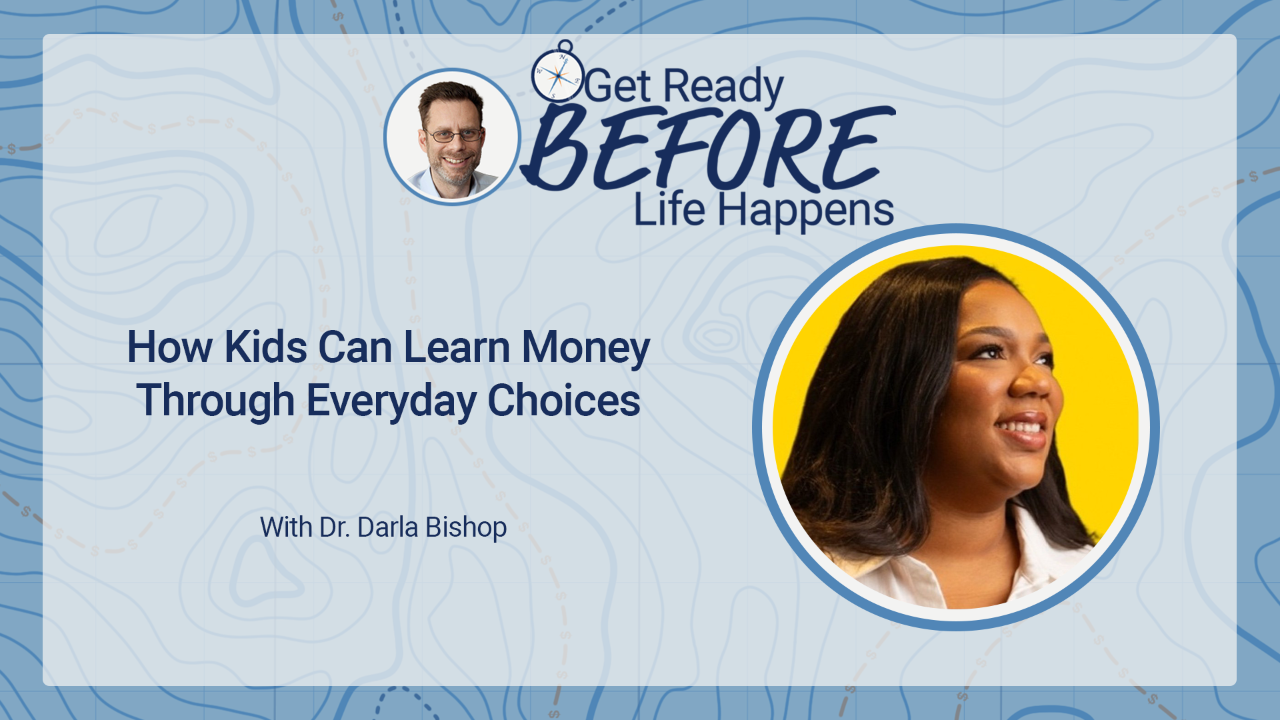
Everyday money moments can become lessons kids remember.
Dr. Darla Bishop, founder of Piggy Bank Pathways and co-author of Madeline’s Money Adventures, joined me to talk about how everyday experiences and family conversations can help children develop healthy money habits.
What Stood Out
- Everyday family conversations help children develop their understanding of money.
- Discussing wants, costs, and trade-offs teaches kids to think through financial choices.
- Hands-on experiences with cash and coins make money concepts more tangible.
- Children can bring financial lessons home and influence family money habits.
The Bottom Line: Helping children develop financial confidence starts with everyday conversations and opportunities to practice making choices.
🎥 Watch this episode below:
🎧 Listen to the podcast below or on your favorite podcast app.
Connect with Darla Bishop, DrPH:
- Darla Bishop Website: https://www.darlabishop.com
- Piggy Bank Pathways Program Website: https://www.piggybankpathways.org
- How To Afford Everything Website: https://howtoaffordeverything.com
- LinkedIn: https://www.linkedin.com/in/darlabishop/
- YouTube: https://www.youtube.com/@my_finansis
- Instagram: https://instagram.com/my_finansis
- Instagram (Kids Brand): https://instagram.com/piggybankpathways
Books:
- Madeline’s Money Adventure by Madeline Bishop and Dr. Darla Bishop (Amazon)
- How to Afford College by Dr. Darla Bishop (Amazon)
- How To Afford College (ebook)
Resources mentioned:
- Billion dollars by Kevin Kelley (read)
Bio:
Dr. Darla Bishop is a public health expert, financial wellness strategist, and author of How to Afford Everything. She is the founder of Piggy Bank Pathways, a financial literacy program designed to help kids—and their grownups—build healthy money habits together. With over 15 years of experience across health policy, education, and financial wellness, Dr. Bishop helps individuals and organizations reduce financial stress and build sustainable systems for long-term success. She is also a proud mom and co-author alongside her daughter, Madeline.
Transcript:
Tony Steuer:
What happens when kids learn about money early and start teaching the adults around them?
Welcome to Get Ready: Before Life Happens. I’m your host, Tony Steuer, and I’m pleased to be joined today by Dr. Darla Bishop.
Darla, welcome to Get Ready: Before Life Happens.
Dr. Darla Bishop:
Thanks for having me here.
Tony:
As I alluded to in the hook, one of the most interesting things in talking to other people about kids’ financial literacy is that it is often a reflection for the adults around them.
It can be a great way to get families connected to financial literacy. I’m looking forward to getting into this conversation with you.
To start out, tell us a little bit about what led you to focus on early financial education.
Darla:
My daughter, who is pictured somewhere in this screenshot here, helped start this.
Tony:
I can see her.
Darla:
I wrote a book back in 2023 called How to Afford Everything.
When you have kids and you’re a business owner, you find ways for them to work in the business. Partially because you need them to, and partially because then you have a legal and legitimate way to pay them for doing work for the business.
One of the things I would often have Madeline do was pack books.
If I was going to a speaking engagement or an event, I’d say, “Madeline, please go get 25 copies of the darlabishop.com books and put them in that box.”
One day she was counting the books into the box: “Eleven, twelve. Mom. Thirteen.”
“Yes, sweetie?”
“When am I going to get to write my book?”
“You want to write a book?”
She said, “Yeah, you said I could write a book.”
I said, “Oh, yes, absolutely. What’s it going to be about? Because if it’s about money, I can totally help you. If it’s about something else, I don’t know if I can help you with that.”
She said, “Oh, yeah, I know everything about money.”
I said, “Great. Let’s find an illustrator. What’s your story going to be about?”
She told me this great story, and that became the premise of the book.
It took me a few months to find an illustrator. Once we had the illustrator identified, and while the illustrator was doing their work in the background, I thought about how to turn this into a program.
I have a background in public health and higher education, and I’ve also had every job under the sun, thanks to being a military spouse plus my own ADHD. I know how to write curriculum.
So I thought, what if I turn this into a program that schools, after-school programs, and libraries could use?
There is a lot of work happening for that high school age group. Our great friends at NGPF are doing all types of things to make sure more states require personal finance education before graduation.
But some states are taking it further and bringing those lessons earlier. They are including it in social studies curriculum when they talk about money and life. Some are including it as early as third and fifth grade.
So I thought, what if there are states, schools, or after-school programs that want to include financial literacy? Our programs could be part of that.
What is so cool about having Maddie drive the bus is that it is really from a kid and how she thinks about money.
Yes, that is informed by me, her dad, her grandma, her Nana, and her Pop Pop. But she still looks at it as a kid.
That allows us to keep the magic there, and kids are drawn to it.
My daughter said she wanted to write a book, and I said, “Let me do my part and add curriculum to it.”
Tony:
That’s awesome.
Let’s talk about the book a little bit. It’s called Madeline’s Money Adventures. What went into it? What was her idea?
Darla:
She started the story by saying, “Remember that time we went to the store and I wanted that unicorn and you told me no?”
In my head, I thought, “Where is this going?”
She said, “But then I checked my piggy bank, and I almost had enough money.”
I said, “That’s right.”
She said, “Then I did some extra jobs, and then I had enough money for the unicorn.”
I said, “Right.”
She said, “We’ve got to teach kids that. When you want something, you have to check your piggy bank. If you don’t have enough, you have to do jobs to make extra money.”
I thought: financial literacy 101.
Yes, check your piggy bank, because that means you have a piggy bank and you are saving money. Then, if you don’t have enough, you find a way to close the gap.
If more of us adults knew that, maybe our national debt would be lower.
Tony:
If we could close the national debt, that would be pretty cool. I think this could be a top podcast if we could figure that one out.
Darla:
Let’s do it.
I think we need to put the eight-year-olds in charge because it is that simple. You have to spend less money than you are taking in.
Tony:
Who are we to come up with that kind of idea?
Darla:
Or bring more in.
Maddie realizes that Mom does a lot of things. She has her day job. She runs her business. She sells books. She gives speeches.
She is very clear that you are not always limited to how much money you have. It might mean you have to do different things to bring more in. So go do those different things.
Tony:
That is important because it can be complex and hard for people, but at the end of the day, it is also simple.
When you want something, you check your piggy bank. If you don’t have enough, you find a way to close the gap.
That is where saving, budgeting, and planning come in. What Maddie is talking about is a very simple financial plan. She created a plan. She didn’t need software or anything else.
In that way, and this gets back to what we were talking about earlier, how do kids influence how families think about money?
Darla:
Absolutely.
Think about every time you are in line at a grocery store, deciding which sports to play, or maybe even making big life decisions about which neighborhood or school district you live in.
Those decisions are influenced by the type of experience you either want or can provide for your kids.
No matter where we sit in life, all of those interactions are money lessons. If we put intentionality around them, then when kids ask for things, instead of shooing the question away with “No, we can’t have that” or “No, we can’t afford that,” we can engage it.
One story I often tell is when we are in the store and Maddie or her brother Myron asks for something shiny in the checkout line.
I say, “Why do you like it? Can you look at the price tag? How much does it cost? I didn’t bring money for that today because we came to the store for a specific item. We came for trash bags and light bulbs. That’s all we’re getting today.”
Then I say, “When we get home, remember how much that thing costs. If you have enough in your piggy bank, then next time I’m here, or maybe even if we make a special trip, we can come get that thing if you still want it later.”
The store is close to our house.
That conversation may take two minutes instead of a 30-second negotiation, but it changes the whole way they think about money and the steps to take.
They have to think about why they like it, why they want it, how much it costs, and whether they have that amount of money.
Sometimes both of my kids will say, “I definitely have enough. Can you buy it for me now? I’ll give you the money when we get home.”
Sometimes I say yes, because if they know what is in their account and they just don’t have the money with them, we can work that out.
That happened Saturday. We went somewhere, and they wanted to buy a toy from another kid vendor. My daughter said, “I really want to buy this. It costs $15. Can you buy it for me? I didn’t bring my money, and as soon as we go home, I’ll give it back.”
As soon as we walked in the door, she ran to her piggy bank and handed me the $15.
Tony:
That is awesome. She has responsibility and understanding.
It also reinforces math skills as a side benefit. This is a way to engage kids with math rather than just having them add and subtract aimlessly.
Math is super important, and I use math every day, but this is a practical way to help kids learn math.
Darla:
It is so important.
When I talk to some of our credit union partners, they talk about how rare it is now for kids to handle actual money and that kids sometimes can’t identify coins.
We still keep coins and cash in their physical piggy banks because they need to be familiar with that type of currency, at least for a little bit longer.
Tony:
I think they call that manipulatives in education.
There is something to that tactile element because in today’s world, money is not tangible.
When you and I were growing up, if we wanted to buy something, we had to get money, go somewhere, and physically take money out of our wallet. It could be painful because you were actually giving up the money.
Now you do it online. It is not really there. You don’t see the money.
Darla:
Having them see money go up or down in their jar reinforces it.
One thing my son will do for money is sweep hair after he gets his hair cut. He’ll say, “I noticed some hair on the floor. Do you want me to sweep?”
He can get a few dollars. When it is a lot of hair, he gets four dollars. When it is only a little bit of hair, he gets two dollars.
He recognizes that working harder or working more might mean more money. Working less might mean less money.
He connects that labor to money.
Then he may think, “I had to sweep a lot of floors. I don’t know if I want to buy bubble gum after sweeping that much floor.”
He is connecting the labor to the money in a way that tapping or swiping doesn’t always do.
Tony:
That is such an important thing: connecting labor to money.
That is another part of it. We get paid, and it is just a number that shows up. Most of us don’t even look at it beyond making sure the paycheck deposit arrived.
It is just a number, and other numbers come and go. It all sort of happens and has less tangible impact.
Let’s switch gears a little bit because you’ve started this whole program, Piggy Bank Pathways.
What is Piggy Bank Pathways?
Darla:
Piggy Bank Pathways is our program for early learners, from pre-K, so four-year-olds, to fifth grade.
It has lessons and is meant to bring three groups together: the student, the parent, and the teacher or instructor.
When I built it, I had schoolteachers in mind. But as I’ve done more work, I’ve realized that the third adult might be a teacher, a librarian, or someone in an after-school program.
The point is that there is common language and that the lessons get reinforced.
Tony:
I love that idea of common language. That is something we do not talk enough about with financial literacy.
Money has all these jargony words, complex multi-syllable words, and concepts. We need to boil it down.
When you boil it down to the point where a child can use the words, we all start to understand it.
This gets back to the lead-in to the show. Have you found that some of the kids are now teaching the parents?
Darla:
Absolutely. And even the teachers.
In public health, we use this all the time. Anytime there has been a major societal shift in how we do a health behavior, we go to the kids.
Handwashing is one example. We teach kids in school the importance of handwashing and when to wash their hands throughout the day.
As soon as kids learn those lessons, they come home and reinforce them: “Mom, Dad, did you wash your hands?”
When we wanted to decrease smoking rates, we talked about the dangers of cigarette smoke, including secondhand smoke, in schools.
Then every time Grandma, Grandpa, or Auntie wanted to smoke a cigarette, kids would say, “I learned in school that you shouldn’t do that around me. It can hurt my lungs.”
Seatbelts are another example. We teach kids about seatbelts. Don’t get into a car with a kid who recently had a seatbelt lesson without snapping that click.
They’ll say, “We can’t drive. Mom didn’t put on her seatbelt.” Even the car is beeping.
Kids end up being the enforcers of this new social norm.
After a while, whether because you are tired of hearing your kid tell you to buckle up or because you have formed the habit, every time you get in the car, you click that seatbelt.
The same thing happens when kids start to say, “Mom, did you get paid today? Did you put some in your savings for later?” Or, “You said you want to get a new car. Do you have enough in your piggy bank?”
They start to form questions that act as little reminders or maybe even first-time lessons.
Just because we are parenting or older, it does not mean we already have the lessons either. We get to learn it with the kids if we need to.
Tony:
We get to learn it with the kids if we need to. I love that.
What you said about cigarette smoke made me laugh because I remember hearing that and thinking, “No smoking. You can’t smoke around me. Secondhand smoke is bad.”
That is an interesting technique, and we are seeing it have success in financial literacy. Youth financial literacy programs can lead kids to go home and teach parents.
How can early money conversations help families shift generational patterns around money?
Darla:
I’ll use a bit of a story from my own journey.
Once I got to a place where I was more knowledgeable and able to make different decisions, take different actions, and have different habits around money, it changed the trajectory of my spouse and my children because they are closest to me.
It also changed the generations above me. My mom and my aunt, for example.
I was able to share things with them about how money works today that might be different from when they were coming up, or that they simply never learned because it wasn’t relevant or accessible.
Those early money lessons allow families to have conversations in ways that are age and developmentally appropriate, especially for families where the resources may not be as strong.
That way, parents are not inadvertently planting negative seeds around money because they are not where they want or need to be.
There are ways to talk about the information without necessarily adding the emotion of “we never have enough.”
The example I gave earlier about being in the checkout line is a good one. Saying “No, we don’t have it” is different from saying, “How come you want that? What do you like about it? We can’t get that today for this reason.”
That completely changes how that conversation runs, not only in the child’s head but also in your head the next time you are negotiating with yourself about something you may want that was not a planned purchase.
Tony:
I love this point because there are families where money has not been a topic. Some families talk about money. Other families don’t.
This is a way to change that pattern: to have the conversations.
Darla:
If I am in my 40s or 50s and I can get my five- to 20-year-old many of the lessons that took me longer to learn, then they have a head start, at least intellectually.
Then, if they can get the money and habits to line up with the information, what can we do as a family?
Tony:
Learning about money early gives kids a head start. That is important.
What do you recommend as a simple way for parents to start conversations about money with their kids?
Darla:
What is funny is that you are having conversations about money all the time with your kids. You just have not labeled them in your brain as conversations about money.
Anytime your family is deciding what to do for dinner, what sports to play, or whether you are going to this thing or that thing, those are all conversations that have a money consequence.
By bringing money into those conversations, you can say, “This thing costs this, and this thing costs this. Since they cost almost the same, which would we enjoy better? Which would last longer?”
That is a simple way to add money in because it is one of the considerations you are probably making as a grown-up.
Having that language and saying it out loud matters.
The second thing I encourage parents to do, if they are not sure they are ready to have the conversation, is to use their phone for about two weeks.
We are in the beginning of the school year, so there are all types of conversations.
Anytime there is a conversation about money, either directly with your kids or somewhere within earshot of your kids, they are in the same household or car as you, make a note in your phone.
Start a bullet point list of all the things your kids may have heard you say about money.
After two weeks, look at that list.
If you are comfortable with that being the inner monologue of your kids, don’t change anything.
If you look at the list and say, “These kids probably think we are richer than we are,” or “These kids might think we are struggling, which is true, but I don’t necessarily need them to carry that,” then make small adjustments.
Knowing how you are currently talking about money will tell you a lot.
Tony:
I like that because it is understanding the money story our kids are adopting.
The classic example is parents arguing about money. Kids may grow up being a little gun-shy around money.
That is a great suggestion: write down what your kids hear you say.
I also want to go back to the point that everything has a money consequence. Money is tied into so much of what we do, but it shouldn’t rule everything.
As you talked about, there are trade-offs. If we want to go here on vacation or there on vacation, we may have enough money for one but not both. Then kids can have some agency in the conversation, and they are learning.
Darla:
That’s right.
Maybe it is not as big as a vacation. Maybe vacations are not on the menu. You can do this with apple juice and jelly.
When we are in the grocery store, I might say, “Do you see the apple juice we normally buy? Do you recognize it?”
They say, “Yes, I like this one.”
I ask, “Why do you like that one? Look at the one next to it. Is it the same size? Which one is bigger? Which one costs more?”
They start to see the difference in prices and size. That is one way they start to judge value in a simple way.
Again, maybe it is not vacations. It could be apple juice or a common food item you buy.
Tony:
That is important. It doesn’t have to be vacations. Vacations can be a big-ticket item, and most of us are not dealing with vacations all the time.
But we are going to the store every week.
It is one of those things, like going to McDonald’s. As someone with a public health background, you may have your opinions about McDonald’s.
Darla:
You have to feed your kids. Feed them.
Tony:
And kids like McDonald’s.
You can have the same conversation. It might cost this much to cook at home or this much to go out to McDonald’s.
Food is a good place to start.
To wrap up, Darla, I have what I call the Get Ready Hot Take Trio. These are three quick questions I ask all my guests.
The first one is: what is one money myth that you are trying to break?
Darla:
That you have to be rich to be financially stable.
You can be financially stable and have a level of comfort at any income level.
A lot of that is driven by environment. If you live in an environment that isn’t as resource-rich, and if you can find a way to somehow change that, it can help.
For example, the neighborhood we just moved from had a wonderful library. It had a podcast studio you could use for free. It had an amazing library collection and a consortium, so even if they didn’t have the book or material you were looking for, you could get it within a couple of days by asking the librarian.
They had a huge library of things. If you needed a sewing machine or wanted to try out an American Girl doll because maybe you were thinking about making the investment but weren’t sure your child would like it, you could check it out.
They had different pans. If you wanted to make a special cake, they had a cool butterfly-shaped cake pan. You could check out the cake pan, make the butterfly-shaped cake, and none of that cost anything. You just had to have a library card.
On the other side of town, the library didn’t have as many things.
The same thing goes with transportation. If I live in an environment where transportation is easier because there is a lot of it, then it is easier for me to get to events and free things like libraries and museums.
Even if you qualify for EBT, what used to be called food stamps, a lot of times you can go to museums for free or very close to free, like a $3 entrance fee. But it might be hard to get there if you don’t have transportation.
If you can figure out how to use the resources in your environment, or spend a bit more time in resource-rich environments, you can do a lot of cool things without spending money.
You can still give yourself and your children a lot of enrichment and have a beautiful day, week, or month, even if financially these are not things you would be able to pay for.
Tony:
That is great. I have never seen a library like that.
Darla:
There are a few in the country now.
Tony:
That is incredible.
It is good because unfortunately it is about more than books now. Unfortunately, Americans don’t read as much as they should, but that is a whole other topic. We’ll deal with that and the national debt on our next show.
You point out that there are a lot of cool things you can do without money. When a lot of us think back to childhood, many of our memories are not tied to things that cost money. They might be playing ball with friends or going to the park.
That is great advice.
You can also look at people who have a lot of money, and they do not always seem happier with the money.
I just read something called “A Billion Dollars” by Kevin Kelly. I’ll put it in the show notes.
He says, if I waved a magic wand and gave you a billion dollars today, what would you do with it?
People might say, “I’d buy a new house. Maybe I’d get a new car. I’d buy my mom a house. I’d take a nice trip.”
Then he points out that at the end of the day, you still have pretty much a billion dollars left. You haven’t even put a dent in that first million.
It made me think: what does a billion dollars really do? I always thought it would be cool to have a billion dollars, but what would I do with it?
It’s not about how much you have. It’s about making the most of what you have.
I’ll send you the link as well, Darla, and it will be in the show notes.
Let’s get back to those questions.
Let’s get out the time machine for a minute. If you could go back in time, knowing what you know now about money, what advice would you give your younger self, maybe that eight-year-old?
Darla:
To be relaxed.
I was so anxious as a teenager and young adult about how it was all going to work out.
That is what led me to read more than 100 books about money and career because I wasn’t sure if I knew what I was doing or if I could get it right.
I would tell myself, whether or not I would have listened: be a bit more relaxed.
There are a million ways to get it right.
You are so worried about all the ways you might get it wrong, but there are a million ways to get it right also.
Tony:
That is great advice.
There are a lot of ways to get it wrong, but as you point out, there are also a lot of paths to success.
People who watch and listen to the podcast have heard from every guest that there are many unique paths to getting where they are.
To close out, what is your number one tip to change the way we think about money?
Darla:
Change the way you talk about money.
Your words have so much power. Changing the way you talk about things changes the way your brain processes and thinks about them when it is on automatic mode.
Professional athletes do this all the time.
At the starting line of a race, a track runner might say, “Run. You’ve got this. Focus. Jump every hurdle.”
Hearing that hits their brain from the outside.
It is the same thing with money.
If you are having a hard time financially, don’t say, “I’m broke.”
Say, “Things are a little tight right now, but they’re changing.”
Don’t say, “I’m not good at money.”
Say, “I’m getting better at money. I’m learning more every day. I’m learning more every week.”
Don’t say, “I made a huge mistake.”
Say, “I learned a good lesson.”
It feels corny and unnatural at first. Sometimes it can even feel a little woo-woo. But it is powerful to shift how you speak because then it shifts how you think.
Start with how you talk about it. If you notice you always say, “I’m broke,” you are more likely to feel broke.
Tony:
I always come back to Michael Jordan, and I’m one of those “MJ is the GOAT” people.
That is what people talked about with him. He would always find some little thing to motivate him. With him, it was some diss somebody had said about him, maybe almost nothing.
But it was that motivation where he would say, “I’m going to take it to the next level because I’m inspired.”
That is what I think about when I hear that self-talk.
There is nobody who was more competitive than Michael Jordan. It was his self-talk that did it: “They think I can’t do it. I’m going to go out and do it.”
That is powerful. Anybody who is an old hoops fan like me can relate to that with MJ.
Darla, sorry as I go on a hoop-head tangent.
Darla:
No, that was wonderful.
Tony:
Where can people learn more about you, Piggy Bank Pathways, and pick up a copy of Madeline’s Money Adventures?
Darla:
The easiest way to find me is either at darlabishop.com or piggybankpathways.org.
We are very excited. Madeline’s Money Adventures is bilingual English-Spanish.
We recently had it translated to Arabic, so it is also available in English and Arabic, thanks to a community partner we have in Michigan that serves a large Arabic-speaking population.
Early next year, we are putting out a new edition called the Educators Edition.
We worked with our friends at the Michigan Financial Wellness Network, and we are going to be distributing 18,000 copies of the book as part of Financial Literacy Month 2027.
As part of that, we decided to make some adjustments to the book to make it more friendly to educators and story-time readers.
We added some things to the art to make trackers and make it easy to do the math right on the page. We added a little more clarity around how she went from the $2 to the $10 to meet her goal so that it didn’t seem like it happened magically.
That expanded Educators Edition will be available at the beginning of the year.
Tony:
That’s awesome. Congratulations to you and Maddie on all the success.
Darla:
It’s really very exciting. Thank you.
Tony:
For everybody watching and listening, there will be links to those things Darla talked about in the show notes.
Darla, thanks for joining us on Get Ready: Before Life Happens.
Darla:
Thank you so much for having me. What a lovely conversation.
Tony:
This was awesome.
Thank you, everyone, as always, for tuning in to this episode of Get Ready: Before Life Happens.
If you learned something today that changed the way you think about money, please be sure to share and subscribe.
Start your free Financial Readiness Plan at tonysteuer.com. It is a practical way to begin building your in-case-of-emergency plan before life happens.
You can also help keep the Plan free and support this podcast by becoming a Get Ready Insider for $5 a month.
Because when life happens, the way you think about money matters.