
How to Build a Better Relationship With Money
Sep 25, 2026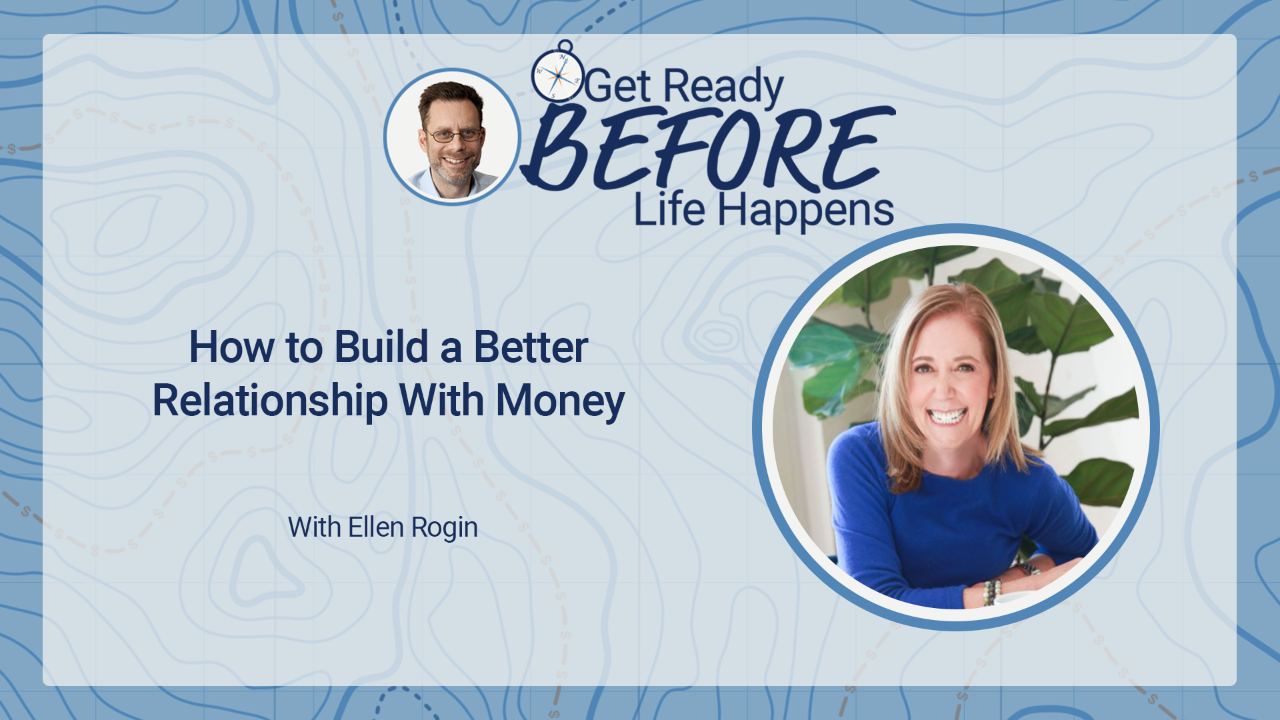
Your relationship with money shapes how you think, feel, give, and make decisions.
Ellen Rogin, CPA, CFP®, Author, Speaker and consultant joined me on Get Ready Before Life Happens to talk about building a healthier, more intentional relationship with money. Ellen shares how money beliefs are formed, why early money memories matter, and how generosity, visualization, and self-awareness can create more confidence and possibility.
Key Takeaways
- Your relationship with money influences every financial decision.
- Early money memories can shape beliefs that guide your choices.
- A belief can be examined, questioned, and updated.
- Confidence grows when people understand their money story.
- Generosity can support happiness, purpose, and prosperity.
- Visualization helps people connect money with meaningful goals.
- Advisors can create calm by listening beyond the numbers.
Tony’s Take: Money is personal before it is technical. The numbers matter, but they rarely tell the whole story. Our beliefs, memories, fears, hopes, and habits shape how we make decisions.
🎥 Watch this episode below:
🎧 Listen to the podcast below or on your favorite podcast app.
Connect with Ellen Rogin, CPA, CFP
- LinkedIn: https://www.linkedin.com/in/ellenrogin/
- Website: https://www.ellenrogin.com
- YouTube: https://www.youtube.com/@EllenRogin
Books:
- Messages from Money: How to Stress Less, Prosper More, and Reshape Your Relationship with Money by Ellen Rogin (Amazon)
- Picture Your Prosperity: Smart Money Moves to Turn Your Vision into Reality by Ellen Rogin and Lisa Kueng (Amazon)
Bio:
Ellen Rogin, CPA, CFP®, is a money expert, intuitive, and New York Times best-selling author of Picture Your Prosperity and the Amazon best-seller Messages from Money: How to Stress Less, Prosper More, and Reshape Your Relationship with Money. A former financial advisor, Ellen combines deep financial and business expertise with a strong intuitive ability that helps people see their financial lives, opportunities, and next stage of success with a deeper level of clarity.
Ellen works with successful individuals and organizations who sense there is more available to them and want to see money, opportunities, and what’s next from a deeper perspective, revealing new possibilities and a more aligned path forward.
Ellen is a sought-after speaker, consultant, and TEDx presenter whose work has been featured in The New York Times, Money, Time.com, and Forbes.com.
👉 Start Your Financial Readiness Plan: A free, practical plan that helps you create your in-case-of-emergency Financial First Aid Kit, organize what matters, and prepare before life happens. Start Your Free Financial Readiness Plan https://www.tonysteuer.com
👉 Support Get Ready. Become a Get Ready Insider and help keep the Financial Readiness Plan free, support the podcast, trusted resources, and consumer-first financial education. You’ll receive access to the Get Ready Library. Support Get Ready here. www.tonysteuer.com/support
Transcript
Tony Steuer:
What if your relationship with money begins with how you show up for yourself?
Welcome to Get Ready: Before Life Happens. I’m your host, Tony Steuer.
Today, I’m joined by Ellen Rogin.
Ellen, welcome to Get Ready: Before Life Happens.
Ellen Rogin:
I’m so excited to be here with you, Tony. Thank you.
Tony:
I’m excited to have you. You’re doing so many interesting things, and I really love your approach.
Let’s start here. What inspired you to focus on people’s relationship with money?
Ellen:
I was a financial advisor for more than 25 years, and what I saw over and over was that people’s contentment and happiness weren’t directly related to how much money they had.
Even when they were on track for their goals, there was something happening internally that had a big impact beyond their net worth statement or budget.
I became fascinated with how we are around money, how we make decisions, and how we relate to it.
Tony:
I think that’s such a big part of this.
We get so engrossed in the numbers that we don’t always stop and ask, “How does money make me feel?”
Where does that come in for you?
Ellen:
I completely agree.
People tend to focus on the tactical side of money, whether in business or their personal finances.
Of course that’s important. You need to understand how money works, have a good handle on it, and care for it.
I think of our relationship with money as the roots of a tree.
What’s happening under the surface impacts everything happening above the surface, yet we often don’t spend much time looking at it.
If the roots are focused on scarcity or fear, even if the tree looks good above the surface, that doesn’t necessarily mean you’ll be happy, have healthy relationships, or ultimately use your money in ways that feel meaningful.
Those roots impact every decision you make, every opportunity you see or don’t see, and every risk you take.
Much of it goes unexamined.
Tony:
How can people start thinking about that?
What do you recommend to people, or to advisors, to help them begin?
Ellen:
One of my favorite things is to encourage people to look at their relationship with money as if it were a personal relationship, even a romantic relationship.
Most people tend to think about what money can do for them.
In any relationship, though, we also have to look at how we’re showing up.
We personify money in our language all the time.
“Don’t outlive your money.”
“Make your money work hard for you.”
So if you thought about your relationship with money the same way you might think about a romantic relationship, what kind of partner are you?
Are you caring and loving?
Are you jealous?
Are you constantly looking at how money is showing up for other people and wondering why it isn’t showing up the same way for you?
I was giving a workshop to a group of women business leaders in Chicago, and one woman said she had a promiscuous relationship with money.
She was looking for a hookup.
She wanted money there when she wanted it, and otherwise she didn’t pay much attention to it.
Tony:
That’s a fascinating way to think about it.
I’m not even sure what my personal relationship with money is. I’d have to give that some thought.
How do you encourage people to go deeper and understand how they’re actually showing up for money?
Ellen:
Part of going deeper is looking at what we think, say, and believe about money.
That’s fundamental to our relationship with it.
Our attitudes and beliefs about money start much earlier than most people realize.
A good place to begin is to ask:
What’s your earliest money memory?
What was money like in your house growing up?
When I started as a financial advisor, I became fascinated by this.
I realized I had been operating out of what I saw in my own home.
We were financially fortunate in some ways. My mom was able to stay home with me when I was little, and my dad went to work.
That was the model I saw.
Mom stayed home.
Dad went to work.
When I started my own firm at about 28, I realized I had this unexamined subconscious belief that it was my husband’s job to make money.
And underneath that was another belief: maybe I couldn’t do it.
That made no sense.
Just because we believe something doesn’t mean it’s true.
At 28, I had my MBA, CPA, and CFP.
None of that belief was grounded in reality.
I’m so grateful I examined it, because if I hadn’t, I might not have built the successful financial advisory practice that I eventually sold.
That’s what happens.
These unexamined beliefs play in the background until we bring them into the light.
Tony:
That really resonates.
My grandfather went broke during the Great Depression.
He owned a couple of laundromats and lost them.
I grew up hearing that story, so I’ve always carried some fear that something dramatic could happen and everything could disappear.
That’s one of those background stories.
I also think what you said about women is really important.
There are still many women who feel they aren’t competent with money or that money somehow isn’t for them.
What would you say to women who feel that way?
Ellen:
First, notice that you’re saying it.
If you were in a personal relationship and said, “This just isn’t for me,” that would tell you something.
Money has bad PR with a lot of women based on how they were raised and the messages they received.
So notice what you believe and ask whether that belief is actually helpful.
When I had my advisory practice, about 70% of my clients were women.
I remember women coming in and saying, “I just don’t have a head for money.”
That often wasn’t true at all.
They were capable.
Maybe they needed to learn a little more.
That’s different from being incapable.
Again, just because you believe something doesn’t mean it’s true.
Tony:
That’s especially important today.
We have more women solo aging, gray divorce is increasing, and women tend to live longer.
Even if you’re married, there’s a good chance you may eventually be managing money on your own.
Women are also going to control a significant share of wealth in the years ahead.
Ellen:
And that’s a beautiful opportunity.
As more women control wealth, it becomes even more important to change both mindset and education around money.
There’s also an opportunity to change the world with that money.
Women often use financial resources to support their families and communities.
As that wealth transfer happens, the more women who feel confident and powerful around money, the more impact they can have.
Instead of always asking, “Am I going to be okay?” they may be able to ask, “How much can I give?”
For financial advisors, whether you’re a man or a woman, this is an opportunity to support clients in feeling competent and successful around money.
Sometimes it’s about holding space for them to feel better about their situation and helping them recognize what they’re already capable of doing.
Tony:
You bring up something really important.
I recently completed an Impact Philanthropic Advisor certificate, and one of the themes was the changing face of philanthropy and how women often approach giving differently.
You can see that with MacKenzie Scott and the way she gives.
She often supports smaller nonprofits with transformational gifts and very little fanfare.
She’s not necessarily looking for a building with her name on it.
She’s simply putting resources where they can help.
Ellen:
She’s incredibly inspiring.
And for the many people listening who don’t have MacKenzie Scott-level wealth, nonprofits still rely on small donors.
From a money mindset perspective, generosity can also be a beautiful way to loosen our grip on money.
People worry about money so much.
When you’re generous with your financial resources, within what you can comfortably afford, it can reduce stress and increase happiness.
It can make a difference in the world and in how you feel about your own money.
Tony:
I love that.
And there are many ways to support nonprofits beyond money.
There’s time, talent, and treasure.
If you’re an HR professional, a nonprofit may need help with governance.
If you’re an investment professional, a small nonprofit may need financial guidance.
A lot of small nonprofits don’t have a CFO.
You may be able to make a meaningful contribution as a treasurer or board member.
If there’s an organization that has helped you, your family, or your community, there are many ways to amplify that work.
Sorry, a little commercial for nonprofits there.
Ellen:
I love it.
And I want to add something for people who own businesses.
What goes around comes around, and not necessarily from the same person.
When you’re out there doing good in the community, you’re showing up as someone people trust and respect.
When I was growing my practice, that often led to referrals.
I wasn’t doing philanthropic work to get referrals.
It just happened naturally because people saw how I was showing up.
I like to say:
Generosity precedes prosperity.
People often say, “I’ll give back once I have enough.”
I actually don’t love the phrase “give back.”
I prefer “give forward.”
It helps us grow our own prosperity, and prosperity is about more than money.
It’s also about feeling successful and thriving.
Tony:
That’s great.
And for small nonprofits, even a $100 annual donation can matter.
If a nonprofit has a modest annual budget, a number of small gifts add up quickly.
The same goes for an hour a week of volunteer time.
You can make a difference even if you don’t have large amounts of money.
Ellen:
Absolutely.
And can I bring this back to the broader conversation about money mindset?
Tony:
Please.
Ellen:
There’s a very small nonprofit I’ve worked with on the East Coast that supports people with mental illness.
I’ve done a couple of Zoom sessions for them around money mindset.
After the first session, the person running the nonprofit told me that they unexpectedly received several donations afterward.
More recently, we did another session and talked about visualization.
As a group, we envisioned money coming into the nonprofit to help them fund a new employee.
The following week, the organizer texted me and said they received a surprise $5,000 gift from a foundation, and the donor was planning to give another $10,000.
That led me to become interested in group visualization and the research around shared vision in organizations.
There’s evidence that when groups have a clear vision they’re collectively focused on, people are more likely to step up and work toward achieving it.
Tony:
That makes sense.
There’s something powerful about getting people aligned around the same goal.
For nonprofits especially, leaders can be moving so quickly that they don’t always take time for longer-term planning and vision.
Getting donors, volunteers, and staff on the same page can be really important.
Ellen:
Exactly.
And that connects directly to money mindset.
We tend to think about money in two broad categories:
scarcity thinking and abundance thinking.
Scarcity thinking is fear-based.
It’s competitive.
For me to win, you have to lose.
There’s only so much to go around.
Abundance thinking is more generous and collaborative.
It recognizes that there may be more possibilities than we first see.
For a nonprofit operating on a shoestring, or even for someone personally who feels stretched, if all the focus is on “there isn’t enough,” that shapes what they notice.
The same is true for businesses.
What are you focusing on?
Lack?
Competition?
Or possibility?
Tony:
So bringing that back to financial advisors, how can they work with clients who come in with a scarcity mindset?
Ellen:
The first step is simply noticing it.
It’s easy for advisors to focus on the tactical part:
Is the portfolio performing?
Is the asset allocation appropriate?
Do they have enough protection?
All of that is important.
At the same time, listen carefully to how your clients talk about money.
Are they expressing constant worry?
Are they focused mainly on what could go wrong?
Are they able to see opportunities?
There are ways to shift the conversation so that clients feel calmer and clearer, assuming the facts support that.
And if they’re not on track, there can still be hope.
I think advisors have an opportunity to help clients feel as calm and clear as possible.
When clients feel better, they can make better decisions.
They’re also more likely to hear the advice.
And from a business standpoint, when people feel better about themselves after spending time with you, they tell other people.
That helps the client and the advisor.
Tony:
This feels especially timely with AI.
We’re all asking what the role of the advisor, advocate, or educator will be in an AI-driven world.
That human conversation and the confidence you help create may become even more important.
Do you see it the same way?
Ellen:
Absolutely.
And I think it was always important.
It’s just easy to get overly focused on the tactical side.
When I think back to my own practice, clients referred people to me because they felt better about where they were.
Some of that was because of the financial plan.
I used to think it was mainly because I showed them projections demonstrating that they were going to be okay.
Looking back, that was only part of it.
That helped their analytical brain.
What helped their nervous system was that I was calm and I conveyed confidence.
They left feeling better than when they came in.
Tony:
That makes me think of the saying that people may not remember exactly what you said, but they remember how you made them feel.
Ellen:
Exactly.
And that’s still underrated in financial advice.
I work with a lot of advisors on growing their businesses.
We talk about mindset because the psychological side of advice is receiving more attention, yet there’s still room to think much more intentionally about what advisors can do so clients actually feel better about their situation.
A lot of advisors may assume they’re already very good at that.
Maybe they are.
And they may be able to get even better.
Tony:
I love that.
It also reminds me of my wilderness first-response training.
It wasn’t just about tactical knowledge.
A huge part of it was helping someone calm down.
Sometimes you’d even match their breathing and gradually slow your own breathing so they would slow down with you.
You had to project calm and confidence.
If you arrived at a scene panicked, you could make the whole situation worse.
Ellen:
That’s a beautiful metaphor.
It starts with you being calm.
You couldn’t be saying, “You’re going to be fine,” while you were visibly panicking.
Your breathing had to be slow.
You had to see the bigger picture.
You had to feel enough conviction that you could help, even if you didn’t know exactly how everything would unfold.
Tony:
Exactly.
And another principle in first response is:
Don’t become another victim.
Before jumping into an emergency, you have to survey the scene.
That applies in a lot of places.
Whether you’re dealing with a client, speaking to a group, or walking into any difficult situation, take a few seconds to understand what’s happening before rushing in.
You can always make a situation worse by jumping in too quickly.
Ellen:
I love that.
And for an advisor or someone educating people about money, it also starts with their own money mindset.
It’s easy to think, “I help other people with their money.”
And it’s important to explore your own relationship with money too.
That allows you to show up more effectively for the people you’re meant to serve.
Tony:
Exactly.
Your own relationship with money affects how you work with clients whether you realize it or not.
So as we start to wrap up, what are three things people should know about creating a healthier relationship with money?
Ellen:
First, recognize that you actually have a relationship with money and that it deserves attention.
Ask yourself:
How am I showing up for money?
What do I expect money to do for me?
Could that relationship be better?
Second, talk about money.
One thing I find over and over is that financial advisors often don’t realize how nervous people are when they walk into their offices.
Many people are uncomfortable talking about money even though they know those conversations are important.
So ask:
How well do you talk about money with your partner?
With your kids?
With the people in your life?
Start with yourself.
And third:
Generosity precedes prosperity.
If you can loosen your grip on money and give some away, especially when fear is showing up, it can shift your relationship with money very quickly.
Tony:
I think that point about talking about money is so important.
Even people who work in finance can be reluctant to talk about certain areas.
My specialty was insurance, and a lot of financial planners don’t like talking about insurance for all kinds of reasons.
Some of those reasons are understandable.
We still have to have those conversations.
The more we bring something into the open, the less power the fear can have.
Ellen:
Absolutely.
Tony:
Ellen, to wrap up, I have the Get Ready Hot Take Trio.
Three quick questions I ask all my guests.
What’s one money myth you’d like to break?
Ellen:
That it’s all about the money.
People think, “If I just had a little bit more, everything would be okay.”
Advisors know that people can have enormous wealth and still worry that it’s going to disappear.
The more important work is examining your relationship with money.
That can help you create both the emotional and material results you’re looking for.
Tony:
Exactly.
You can meet people who have more money than they could realistically spend and they still fear running out.
Let’s get out the time machine for a minute.
What advice would you give your younger self knowing what you know now about money and your relationship with it?
Ellen:
I would tell my younger self to listen more closely.
I was always very intuitive around people’s money.
I could often meet with a client and have a strong sense of whether they were going to be okay.
I used to think it was because I listened differently.
And that was part of it.
I listened to how they talked about money.
Over time, I came to recognize that we all have more intuitive abilities than we often realize, especially people in finance who are trained to rely heavily on their thinking brain.
If we listen more with our hearts, whether that’s to the messages coming from clients or to our own intuition, we can serve people more effectively.
Tony:
That also speaks to how much communication happens beyond the words themselves.
A lot is happening nonverbally.
So Ellen, to close, what’s your number-one tip to help people change the way they think about money?
Ellen:
Notice when you’re worrying about money.
Notice when you’re in scarcity.
I think of scarcity as swimming against the current.
It makes everything harder.
Sometimes worry feels completely natural.
The world can be difficult.
And our ability to move from scarcity thinking toward abundance thinking is crucial.
That means noticing how you’re feeling about money and recognizing when fear is driving the conversation.
Tony:
I love that.
Sometimes the situation is genuinely difficult.
If you’re struggling to pay rent, that’s a very real concern.
And often, when things aren’t quite that dire, slowing down and separating what you’re feeling from the actual facts can help you move forward.
Ellen:
Exactly.
And there’s research showing that when people are under severe financial pressure, cognitive bandwidth can be affected.
That’s why this isn’t just about feeling better.
When you’re deep in scarcity, it can become harder to make good decisions.
And that mindset is contagious.
If you’re an advisor, a parent, a business owner, or a team leader, what you bring into the room affects the people around you.
Tony:
Ellen, where can people learn more about you, your work, and your books, Messages From Money and Picture Your Prosperity?
Ellen:
I spend a lot of time on LinkedIn. You can find me there as Ellen Rogin, R-O-G-I-N.
You can also visit EllenRogin.com to learn more about my speaking, coaching, books, and other resources.
I also have Money Talks cards, which are conversation starters designed to help people go deeper in their money conversations.
Tony:
Fantastic.
For everybody watching and listening, links to Ellen’s website, social profiles, books, and resources will be in the show notes.
Ellen, thanks for joining us on Get Ready: Before Life Happens.
Ellen:
I’m honored to have been here with you and your audience.
I love the work you’re doing in the world, Tony.
Tony:
Thank you. I appreciate that.
And I appreciate what you’re doing too.
Thank you, everyone, for tuning in to this episode of Get Ready: Before Life Happens.
If something today changed the way you think about your relationship with money, please share the episode and subscribe.
Because when life happens, the way you think about money matters.