
How to Build the Retirement That’s Right for You
Oct 09, 2026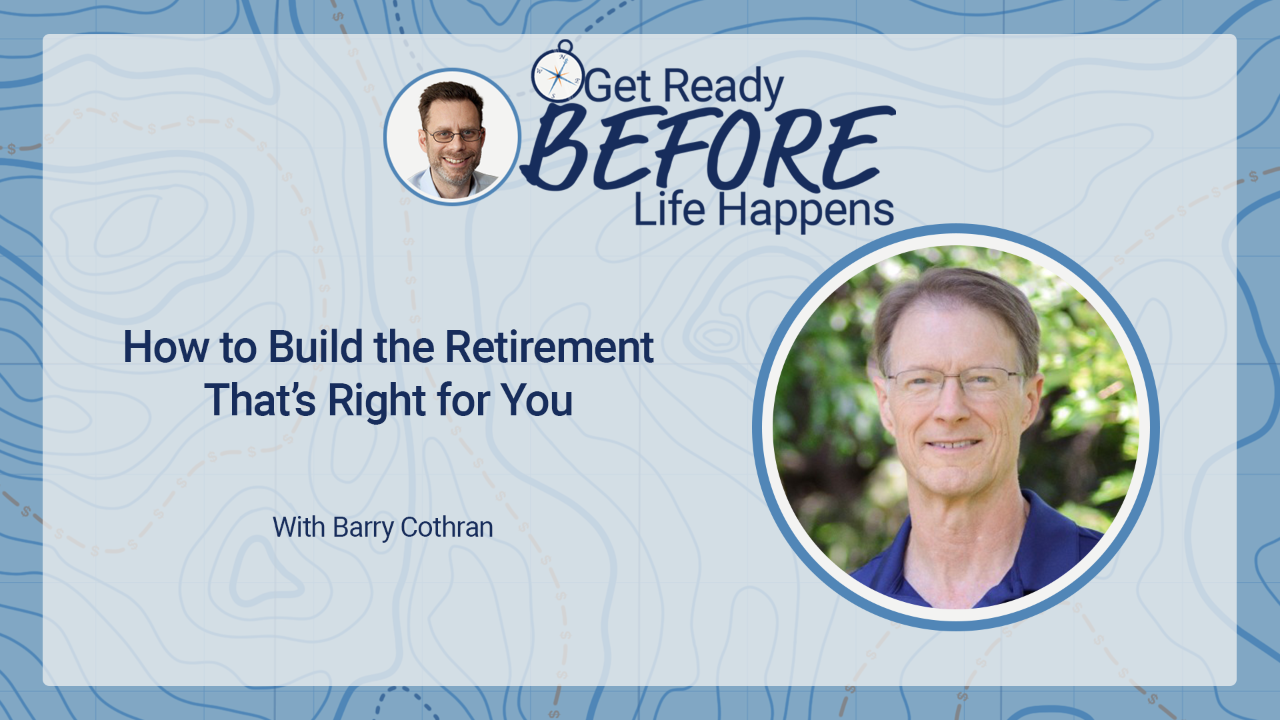
How can a clear view of your money help you build the future you want?
Barry Cothran joined me on Get Ready Before Life Happens to talk about why many people have a visibility problem rather than an income problem when thinking about retirement and how a written financial plan can replace uncertainty with knowledge and hope.
Key takeaways
🔹 Start by understanding where your money goes.
🔹 Define the retirement lifestyle that matters to you.
🔹 Calculate your own retirement number instead of chasing someone else’s.
🔹 Small steps, such as automatically increasing savings by 1% each year can make a meaningful difference.
🔹 A budget gives you permission to spend on what matters
🔹 It is never too late to begin saving and investing
Tony’s Take: A financial plan should help you see what is possible. When you understand where you are, what matters to you, and what your future may require, you can make informed decisions without measuring your life against someone else’s number.
🎥 Watch this episode below:
🎧 Listen to the podcast below or on your favorite podcast app.
Connect with Barry Cothran:
- Vision and Hope Planner Website: www.visionandhopellc.com
- LinkedIn: https://www.linkedin.com/in/barrycothran/
- Facebook: https://www.facebook.com/visionandhopefinancial/
- Instagram:https://www.instagram.com/visionandhopefinancial/
- YouTube: https://www.youtube.com/@VisionandHopeFinancial
Bio:
Barry Cothran is a financial educator and entrepreneur who helps individuals and families gain clarity and control over their financial future. As the founder of Vision and Hope® Financial, he developed a practical personal financial planning system built in Microsoft Excel that transforms complex financial decisions into clear, actionable insight.
Barry’s perspective is grounded in real experience. He went from $85K in debt to building a seven-figure portfolio through disciplined saving and investing in a 401(k) plan. Today, he teaches others how to replace confusion with confidence and build a financial plan they can follow.
For almost two decades, Barry has served as a trusted business analyst and consultant to the United States Department of War working with numerous companies on more than half-a billion dollars in government-funded programs. Corporate executives around the world have called on his keen business insight for business strategy and growth ideas.
👉 Start Your Financial Readiness Plan: A free, practical plan that helps you create your in-case-of-emergency Financial First Aid Kit, organize what matters, and prepare before life happens. Start Your Free Financial Readiness Plan https://www.tonysteuer.com
👉 Support Get Ready. Become a Get Ready Insider and help keep the Financial Readiness Plan free, support the podcast, trusted resources, and consumer-first financial education. You’ll receive access to the Get Ready Library. Support Get Ready here. www.tonysteuer.com/support
Transcript
Tony Steuer:
Feeling behind with money? You can always build a plan that works.
Welcome to Get Ready: Before Life Happens. I’m your host, Tony Steuer.
Today, I’m joined by Barry Cothran.
Barry, welcome to Get Ready: Before Life Happens.
Barry Cothran:
Glad to be here, Tony.
Tony:
I’m glad to have you here and excited to share the Vision and Hope Financial Planner and the work you’re building.
Let’s start at the beginning.
What led you to create the software?
Barry:
It started about five and a half years ago.
It was a cold day in January, and my wife came home from work and asked:
“Can I retire?”
I said:
“No.”
She was 59 at the time, and that was definitely not the answer she wanted to hear.
But it sent me on a journey because I realized I didn’t actually know.
I knew what we had in our 401(k) and her 403(b), but that was about it.
And I knew the totals were nowhere near what I thought we needed for retirement.
So for the next several months, I did a deep dive into retirement planning.
I watched hundreds of videos.
I read books.
I went to seminars.
I learned everything I could.
Then I sat down and started creating a spreadsheet.
Originally, it was simply going to help me understand our numbers.
Then I started adding charts and graphs.
I added Social Security.
I added pensions.
I added taxes.
After a couple of months, I had it in pretty good shape.
I called my wife over to the computer, pointed to the screen, and said:
“Yeah. You can retire.”
We had no idea we were doing as well as we were.
Before that, I simply didn’t understand all the pieces that go into the retirement puzzle.
Social Security.
Pensions.
Taxes.
Required minimum distributions.
Once I had everything pulled together, it gave us a level of knowledge and clarity we had never had before.
Tony, it changed our lives.
It changed us individually.
It changed us as a married couple.
It freed us up to live.
I started sharing the software with family and friends and realized it was making a difference for them too.
So I decided to go all in.
I spent the next three and a half years writing code and making it usable by almost anyone.
Since then, we’ve launched the website.
We sell the planner online.
I’ve also given it to pro bono advisors and to people affected by a California fire.
And we’re seeing it help people.
That’s what I hoped it would do.
Tony:
Is that where the name Vision and Hope came from?
Barry:
It is.
I wanted people to have a vision of their future.
And hopefully, that vision gives them hope that the future can be good.
A lot of people feel behind financially.
And much of that comes from not understanding all the pieces that go into retirement.
Tony:
Was there one moment that made you think this could really help other people?
Barry:
There were several.
I sat down with a woman around age 60 who thought she was going to have to work until 70 or later.
We put her numbers into the planner.
She literally cried because she realized she was better off than she thought.
I worked with a man who had a military retirement pension.
He was saving money but had no idea how he was doing.
Once we put all the numbers together, it opened his eyes.
Those were the kinds of moments that made me think:
“Maybe this really can help more people.”
Tony:
That’s fantastic.
One of the things I talk about a lot is seeing all the pieces of your financial puzzle.
Many people don’t even know what all the pieces are, much less how they fit together.
Retirement is especially complicated.
You have required minimum distributions.
Some people have pensions.
Others have 401(k)s and IRAs.
The list goes on.
A lot of people also say:
“I’m behind.”
How do you help someone shift from that feeling to:
“I can still move forward”?
Barry:
It’s easy to understand why people feel behind.
I think there are three primary reasons.
First, they don’t know where they are.
Second, they don’t know where they’re headed.
Third, they don’t know how much they actually need.
Let’s start with where they are.
Many people don’t necessarily have an income problem.
They have a visibility problem.
And I know there are people listening who will say:
“Barry, I absolutely have an income problem.”
And some people do.
But I’ve seen research showing that people can feel financially stretched across a wide range of income levels.
I saw one study that said a significant percentage of people earning six figures were still living paycheck to paycheck.
That’s a different struggle than someone making $40,000 or $50,000, but it’s still a financial struggle.
For many people, the issue is that they don’t know where their money is going.
Over and over, I’ve met people who simply can’t tell me where they spend their money.
They don’t track it.
And that includes people who are already retired.
If you don’t know where your money is going, it’s hard to know where it’s taking you.
That’s the first problem.
The second is that many people don’t have a financial plan.
They’re just winging it.
And Tony, that was me until about five years ago.
I was saving.
I was doing some good things.
But I couldn’t have told you what our future looked like.
We didn’t have a plan.
Then there’s the third issue.
People see surveys or social media posts saying:
“You need $1.26 million to retire.”
That’s a real number I’ve seen from a survey.
People hear that and think:
“I’m nowhere near that.”
“I’m behind.”
“Is it hopeless?”
They’re being influenced by surveys.
They’re being influenced by other people.
They’re being influenced by social media.
You see people living their “best life.”
Maybe they’re standing in front of a Lamborghini they don’t own or a house they don’t live in.
But we still compare ourselves.
The problem is that people don’t necessarily need a million dollars to have a good retirement.
What they need to know is:
How much do I need to support the lifestyle I want?
That number should be based on your income, your spending, your Social Security, your pensions, your savings, and your goals.
You have to stop following the generic number and start understanding your own number.
Tony:
That’s some of the best financial advice people can hear.
You have to think about your own goals and the lifestyle you want.
Social media makes that harder because people are usually posting their best moments.
They show the once-a-year vacation.
They don’t show the other 51 weekends when they’re sitting at home watching TV.
My wife and I recently took an Alaska cruise.
Of course I posted a few photos for friends and family.
Most of us aren’t trying to make anyone feel bad.
We’re simply sharing our lives.
But someone else can see that and think:
“I don’t have that.”
“I’m falling behind.”
Barry:
Exactly.
When you and I were growing up, we didn’t have social media.
Our “social media” was the neighborhood.
Most people compared themselves with people in similar circumstances.
I grew up in Georgia.
Maybe the next-door neighbor went to Florida for a week.
Maybe my family did too.
We were usually comparing ourselves with people who lived somewhat similar lives.
Now we compare ourselves with almost anyone, anywhere.
And sometimes what we’re seeing isn’t even real.
Tony:
And AI can make that even harder because now an image can be made to look even better than reality.
So let’s talk about the Vision and Hope Financial Planner.
There are several planning tools available.
What makes yours different?
Barry:
There are some excellent personal financial planning platforms out there.
I’ve had the privilege of meeting the CEOs of a couple of those companies.
Great people.
Great products.
Different tools are designed for different users.
Some software is very complex and designed for professional advisors.
I’m focused more on the do-it-yourself individual.
Someone using it at home on their own computer.
Some platforms are cloud-based.
You enter account information, logins, passwords, and investment information.
Some people really like that kind of day-to-day integration.
The Vision and Hope Financial Planner is designed to be:
Simple.
Comprehensive.
Affordable.
Familiar.
It’s simple because it’s essentially fill-in-the-blank.
The formulas are built in.
You enter the information you already have.
Now, one thing is still essential:
You need to know where your money is going.
You can’t build a good financial plan without understanding your spending.
That may be the hardest part for some people.
They may need to track their expenses for a month or two before they begin.
But once you have that information, the planner is straightforward.
It’s comprehensive because it includes retirement savings accounts, pensions, IRAs, brokerage accounts, federal taxes, state taxes, Social Security, Roth contributions, and Roth conversions.
There are more than 20 charts and graphs.
It also provides what I call a dynamic narrative.
Some people prefer to see charts.
Other people want the answers written in sentences.
You can change the assumptions, and the narrative changes with them.
It’s affordable.
And I call it familiar because it’s built in Microsoft Excel.
You download it to your own computer.
Your information stays with you rather than residing in the cloud.
Tony:
I’ve played with it, and it’s easy to use.
I’ve even imported it into Apple Numbers.
A few things didn’t translate perfectly because it’s built for Excel, but overall it’s a very useful platform.
And the local-versus-cloud question is worth considering.
Some people are comfortable connecting accounts to online platforms.
Others prefer to keep their financial information on their own computer.
Neither approach is necessarily right or wrong.
It’s something to think about.
Does the planner also help people understand where retirement income comes from?
For example, how it pulls from different accounts?
Barry:
Yes.
The planner allows someone to enter up to six retirement savings accounts.
That could include a 401(k), 403(b), brokerage account, Roth account, and so on.
You enter your current expenses.
Then the planner projects those expenses forward using assumptions about inflation.
It looks at Social Security for you and your spouse.
It looks at pensions.
Then it compares your income with your projected expenses.
If there’s a gap, the software begins drawing from retirement accounts based on the rules built into the program.
It also factors in required minimum distributions when those apply.
So the goal is to show how the pieces work together over time.
Tony:
That’s great.
And for people watching and listening, RMD stands for required minimum distribution.
Let’s talk about people who are starting later.
It would be great if everyone started at 21, but that’s not reality.
Many people don’t get serious about retirement until their 30s or 40s.
What should they know?
Barry:
That’s a great question because I started later myself.
I was married.
We were mostly a single-income family.
We had three kids.
I was in what people call the messy middle.
Retirement felt 30 years away.
I didn’t start investing until I was 36.
I wasn’t raised in a family that talked about investing.
My parents didn’t start saving for retirement until they were in their 50s.
I knew almost nothing about investing.
The reason I finally started was that I changed companies.
I went through an HR onboarding session.
Someone talked about the company retirement plan.
And I thought:
“Maybe I should do something.”
So I talked with my wife and decided to contribute enough to get the company match.
That was it.
I did that for several years.
I didn’t increase it.
I didn’t think much about it.
Then eight years later, I changed companies again.
Now I was 44.
I signed up for the new 401(k) and again contributed enough to receive the company match.
But this time I checked one small box.
It said:
Automatic 1% annual increase.
Every year, my contribution would go up by one percentage point.
And I left that box checked for 17 years.
During that time, we were still raising kids.
We were still largely a single-income household.
But year after year, the contribution increased.
Eventually I was saving in the double digits.
There were times my wife and I talked about stopping the automatic increase.
But we didn’t.
We adjusted.
We lived on a little less.
That one decision made a tremendous difference.
So the first thing I would tell someone starting later is:
It’s never too late to start.
I started at 36.
Even if all you can do is contribute enough to get a company match, that can matter over time.
The second thing is:
Investing is for everybody.
It isn’t only for wealthy people.
If you don’t have a company retirement plan, you may still be able to use an IRA.
There was a time when I didn’t even understand what an IRA was.
It intimidated me.
But it’s something people can learn.
And the third thing is:
A financial plan gives you permission to live.
People hear “budget” or “financial plan” and think:
“Now I won’t be able to do anything fun.”
I think it’s the opposite.
A plan lets you see where your money is going.
It shows where you’re headed.
Then you can make informed choices.
Maybe you decide:
“We’ll do less of this so we can do more of that.”
So:
It’s never too late to start.
Investing is for everyone.
And a plan gives you permission to live.
Tony:
I especially like the automatic 1% increase.
It’s small.
And after a few years, yes, you’ll notice it.
But the most important piece is that it happened automatically.
For someone listening who thinks:
“I can’t save enough to make a difference,”
starting automatically can be powerful.
Barry:
Exactly.
And this is something I feel strongly about.
People sometimes think:
“If I can’t invest $500 or $1,000 a month, why bother?”
My answer is:
What can you do?
Maybe it’s $50.
Start there.
Build momentum.
Automate it.
Have it come out of your paycheck.
Let it go directly into a retirement account.
Do $50 for a few months.
Maybe later you increase it to $100.
Get used to investing.
Get used to seeing the habit build.
Then gradually increase it.
You don’t have to start with some huge number.
Start with what you can do and grow from there.
Tony:
That’s an excellent point.
And I wish I could take back my comment about $100 not being enough because Barry is right.
Start with whatever you can.
Something is better than nothing.
Then build from there.
Let time work for you.
So Barry, let’s wrap up with the Get Ready Hot Take Trio.
What’s one money myth you would like to break?
Barry:
That you need a million dollars to have a great retirement.
You don’t necessarily need that.
The important thing is to understand your own lifestyle and your own number.
If you live on $50,000, $60,000, or $70,000 a year, your financial plan should help you project what you need based on your life.
I’ve spoken to corporations, colleges, and high schools about this.
When we run the numbers for different income levels and occupations, many people discover their target may be very different from the generic numbers they see in surveys.
That’s why I want people to know their number.
I’ve actually written a book called Know Your Number that’s coming out later this year.
It talks about my own journey from debt to wealth and gives people practical steps for saving and understanding what they may need.
I just want people to stop assuming they need some arbitrary million-dollar number.
Tony:
That’s one thing that always gets me about retirement surveys.
People are often answering what they think they need rather than working from an actual personal calculation.
Barry:
Exactly.
And I don’t want people to think I always had this figured out.
When I was around 40, I built a simple spreadsheet that projected my savings into the future.
The projected number was well over a million dollars.
So that became my target.
But there was no real basis for it.
It didn’t include my pension.
It didn’t include Social Security.
It didn’t include changes in spending after retirement.
It was simply a number generated by a calculation.
A comprehensive plan brings all of those pieces together.
Tony:
Exactly.
Let’s get out the time machine.
If you could go back and talk to 25-year-old Barry, what advice would you give him about money?
Barry:
I’d say:
Start younger.
If you’re in your 20s today, start investing if you can.
But if you’re older than that, don’t give up hope.
You can still start.
You can still build a meaningful retirement nest egg.
My parents didn’t begin investing until their 50s.
They still saved enough to have a great retirement.
They loved cruises.
They cruised all over the world.
But they didn’t start until their 50s.
They just became aggressive savers once they started.
So I’d tell 25-year-old Barry:
Start early.
And get a written financial plan.
Don’t wait.
Use tools to understand your day-to-day finances, but also build a comprehensive plan that shows you where you’re headed.
Tony:
That’s great advice.
It’s like taking a road trip.
You have a destination.
You have a map.
Today we have GPS.
Most of us don’t just get in the car and start driving in a random direction.
Your financial life works the same way.
Know where you are.
Know where you want to go.
Then figure out how to get there.
So to close:
What’s your number-one tip to change the way we think about money?
Barry:
Stop chasing someone else’s number.
Wealth is personal.
It’s specific to your income.
Your lifestyle.
Your priorities.
Don’t measure your wealth against somebody else’s.
You are unique.
Your money matters.
Your future matters.
Focus on your own path instead of constantly comparing yourself with others.
Tony:
And someone else’s priorities may be completely different from yours.
Their priority may be travel.
Yours may be something else.
So keep your eye on your own game.
Barry:
Exactly.
We all think about wealth differently.
A lot of that comes from how we were raised.
If you grew up in scarcity, you may think about money through scarcity.
If you grew up around wealth, you may have a completely different relationship with it.
I came across a definition of wealth from Henry David Thoreau that I really like:
Wealth is the ability to fully embrace life.
I love that idea.
People can experience wealth at many different income levels when they’re able to fully embrace their lives.
Tony:
I love that.
That’s a great place to close.
Barry, where can people learn more about you and the Vision and Hope Financial Planner?
Barry:
You can find us at VisionAndHopeLLC.com.
We’re also on LinkedIn, Facebook, Instagram, X, TikTok, and YouTube.
I post most frequently on LinkedIn.
And on the Vision and Hope Financial YouTube channel, you can see videos showing the planner and how it works.
Tony:
Fantastic.
For everyone watching and listening, we’ll include those links in the show notes.
Barry, thanks for joining me on Get Ready: Before Life Happens.
Barry:
Thank you so much for the opportunity.
I loved it.
Tony:
And thank you, everyone, for tuning in to Get Ready: Before Life Happens.
If something today changed the way you think about retirement or financial planning, please share the episode and subscribe.
Start your free Financial Readiness Plan at tonysteuer.com. It is a practical way to begin building your in-case-of-emergency plan before life happens.
You can also help keep the Plan free and support this podcast by becoming a Get Ready Insider for $5 a month.
Because when life happens, the way you think about money matters.