
How Your Money Story Shapes Your Financial Decisions
Oct 15, 2026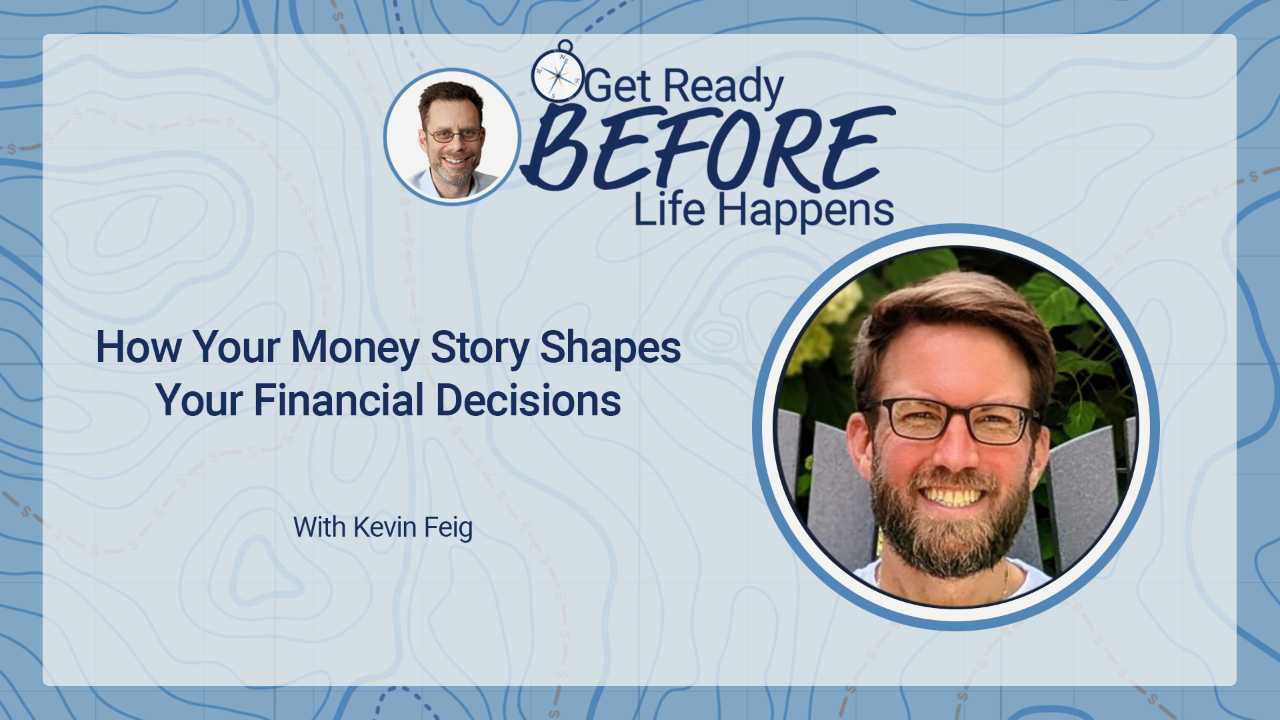
How does knowing your money story change the financial decisions you make?
Kevin Feig, founder of Walk You To Wealth, financial advisor, educator, and author of Walk You To Wealth joined me on the Get Ready Before Life Happens Podcast to talk about how to evaluate financial advice, why advisor compensation matters, and how childhood experiences influence financial decisions.
Key takeaways
- Understand how childhood experiences shape your money story and financial decisions.
- Combine financial knowledge with an understanding of how you think and behave around money.
- Know how a financial advisor gets paid and what their services will cost.
- Choose an advisor who fits your goals, needs, and communication style.
- Treat cryptocurrency as a specialized asset and understand it before investing.
- Recognize how urgency, stress, and promises of easy gains make people vulnerable to scams.
- Build financial literacy to ask better questions and make more informed decisions.
Bottom Line: Understanding your own money story can help you recognize the assumptions behind your financial decisions.
🎥 Watch this episode below:
🎧 Listen to the podcast below or on your favorite podcast app.
Connect with Kevin C. Feig, CFP®, CFT™, CPA, PFS:
- Website: https://www.walkyoutowealth.com
- LinkedIn: https://www.linkedin.com/in/kevin-c-feig/
- X: https://x.com/walkyoutowealth
- Youtube: https://www.youtube.com/@walkyoutowealth
Books:
- Walk You To Wealth (Amazon)
Bio:
Kevin C. Feig is dedicated to helping real people build real wealth. As the founder of Walk You To Wealth, a virtual financial advisory firm, he is committed to making financial planning accessible and affordable through flat-fee financial therapy and fiduciary services.
Kevin believes that everyone deserves a solid financial foundation, regardless of income or assets. His firm operates without asset minimums, focusing on a behavior-first approach to help individuals fix their relationship with money, conquer debt, and master essential skills like budgeting and saving.
With over 20 years of experience in the financial services industry, including executive roles at Fidelity Investments, Coinbase, and Kraken Digital Assets, Kevin brings a wealth of knowledge to his clients. He holds a Bachelor of Science in Accounting and an MBA from Fairfield University. Kevin is a Certified Financial Planner™ (CFP®), a Certified Financial Therapist™ (CFT™), and a Certified Public Accountant (CPA). Additionally, he shares his expertise as a financial planning instructor at Columbia & Regis Colleges.
Kevin's book, "Walk You To Wealth," presents his simple, authentic approach to personal finance, providing readers with a clear path to financial wellness. He resides in Massachusetts with his wife and two children. Learn more at https://www.walkyoutowealth.com/.
👉 Start Your Financial Readiness Plan: A free, practical plan that helps you create your in-case-of-emergency Financial First Aid Kit, organize what matters, and prepare before life happens. Start Your Free Financial Readiness Plan https://www.tonysteuer.com
👉 Support Get Ready. Become a Get Ready Insider and help keep the Financial Readiness Plan free, support the podcast, trusted resources, and consumer-first financial education. You’ll receive access to the Get Ready Library. Support Get Ready here. www.tonysteuer.com/support
Transcript
Tony Steuer:
Financial confidence grows when we better understand risk, slow down our important decisions, and rewrite the story shaping how we think about money.
Welcome to Get Ready: Before Life Happens. I’m your host, Tony Steuer.
Today, I’m joined by Kevin Feig.
Kevin, welcome to Get Ready: Before Life Happens.
Kevin Feig:
Thanks for having me, Tony. I appreciate it.
Tony:
Thanks for being here.
Let’s start with your origin story. How did your career lead you to focusing on money stories?
Kevin:
I started the bulk of my career in external audit and consulting.
Eventually, I interviewed at Fidelity Investments, one of the largest financial institutions in the U.S.
During the interview, I told them I knew nothing about financial services.
That was absolutely true.
I was in my twenties, and financial services always felt a little like the Wizard of Oz.
There was this curtain.
It seemed mysterious.
It wasn’t tangible in the way other products or services can be.
Despite that answer, Fidelity made me an offer.
I spent about 15 years there, mostly on the audit and risk side.
After Fidelity, I went to Coinbase and worked as head of risk.
Then I became head of risk at Kraken.
Along the way, I picked up more certifications than I probably needed.
One was the Certified Financial Planner designation.
I had always been interested in personal finance.
I didn’t know how or when I would use that interest.
I just wanted to learn.
Eventually, I figured out what I wanted to be when I grew up.
I took the leap, started my own business, and now I’m trying to help as many people as possible navigate the financial world. Pasted text
Tony:
Before we get to your book, I want to touch on crypto.
A lot of people are excited about it, while plenty of people still don’t really understand what it is.
Can you give us a quick overview?
Kevin:
Quick is hard with crypto.
There are an enormous number of cryptocurrencies.
A lot of them are frankly useless.
Then there are others with interesting use cases.
Take Ethereum.
I think of Ethereum almost like an app store.
It gives people a way to build applications and protocols on top of a shared system.
A big part of crypto is decentralization.
Bitcoin, in particular, came out of the 2008 financial crisis.
The idea was:
How do we send value back and forth without relying on the large financial institutions being bailed out at the time?
How do we create more autonomy?
How do we create a hard cap on supply?
I still think we’re in the early innings of crypto.
Most clients I talk with have heard of Bitcoin.
They’ve probably heard of Ethereum.
But that’s about as far as the knowledge goes.
So a lot of my role is education.
Tony:
And I think that’s one of the biggest issues.
People ask:
“Should I buy Bitcoin?”
Or:
“Should I invest in crypto?”
And the first question really should be:
“What are you trying to accomplish?”
Kevin:
Absolutely.
With Bitcoin, I often compare it to a collectible.
Think about baseball cards.
Or Beanie Babies.
There was a Princess Diana Beanie Baby.
I never collected them, but I remember the craze.
The thing that drives people toward Bitcoin is scarcity.
There will only ever be 21 million Bitcoin.
Now, scarcity by itself doesn’t create value.
If nobody wants your collectible, it doesn’t matter how rare it is.
But if there is global demand, and that demand includes individuals, institutions, and even governments, then 21 million units can feel very scarce.
That’s one of the big reasons people are drawn to it.
There are not many assets that are truly scarce.
Waterfront property is another example.
There is only so much of it.
That scarcity is part of the appeal.
Tony:
That’s interesting.
And the Beanie Baby example lands for me because my wife collected them.
Kevin:
There you go.
And you never know what the next craze will be.
Bitcoin is still a supply-and-demand market.
Its original idea was also about transacting without relying on large financial institutions.
And it introduced a hard cap on the total supply.
That scarcity idea is still central.
There’s a lot of noise in crypto.
Bitcoin is different from a lot of that noise.
Tony:
So one takeaway would be that not all crypto is equal.
Would you call crypto more of a specialized or alternative asset?
Kevin:
Yes.
I’d definitely call it an alternative or specialized asset.
And it’s no different from saying one stock is different from another stock.
Google and Netflix are both public companies.
They are still fundamentally different businesses.
The same applies in crypto.
There are a lot of meme coins and other assets that may not be worth your time.
So you need to understand what you’re buying and why it belongs in a portfolio.
That gets back to your earlier point:
What is the goal?
Tony:
Before we move on, can you define a meme coin?
Kevin:
There are probably a few definitions.
Broadly, a meme coin is an asset that gains attention through social media, memes, and online hype.
The stock-market parallel would be meme stocks.
GameStop is probably the most famous example.
Social media helped drive enormous price swings.
In crypto, this happens even more often because creating a new token is relatively easy.
Some of them catch fire.
Some people make a lot of money.
A lot of people lose money.
So you have to be careful.
Tony:
Thanks for breaking that down.
Let’s move to your book.
What inspired you to write Walk You to Wealth?
Kevin:
I wanted to figure out how to help people.
How do you take what you know and put it on paper in a way that’s useful?
I started writing and thought:
“That’s everything I know.”
It was maybe two pages.
Then I kept adding to it.
I wanted the book to be easy to read.
I also wanted it to be actionable.
Someone should be able to finish a chapter and have something they can actually do.
I wanted personal stories and examples.
I didn’t want a book full of dry financial terminology.
I hate jargon.
So the book became a way to provide financial literacy.
Eventually, the book became the foundation for my business.
I’m just trying to do something a little different and help as many people as I can.
Tony:
I relate to that.
I give a lot away for free because I want to promote financial literacy.
I also have a consumer-advocacy background, and I’ve seen some pretty bad things in the industry.
Sometimes people don’t know how to value something when it’s free.
Kevin:
Exactly.
People ask:
“What’s the catch?”
When I started my business, other advisors would ask why I wasn’t only working with ultra-high-net-worth clients.
Why not have a $5 million or $10 million minimum?
To me, that defeats the purpose.
I do have clients with millions of dollars.
But I don’t have asset minimums.
Everyone pays the same amount.
The whole point is accessibility.
Tony:
Let’s talk about how advisors get paid, because there are a lot of different models.
How does yours work?
Kevin:
There are a lot of different compensation structures.
The good news is that there are choices.
A big part of the decision is fit.
You want someone you can relate to and build a relationship with.
You also want to understand exactly how the advisor is compensated.
There are fee-only advisors and fee-based advisors.
Fee-only advisors are paid by clients.
Within that category, the fee can still be structured in different ways.
It might be based on assets.
It might be a flat fee.
It might be a retainer.
Fee-based advisors may receive fees from clients and also earn commissions from products or services they sell.
My model is fee-only and flat fee.
Clients pay a monthly fee.
There’s no long-term contract.
Everything is included.
We start with a broad financial plan.
We may talk about asset allocation, Social Security, life insurance, and other parts of someone’s financial life.
Investment management is also included.
I don’t charge a separate assets-under-management fee.
The important thing to me is transparency.
Clients know exactly what they are paying.
They receive an invoice.
Nothing is quietly being taken from an investment account.
And if they don’t feel they are getting value, they can cancel.
Tony:
And for people listening, AUM means assets under management.
Some advisors charge a percentage based on the amount of money they manage for you.
The important question is:
How is your advisor getting paid?
And how much are you paying?
Kevin:
Exactly.
When I talk with prospective clients, I usually tell them to focus on three things.
First, credentials.
I think a CFP designation is a strong baseline.
Second, understand compensation.
How much are you paying?
And how is that advisor getting paid?
Third, fit.
You should meet with more than one person.
Different advisors work differently.
My practice is me.
So I tell people:
“Good or bad, you get me.”
If that’s not the right fit, that’s okay.
Tony:
That’s very helpful.
Let’s turn to money stories.
Why is it important for people to understand and sometimes rewrite their money stories?
Kevin:
Money is central to our lives.
And a lot of our beliefs about money start in childhood.
Sometimes they come from major experiences later in life.
But much of it starts early.
We all develop money scripts or psychological profiles around money.
Some people see money as shameful.
Some see money as all-powerful.
“If I have enough, it will solve everything.”
Others see money as scarce.
“There’s only so much, so I need to hold on to every dollar.”
Those beliefs matter.
Understanding them as an individual is important.
Understanding them in a relationship is even more important.
A spouse or partner may think very differently about money.
Those differences help explain decisions people have made in the past.
And once you understand them, you can make different decisions going forward.
The psychological side of money doesn’t get enough attention.
The math matters.
But the math doesn’t help much if someone can’t actually implement the plan because of the way they feel about money. Pasted text
Tony:
I saw that in my years as a fee-based life insurance consultant.
Some people had an incredibly strong psychological attachment to old life insurance policies.
From a numbers standpoint, the policy might no longer make sense.
But it represented something bigger.
Safety.
Security.
Maybe family.
Those emotional connections are real.
Kevin:
Absolutely.
Another psychological wall I see is with people who already have enough money to retire.
They have won the game, so to speak.
They may not even like their jobs.
And they still cannot bring themselves to retire.
For 20 or 30 years, they have been savers and investors.
Then suddenly they are supposed to become spenders.
That is not a switch you flip overnight.
It can be incredibly hard.
There are people who have not saved enough.
There are also people who have saved more than they need and still cannot give themselves permission to spend.
You have to find the balance.
Money ultimately needs to be a tool.
The question is:
How do you want to use it? Pasted text
Tony:
What do you recommend for somebody trying to make that shift?
For me, one part of my money story comes from hearing about my grandfather going bankrupt during the Great Depression.
That stays with you.
Kevin:
That’s a perfect example.
When I work with clients, part of the onboarding process includes questions about money beliefs.
I want to understand the psychological baseline.
Then we build the financial plan.
The plan gives us the dollars-and-cents picture.
For some clients, seeing the plan is incredibly helpful.
They may be afraid of running out of money.
So we can model different scenarios.
We can show that even if they spend more, they still have a very strong probability of success.
That starts to loosen things up.
It doesn’t mean someone should suddenly double their spending.
It means they can begin to see that they have choices.
You combine the psychological side with the planning side.
Then you have someone to check in with when fears come up.
Sometimes my job is simply to tell a client:
“You can take the vacation.”
“You’re okay.”
It still takes time.
Changing financial habits and beliefs is a lot like changing any other part of your lifestyle.
It doesn’t happen overnight.
But having a plan and someone to walk alongside you can build confidence. Pasted text
Tony:
I had Barry Cothran on the podcast recently.
He made a similar point.
People sometimes assume they need a huge investment balance before they can retire.
They focus on one rule or one number and lose sight of everything else.
Kevin:
Exactly.
There are many parts to a retirement plan.
Some people still have pensions.
Social Security is part of the picture.
Then there are savings and investments.
So it’s never just one number.
Social media also makes the comparison problem worse.
Every client I’ve ever met thinks they’re behind.
And plenty of them are actually in very good shape.
Almost everyone wishes they had made some financial decision differently.
Almost everyone wishes they had more.
But there are a lot of people who do have enough.
Their challenge is giving themselves permission to use it.
Tony:
That’s going to be a challenge for me.
I think I’ll always have some fear of running out of money.
Kevin:
And that’s a real fear.
I have some clients who are much more comfortable spending.
They’ve decided:
“I’m okay.”
They travel.
They enjoy themselves.
They may not need every projection to show a perfect result.
There’s something healthy in that too.
The goal is finding the right balance.
And I think having someone independent can help.
A spouse or family member may share the same fears you do.
An advisor can sometimes provide a different perspective.
Tony:
Let’s talk about scams.
What makes people vulnerable to scams and manipulation?
Kevin:
A lot of things.
I spent a large part of my career in risk management.
I saw cases where people were taken advantage of in ways you wish you never saw.
Stress is a big factor.
When someone is under a lot of stress, they may move too quickly and make decisions they normally would not make.
Scammers also create artificial urgency.
I had a client who was contacted by someone claiming to be from his credit card company’s fraud department.
They told him the card had been compromised.
That immediately creates pressure.
You think:
“My account is in danger.”
So you may give away information you normally wouldn’t.
Sometimes greed or hope is part of it.
People want to believe there is a pot of gold.
Loneliness can be part of it too.
That shows up in romance scams.
Age can create vulnerabilities.
And sometimes it is as simple as clicking the wrong link.
There are a lot of different reasons.
One thing they have in common is that scammers know how to exploit emotion and timing. Pasted text
Tony:
The wanting-to-believe part is especially interesting.
I’ve seen that in litigation consulting and consumer-protection work.
It isn’t a character flaw.
It’s how our brains work.
Sometimes we want something to be true so badly that we stop noticing warning signs.
Kevin:
Exactly.
Maybe it’s the investment opportunity.
Maybe it’s the relationship.
Whatever it is, scammers prey on that.
Tony:
Let’s wrap up with the Get Ready Hot Take Trio.
What’s one myth about money or financial decision-making you would like to break?
Kevin:
I’m going to stick with scams because it’s on my mind.
The myth is:
Smart people don’t fall for scams.
That’s just not true.
I’ve seen a lot of shame from people who were scammed.
They say:
“I can’t believe I clicked that.”
Or:
“I can’t believe I believed them.”
Smart people fall for scams too.
I’ve seen extremely sophisticated scams.
I’ll give you an example.
I was the head of risk at Coinbase.
And I once received an email that appeared to be from Coinbase asking me to verify information related to my account.
It was so good that even I paused.
And identifying this kind of risk was literally part of my job.
I’ve also seen scams where criminals create a fake login page that looks exactly like a financial institution’s real site.
You enter your username and password.
Then the fake site redirects you to the real website.
From your perspective, everything looks normal.
Meanwhile, your credentials were already stolen.
That was happening years ago.
Think about how sophisticated scams can be now.
So no, being smart does not make you immune.
Tony:
That’s such an important point.
Anybody can be scammed.
The pause matters.
Curiosity matters.
Ask:
“Is this real?”
Wait a beat.
Think it through.
Ask another question.
Kevin:
Absolutely.
Some of these scams are very good.
That’s why they work.
Tony:
Let’s get out the time machine.
If you could go back knowing what you know now about money, what advice would you give your younger self?
Kevin:
Become financially literate as early as possible.
When I was 22, I bought a vacation property in another state while I was still living with my parents.
I was living in New York and couldn’t believe how inexpensive real estate looked elsewhere.
So I bought a golf condo in Myrtle Beach.
I don’t golf.
I really had no idea what I was doing.
My dad came with me when I was looking at places.
I remember him saying:
“A lot of people talk about doing something like this. Not many people have the courage to actually do it.”
Looking back, I think if I had known more about money, I would have taken more chances.
Not fewer.
Financial literacy doesn’t necessarily make you more cautious.
Once you understand the rules of the game, you feel more confident participating.
Whether it’s real estate, stocks, or crypto, the more you understand, the more comfortable you become taking appropriate risks.
So I wish I had built that knowledge earlier. Pasted text
Tony:
I love that answer.
Knowledge builds confidence.
The financial world can seem incredibly complicated.
But like anything else, there are rules.
There are concepts you can learn.
At the same time, if you don’t understand something, you probably shouldn’t jump into it.
Kevin:
Exactly.
You also don’t want to wait until you’re an expert.
If you do, you may sit on the sidelines forever.
There is a middle ground.
Learn enough to understand how something works.
Understand the risks.
Get comfortable with the rules.
Then participate.
You may never become an expert.
The world keeps changing.
Bitcoin barely existed not that long ago.
So the goal is not perfect knowledge.
The goal is enough knowledge and confidence to make an informed decision.
Tony:
To close, what’s your number-one tip to change the way we think about money?
Kevin:
Find someone.
Find an accountability partner.
Find an advisor.
Find someone outside your normal circle who can be a sounding board.
I think about my health.
I feel better about my health because I have a knowledgeable, competent, trustworthy doctor.
I’m never going to become an expert in medicine.
I don’t need to.
I need someone I trust.
I think money is similar.
Learn as much as you can.
But there is an enormous amount of financial content out there.
Books.
Podcasts.
Social media.
And a lot of it conflicts.
Some of that is because there is more than one good way to build wealth.
Some of it is because people are selling something.
Social media can also become an echo chamber.
If you spend all your time in a community built around one investment idea, everyone is going to reinforce that idea.
So find someone outside your normal circle.
Someone you trust.
Someone who can challenge your assumptions.
Someone who can point out your blind spots.
And ideally someone who is willing to say:
“I don’t know.”
I say that to clients sometimes.
“I don’t know, but I’ll find out.”
You should be cautious around anyone who claims to know everything. Pasted text
Tony:
I completely agree.
That connects to something we talk about a lot on the podcast:
How do you know who to trust for financial advice?
There are real experts.
And there are people who simply look like experts online.
Those are not the same thing.
Kevin:
Exactly.
Anyone can call themselves a financial coach.
Some are very qualified.
Some are not.
An Instagram feed can make anyone look like an expert.
So verify.
Look at credentials.
Look at background.
Ask how they get paid.
Ask what they are selling.
Ask whether they’re willing to admit what they don’t know.
And if someone promises guaranteed returns that don’t make sense, run the other way.
Tony:
That’s great advice.
Kevin, where can people learn more about you, your firm, and Walk You to Wealth?
Kevin:
The book Walk You to Wealth is available anywhere books are sold.
Amazon is probably the easiest place.
For me, the easiest place is WalkYouToWealth.com.
People can also find me on YouTube and X under Walk You to Wealth.
Tony:
Fantastic.
For everyone watching and listening, we’ll include those links in the show notes.
Kevin, thanks for coming on Get Ready: Before Life Happens.
Kevin:
Tony, thank you for having me.
Great conversation.
I appreciate it.
Tony:
This was great.
And thank you, everyone, for tuning in to Get Ready: Before Life Happens.
If something today changed the way you think about money, please share the episode and subscribe.
Start your free Financial Readiness Plan at tonysteuer.com. It is a practical way to begin building your in-case-of-emergency plan before life happens.
You can also help keep the Plan free and support this podcast by becoming a Get Ready Insider for $5 a month.
Because when life happens, the way you think about money matters.