
Making Financial Planning Work for Women
Oct 06, 2026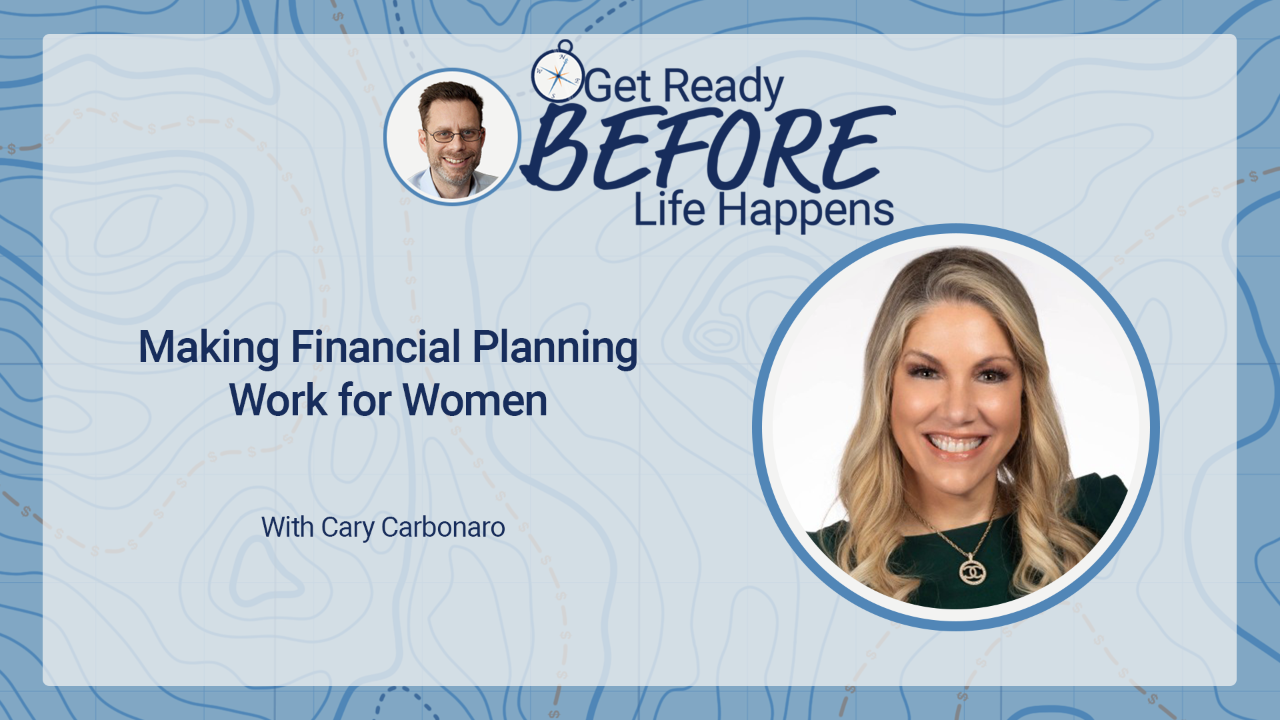
Women need financial planning that reflects real life.
Cary Carbonaro, author and CFP joined me on the Get Ready Before Life Happens podcast to talk about making financial planning work better for women. Cary shares why advisors need to listen first, educate clearly, and understand the real-life path behind the plan.
Key Takeaways:
- Financial planning starts with listening and rapport.
- AI can provide answers, but financial confidence still takes human support.
- Women need to be active participants in money decisions.
- Women’s financial paths often include caregiving, career breaks, and life transitions.
- Traditional planning tools often miss women’s real-life experiences.
- Advisors need to understand the emotions behind the numbers.
- Education and empowerment help clients make decisions with confidence.
Tony’s Take: Financial planning should fit the person. Women need planning conversations that reflect their real lives, their questions, and their future choices.
🎥 Watch this episode below:
🎧 Listen to the podcast below or on your favorite podcast app.
Connect with Cary Carbonaro, CFP:
Books:
- The Money Queen's Guide: For Women Who Want to Build Wealth and Banish Fear (Bookshop)
- Women and Wealth: A Playbook to Empower Clients and Unlock Their Fortune (Bookshop)
Cary’s article that was the basis for this episode:
- What is the total wealth gap for women based on caregiving, longevity, the pay gap? (Read on LinkedIn)
Bio:
Cary Carbonaro is an award-winning Certified Financial Planner™ with over 25 years of experience. She is the Managing Wealth Advisor and Women and Wealth Ambassador at Ashton Thomas, where she leads a multimillion-dollar financial planning practice focused on empowering women. Cary is the bestselling author of The Money Queen’s Guide and Women and Wealth: A Playbook to Empower Clients and Unlock Their Fortune, which offers actionable strategies for better serving women in financial services. Wealth Management listed it in the TOP Books of 2025 for Financial Advisors. A respected industry voice, she’s been named to Investopedia’s Top 100 Financial Advisors list six times and is the first female member of the 2024 Nasdaq Advisor Council. She was named 2025 DEI Trailblazer of the Year by Investment News. She has been a CFP Board Ambassador for over a decade. Through speaking, media appearances, and advocacy, Cary champions financial literacy and female empowerment.
👉 Start Your Financial Readiness Plan: A free, practical plan that helps you create your in-case-of-emergency Financial First Aid Kit, organize what matters, and prepare before life happens. Start Your Free Financial Readiness Plan https://www.tonysteuer.com
👉 Support Get Ready. Become a Get Ready Insider and help keep the Financial Readiness Plan free, support the podcast, trusted resources, and consumer-first financial education. You’ll receive access to the Get Ready Library. Support Get Ready here. www.tonysteuer.com/support
Transcript
Tony Steuer:
Financial planning becomes more effective when it reflects how women actually live and make decisions.
Welcome to Get Ready: Before Life Happens. I’m Tony Steuer.
Today, I’m pleased to be joined again by Cary Carbonaro.
Cary, welcome back to Get Ready: Before Life Happens.
Cary Carbonaro:
Thank you, Tony. It’s so great to be here with you.
Tony:
I’m excited. We were having a great conversation before the show, so I’m glad we can keep it going.
How did your background lead you to focus specifically on how financial planning can better serve women?
Cary:
I guess we have to start way back at the beginning.
I always knew I was going to be involved in financial planning because my dad taught me about money at a very young age.
He was a banker, so financial literacy was normal in our household.
I remember sitting in the living room doing Pronto banking, one of the earliest forms of online banking, through Chemical Bank in the 1980s.
I thought it was amazing that I could do banking from my living room on the TV screen.
My dad and I bonded over money rather than sports.
He took me to financial literacy events. We even went to foreclosure auctions together.
I thought everybody knew about money.
Then I got to college and realized that wasn’t true.
I found myself teaching friends how to balance budgets, find beer money, deal with student loans, and pay off debt.
For me, money was just a normal conversation.
After college, my first job was at JPMorgan Chase working with clients.
I thought, “This is amazing. I get to teach people about money, talk about money, and help people figure out what to do with it.”
It felt very natural.
As for why I focused on women, when I look back at my life, there’s always been this thread of helping women.
In college, I founded a sorority because I wanted to create a safe space for women away from home.
Even earlier, I was teaching dance and cheerleading.
Then I was working at a branch at JPMorgan Chase and women would literally line up to meet with me.
They would wait because they wanted to work specifically with me.
I was interested in what they had to say.
I wanted to understand what financial problem they were dealing with and help them solve it.
When I started my own practice, I knew I wanted to work with women.
I’ve never said I won’t work with men.
I simply attract women.
Today, roughly 78% of my practice is women, and much of the rest is couples where the woman is the major breadwinner or the husband wants to make sure his wife has somebody she trusts if something happens to him.
Tony:
There’s a lot in there.
Going to foreclosure auctions with your dad is certainly an unusual father-daughter activity.
But one thing you said really stands out:
You listened to what the women said.
That sounds obvious, but it gets missed.
Listening may be one of the most important skills we can bring when we’re helping someone.
Cary:
Absolutely.
I always say I’m a people person.
I love people.
I’m genuinely interested in what they have to say because I want to know them as a person.
That comes before anything else.
Before I talk about money.
Before I talk about my expertise.
Before I offer any financial solution.
I want to know the person first.
Establishing rapport comes before the financial discussion.
Tony:
That feels especially relevant now with all the conversations around AI.
People ask whether AI is going to replace financial planners.
I think rapport and listening are part of what separate the human relationship.
Cary:
I just wrote an article for Financial Planning magazine called something along the lines of, “AI can give you financial answers, but it can’t give you financial confidence.”
That’s the difference.
I can give my clients financial confidence.
I’m not worried about being replaced by AI.
I think it’s going to make my life easier because I’ll be able to do things faster.
But I’m not worried about losing my clients.
Tony:
That’s an important distinction for planners, coaches, educators, and really anyone who works with people.
Are you establishing rapport?
Are you helping someone build confidence?
Because helping somebody develop financial confidence is different from simply telling them what to do.
Cary:
Exactly.
You’re educating them.
You’re empowering them.
You’re enlightening them.
Tony:
Those are very human skills.
I also want to go back to something you said about husbands hiring you because they want to make sure their wives have somebody to turn to later.
That’s important.
In a lot of couples, one person handles more of the finances.
I handle much of it in our household because I’ve spent my career in financial services.
But we still have to make sure our partners are prepared if something happens.
Cary:
I love when a man comes to me and says, “I’m hiring you because eventually I may pass away before my wife.”
Maybe he’s older.
Maybe there are health issues.
Whatever the reason.
I’ve already had situations where the husband has passed away.
Everything was ready.
The woman didn’t miss a step financially because the planning had already been done.
At that point, I was there helping her through the transition.
Tony:
That reinforces why women need to understand their money today.
Women generally live longer.
There’s gray divorce.
There are more women aging on their own.
All of that makes this especially important.
Cary:
A woman should have complete ownership of her own financial future, whether she’s married, single, divorced, widowed, or anything else.
There’s no better time than today.
If you want to divide and conquer in a relationship, that’s fine.
I hear that all the time.
“I’m busy. My spouse takes care of the finances.”
But just because your spouse takes care of it doesn’t mean you should take a back seat.
You need to know what you have.
You need to participate in the meetings.
You need to understand the plan.
It’s your money too.
It’s your financial future.
If the other person is suddenly gone, you need to know what to do.
Tony:
That’s something every financial planner should hear.
Meet with both spouses.
Encourage family financial meetings.
And for people who don’t have an advisor, have those conversations with the people you love.
Cary:
Exactly.
When I teach advisors about working with women, I’ll say:
Let’s assume it’s a couple and the woman comes to the meeting, but she doesn’t seem interested.
Offer her a separate meeting.
Offer it at a different time or in a different setting.
Talk about something that matters to her.
Maybe it’s the children.
Maybe it’s philanthropy.
Find something that sparks her interest and bring her into the conversation.
You need to engage her.
Tony:
I like that: find something that sparks her interest.
And I’m glad you brought up philanthropy.
I recently became a Certified Impact Philanthropy Advisor, and women often have a strong interest in giving and impact.
Cary:
Exactly.
There’s usually something on the giving or volunteering side that matters deeply to someone.
Find that cause.
Figure out what’s important to her.
Then figure out how you can help address that need.
Tony:
That may be the best advice of the entire conversation:
Find out what’s important to the other person.
That works in a client relationship and in almost any relationship.
So, Cary, traditional financial advice often falls short for women.
Where do you see that happening most?
Cary:
I wrote a whole book about it.
The industry was largely created by men for men.
Women have often been treated as an afterthought in financial services and wealth management.
For a long time, women were viewed primarily through two categories: divorced or widowed.
But women’s financial lives are much broader than that.
Our paths can also look very different.
They aren’t always a straight line.
Women may leave the workforce to have children, care for children, or care for aging parents.
That can have a huge lifetime financial impact.
Women often earn less.
That can lead to saving less and investing less.
Then there’s the confidence gap.
Women may reach retirement with fewer assets, while also tending to live longer and potentially spending more on healthcare.
So there are additional challenges.
Traditional financial planning software doesn’t always reflect those lives very well.
It tends to assume a straight career path.
Women’s lives can be much more complex.
Women have also often had poor experiences with financial services firms.
Their needs may not be addressed.
Financial conversations can be filled with language about beating the S&P 500 or sports analogies that may not resonate with them.
Often the question women really want answered is:
“Am I going to be okay?”
“Am I going to outlive my money?”
There can be fear and emotion wrapped up in those questions.
So as an advisor, you need to uncover that.
It isn’t simply:
“Here are the facts. Make a decision. Move on.”
It takes time.
Women are worth that time.
They’re fantastic clients.
Do they sometimes take longer to become clients?
Yes.
Do they ask more questions?
Sometimes.
Can there be analysis paralysis?
Sure.
But it’s worth doing the work.
Tony:
And the other side is loyalty.
If someone takes longer to build trust, they may also be much more loyal once that trust is established.
Cary:
My story is fairly extreme.
I moved all of my clients four times in five years.
I may be the only financial planner on the planet who has done that.
And I had 100% retention.
Every client moved with me every time.
That tells you something about loyalty.
Tony:
And probably something about their willingness to do paperwork.
Cary:
Believe me, none of those moves was by choice.
It’s a long story, and I write about it in the first chapter of my book.
Tony:
And your latest book is Women and Wealth: A Playbook to Empower Clients and Unlock Their Fortune.
Cary:
Exactly.
I wrote it primarily for financial advisors, but it’s also useful for women who want to understand how to work more effectively with an advisor.
So it really has a dual purpose.
Tony:
I want to come back to something you said because it really struck me:
Traditional financial planning software often doesn’t account for a woman’s financial path.
I worked for a financial wellness app at one point and kept suggesting that we should design the app around women’s lives rather than assuming a male financial path.
So go a little deeper on that.
Cary:
Math is math.
But a traditional career path might look like a fairly steady upward line.
A woman’s career might look very different.
She may work.
Then leave the workforce.
Then come back.
Then leave again.
Then return again.
So her career and earnings don’t necessarily follow that neat glide path.
As planners, we need to do more work.
We need to educate more.
And we need to make the planning process fit the realities of her life.
Tony:
When advisors want to change the way they work with women, how can they help women feel more confident and engaged?
Cary:
Education is number one.
If I’m not educating my clients, I’m not doing my job.
Then comes empowerment.
You want to get clients to the point where they can make decisions themselves, with your input.
That’s where you want them to be.
I also talk about something I call resilience bonding.
Many of my clients come to me when the sun isn’t shining.
There’s been a death.
A disability.
A divorce.
A job loss.
Something difficult is happening.
I rarely get somebody when everything is wonderful.
My job is to help them move from that moment where it feels as though the world is crashing around them to a place where they feel whole again and the sun is shining.
That’s what I call resilience bonding.
They remember that you helped them get from point A to point B.
That’s where a lot of loyalty comes from.
Tony:
We’ve all experienced that.
When somebody helps you during a time of real need, you remember it.
As a planner, advisor, agent, educator, or anyone helping a community, that’s when you really need to show up.
It’s easy to be there when everything is fine.
When things are on fire, that’s when people really need you.
Cary:
Exactly.
Tony:
You also make an important distinction that women may ask more questions.
Cary:
Yes.
Women are often described as risk averse.
I prefer to say they’re risk aware.
They may have more questions about their portfolio or something they don’t understand.
That isn’t them questioning you.
It’s them being smart.
The more questions, the better.
Women may also feel more lost because of the things we’ve discussed: earning less, saving less, having less, career interruptions, longevity.
So part of the advisor’s role is education and behavioral guidance.
Help clients understand the positives and negatives of the decisions they’re making and why.
Tony:
I love that:
The more questions, the better.
I always felt that if someone wasn’t asking questions, they might not actually be following the conversation.
Cary:
Exactly.
Maybe they aren’t following.
Maybe they’ve tuned out.
Maybe you’re talking over their head.
Maybe you’re using jargon.
Maybe you’re simply not speaking their language.
If a client isn’t understanding me, I put that on myself.
I did something wrong.
It’s my responsibility to figure out how to communicate differently.
Tony:
I completely agree.
If someone isn’t asking questions, that’s something for the advisor to pay attention to.
You also used the phrase “behavioral financial advocate,” which I like.
You’re an advocate for the client.
You’re there to guide them, rather than simply tell them what to do.
Cary:
Exactly.
My newsletter slogan is:
“Compel, don’t sell.”
Or more specifically:
“Compel her, don’t sell her.”
Women don’t want to be sold to or told what to do.
They want to understand why something is in their best interest.
If you can explain that clearly and positively, then you’re doing your job.
Tony:
That’s actually one of the reasons I reached out to you for another episode.
I’ve been reading your newsletter.
We’ll reference your article about the total wealth gap for women and the combined effects of caregiving, longevity, and the pay gap.
All of these things compound.
It isn’t simply the pay gap.
There’s time out of the workforce.
There are missed opportunities to move up.
Women may invest less.
All of these things can have a long-term impact.
You told me a story before the show about a young woman who had been sold financial products she didn’t really understand.
I think that’s worth bringing into this conversation.
Cary:
Yes.
She was somebody I knew through yoga and she was in her 20s.
I gave a short talk and said, “Bring me what you have. Let me take a look.”
When I saw it, I was shocked.
She had a Roth IRA invested through an annuity structure that had produced very little growth over five years.
She also had money going into a life insurance policy that she believed was an investment.
She didn’t understand what she owned.
She told me:
“I didn’t know what I didn’t know. I didn’t know what questions to ask.”
She was almost in tears.
I told her:
“You’re young. This can be fixed.”
That’s the important thing.
She had time.
Tony:
I’ve seen very similar situations.
That’s why financial education matters.
People need enough knowledge to know what questions to ask.
So, Cary, let’s wrap up with the Get Ready Hot Take Trio.
What’s one myth about money that you’d like to break?
Cary:
There is no get-rich-quick.
There’s only get-rich-slow.
Tony:
I like that.
There are so many messages promising shortcuts or some secret that nobody else knows.
Cary:
There are no shortcuts.
Everybody can get rich slow.
Tony:
Let’s get out the time machine.
If you could go back knowing what you know now about money, what advice would you give your younger self?
Cary:
Financially, I followed pretty much everything I would have told myself to do.
The one thing I would change is that I wouldn’t have married my ex-husband.
Tony:
Well, I’m not sure “don’t marry your ex-husband” is universally applicable advice, but it’s certainly memorable.
So to close, what’s your number-one tip to change the way we think about money?
Cary:
Think in decades.
For every major decision I make, I ask:
“How will this affect me over the next decade?”
That’s how I think people should approach money.
Think long term.
Tony:
Wonderful advice.
Cary, where can people learn more about you, your work, and pick up copies of your books?
Cary:
I’m very easy to find because I’m the only Cary Carbonaro.
My website is CaryCarbonaro.com.
You can find me on LinkedIn, Facebook, Instagram, and X under Cary Carbonaro.
And you can find my books through Amazon, Barnes & Noble, or independent bookstores.
Tony:
And I’ll also give a shout-out to Bookshop.org, which supports independent bookstores.
For everyone watching and listening, you’ll find links to Cary’s website, books, and resources in the show notes.
Cary, thanks for joining us again on Get Ready: Before Life Happens.
Cary:
Wonderful. I’m so happy to be here.
Tony:
I appreciate your time and insights.
And thank you, everyone, for tuning in to Get Ready: Before Life Happens.
If something today changed the way you think about money and financial planning for women, please share the episode and subscribe.
Start your free Financial Readiness Plan at tonysteuer.com. It is a practical way to begin building your in-case-of-emergency plan before life happens.
You can also help keep the Plan free and support this podcast by becoming a Get Ready Insider for $5 a month.
Because when life happens, the way you think about money matters.