
Recognizing Financial Abuse: How to Protect Yourself and Find Hope
Jul 24, 2026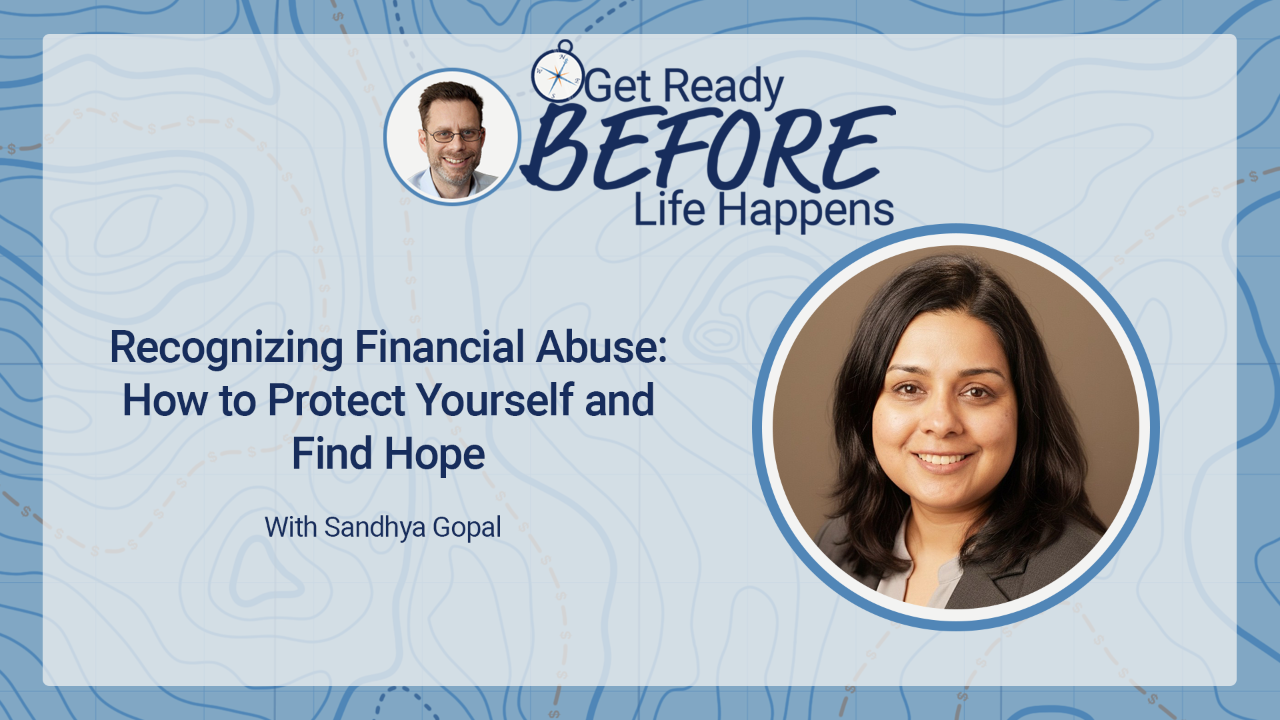
Financial abuse often leaves no visible signs. Recognizing the signs can be the first step toward protecting yourself and finding hope.
Sandhya Gopal, divorce financial planner joined Tony on Get Ready Before Life Happens to explore the warning signs of financial abuse and what women can do to protect themselves during major life transitions.
They discuss how financial control can be subtle and invisible, the importance of access to cash and trusted support, and how small steps and community can help move someone from fear and paralysis toward clarity, confidence, and hope.
Key Takeaways
🔹 Financial abuse is often psychological, subtle, and difficult to recognize.
🔹 Red flags include secrecy, gaslighting, and money moving to untraceable places.
🔹 Emotional paralysis can keep people feeling trapped and powerless.
🔹 Access to cash and a trusted confidante are critical first steps to leaving an abusive relationship.
🔹 Small, practical steps help rebuild confidence and agency over time.
🔹 Support communities, including virtual ones, can reduce isolation and restore hope.
🔹 Financial confidence grows when people realize they are not alone and have options.
Tony’s Take: Financial abuse often hides in plain sight. Recognizing the signs is the first step toward reclaiming clarity, safety, and control. Financial readiness means making sure people know they have resources, support, and a path forward before life’s hardest transitions force decisions.
🎥 Watch this episode below:
🎧 Listen to the podcast below or on your favorite podcast app.
Connect with Sandhya Gopal:
- LinkedIn: https://www.linkedin.com/in/sandhyagopal/
- Spend It Right Website: https://www.spend-it-right.com
Books:
- Breaking Free: Empower Your Mindset, Master Your Money (Amazon)
Resources mentioned:
- Get Ready Before Life Happens Podcast: Connecting Wealth and Great Health With Chris Heye (here)
- Facebook Support Groups (search for divorce)
Bio:
Sandhya Gopal is a financial advisor, Certified Divorce Financial Analyst®, and founder of SpendItRight. After going through her own divorce, she saw how overwhelming financial decision-making can feel when you suddenly have to navigate it on your own - even if you’re otherwise capable and successful.
That experience led her to start teaching financial literacy, where she noticed a clear pattern: many capable women lacked visibility into their finances until life forced them to be involved. Today, she helps women navigate financial transitions with clarity - especially during divorce, where what looks equal on paper is not always equal in reality - and supports them through the rebuilding phase that follows. Her work focuses on helping women understand their numbers so they can make confident, grounded decisions.
👉 Start Your Financial Readiness Plan: A free, practical plan that helps you create your in-case-of-emergency Financial First Aid Kit, organize what matters, and prepare before life happens. Start Your Free Financial Readiness Plan
👉 Support the Mission: Become a Get Ready Insider and receive access to the Get Ready Library while helping support my mission to help people prepare before life happens. Become a Get Ready Insider
Episode Transcript
This transcript has been lightly edited for clarity.
Tony: Financial abuse often hides in plain sight. It can shape decisions, limit options, and quietly undermine confidence long before anyone recognizes what is happening.
Welcome to Get Ready: Before Life Happens. I’m your host, Tony Steuer.
Today, I’m joined by Sandhya Gopal.
Sandhya, welcome to the podcast.
Sandhya: Thanks, Tony. I appreciate being here.
Tony: I appreciate you coming on and sharing about this topic because I think it’s really important and doesn’t get enough coverage.
To start off, tell us a little bit about yourself. What is your origin story, and how did it lead you to helping women navigate financial transitions?
Sandhya: That’s a good question.
I have to link my origin story back to the finance part of it.
My formative years were in India. I grew up in the south of India, and I came to the U.S. when I was 18 for engineering school.
In India, the way I was raised, women generally did not manage the finances.
But I grew up in a family where money was spoken about quite a bit.
I landed here when I was 18, and a month after I arrived, I got my first job.
So I had a paycheck and had to manage all my own money.
That was my introduction to finance: managing a budget on $450.
Then when I graduated and got my first job, with my first paycheck I opened a taxable brokerage account.
That was my foray into investing.
I loved it so much that I went back and got my master’s in finance.
That’s the education side of it.
I was still investing, and then I had kids while I was in school.
I started my corporate career in oilfield services, where I was able to combine my engineering and finance background in supply chain and planning.
I was managing multibillion-dollar spend and multimillion-dollar projects.
I was also investing on the side.
Then 2020 happened, and I got divorced.
So now it’s early 2020, during COVID, and I’m a single mom going through the divorce process.
Something within me shifted.
Everything I had been doing and everything I knew about finance suddenly became very hard to apply.
I wasn’t able to make decisions the same way.
It became very emotional.
That’s how I got into what I’m doing now.
When you go through divorce, or any major transition, no matter how much you know about finance, your emotions can take over.
It becomes a very intricate struggle between finance and emotions.
I was fortunate to know finance, but I know many women who go through divorce who are not in the same position.
Tony: I think that’s something that has come up in other conversations too.
The importance of women knowing about money isn’t just because of the potential for divorce, which is significant, especially with the rise of gray divorce.
It’s also because many women will become widows.
Women often outlive men, so if something happens to your husband, you may need to learn very quickly how to manage the money.
As you point out, emotions can easily take over during a life transition.
Sandhya: Women often don’t have enough reps with this.
If you’ve never managed money and suddenly you’re put in charge of it, it’s like being a kindergartner dropped into 12th grade.
You don’t know how to manage it because you’ve never done it before.
You need multiple repetitions before you feel confident, and that can be frightening.
Tony: Before we dive into the main topic, what do you tell women who are facing that kind of shock?
I imagine it’s like suddenly plunging into a cold swimming pool.
You’re there, and it’s overwhelming.
What do you tell clients in that moment?
Sandhya: There is a nuance between women going through divorce and women dealing with the death of a spouse.
With divorce, the divorce typically doesn’t happen in a happy relationship.
Something has gone seriously wrong by the time you get to divorce court.
In that situation, many women realize they don’t have the money they thought they had.
Something has happened during the marriage or divorce process.
The money is gone.
They thought they would have a certain amount, but they don’t.
So the first shock is the money shock: “I don’t have the money I thought I had. What happened?”
The second shock is: “What am I going to do next?”
If you think about a woman dealing with the death of a spouse, it can be different.
The shock there is that the person is no longer there, but there may still be money left.
The marital home may still belong to her.
There may be an insurance policy.
The shock of “there’s no money” may not exist in the same way, unless there were also financial problems before the spouse died.
So there can be a money shock and an emotional shock, and the balance between them depends on the situation.
Tony: With either one, there’s grief.
Even in divorce, you’re grieving that the relationship is over.
If you have kids, that adds another layer.
Let’s switch gears to the main topic.
When we think of abuse, we often think of it as physical.
But financial abuse is often psychological and invisible.
How would you define financial abuse, and what are some early signs that people often miss?
Because it can come on slowly.
Sandhya: I’m so glad you’re doing these episodes on financial abuse.
It’s very real, very subtle, and people often miss it.
Let’s take gray divorce as an example.
A couple may have been married for 10, 15, 20, 25, or 30 years.
They have kids, careers, and a life together.
One person manages the money, and the other person hands it over and takes care of other parts of life.
Why does that happen?
Often there are subtle messages like:
“Let me manage the money. You have too much on your plate.”
“You’re not very good with finance.”
“I’m better with numbers.”
“You don’t have the attention to detail.”
“I can take care of this.”
That’s where the gaslighting can begin.
The other person starts thinking, “Maybe I’m not good enough at this.”
I’ve seen this quite a bit.
And that’s where financial abuse can start.
I do want to add a caveat.
This is not all men.
I studied engineering with a lot of men, and many of them are still very good friends of mine.
There are many men who do not abuse.
But there are some people who can take advantage of the dynamic.
Tony: I think that’s an important distinction.
Women may already feel like they can’t handle money as well.
Sometimes the dynamic can also be more benign.
In my household, for example, I naturally handle a lot of the finances because I have more background in financial services and investing.
My partner is perfectly capable, but she’s not especially interested in investment allocation.
So how do you advise women who don’t necessarily want to take the lead on the finances but still need to have some kind of role?
Sandhya: I think it starts with getting out of the comfort zone.
If you haven’t studied finance, engineering, or other math-based subjects, finance may feel uncomfortable.
But if you understand there is a possibility that a partner could move money or make decisions without your knowledge, that can motivate you to get involved.
The fear of loss can sometimes help someone move from comfort into action.
How can they do it?
It doesn’t have to start with investments.
Maybe once a month, the couple looks at something together.
Don’t start with the budget.
The budget is the most boring part.
Look at the bigger goals.
“Let’s look at a retirement home together.”
“Let’s plan this vacation together.”
“Let me handle the finances for this vacation.”
If a partner genuinely wants the other person to understand finance, they can give them small projects that build financial confidence.
That’s what it comes down to: financial confidence.
If the goal for the vacation is $5,000 and the person manages it for $4,500, they feel good.
“I did it. I can do it.”
That’s how you bring someone into the conversation.
It doesn’t have to be, “Should we invest in the S&P 500 or the Nasdaq 100?”
If that person doesn’t care about that, make it tangible.
Help them build financial confidence.
That way, if something happens later, whether divorce, disability, dementia, or death, they know where the accounts are and they have the confidence to manage the money.
Then they can seek the help of an advisor if they need it.
That’s my approach.
Tony: I love that.
My wife doesn’t care much about how I diversify our portfolio.
That’s just not interesting to her.
But the bigger-picture ideas are things she’s involved with and aware of.
You also brought up cognitive decline, and I think that’s really important.
I had a guest on, Chris Heye, and we talked about how cognitive decline can affect financial decision-making.
That’s another good reason for both partners to be aware of what’s happening financially.
Even if someone doesn’t understand the investments themselves, they can still notice if there are big changes.
For example, if a partner suddenly moves a large amount of money from one place to another, you can ask why.
That kind of awareness matters.
Sandhya: Exactly.
If you engage your spouse not because of divorce, but because of aging or cognitive decline, the conversation can feel very different.
You might say, “I want to make sure this money is protected for the kids,” or, “I want to make sure we don’t lose this money.”
If someone isn’t comfortable with finance, fear can be used in a constructive way to motivate proactive action.
They can say, “Yes, I’ll be part of this conversation.”
“Yes, I’ll make sure we understand who is advising us.”
“Yes, I’ll help monitor what’s happening.”
Little things can make a big difference.
Tony: I love that.
Engage your spouse to help make sure they’re safe.
In a way, it becomes a gift to your spouse by making sure they understand how money works and what’s happening in your financial life.
Let’s get back to gaslighting.
What role do gaslighting and shame play in keeping people stuck in financially abusive relationships?
Sandhya: Let’s go back to the same example.
A woman wants to get involved and asks, “Why are you making these decisions? Can we look at this together?”
If the man says, “You don’t have the aptitude to understand this,” or, “You’re not good at math, so you don’t need to be involved,” right there he is shutting her out.
That is where gaslighting comes in.
Gaslighting is very subtle.
It makes the person doubt themselves.
The immediate reaction may be, “Maybe he’s right. I’m not good enough. Why should I get involved?”
Then she checks out.
Shame can work the same way.
The woman may question a financial decision.
The other person may follow one of her suggestions, and if it doesn’t work out, use that against her.
“You said this. See what happened?”
It can be very strategic.
It’s not necessarily a one-time event.
It isn’t always screaming or anger.
It can be a form of emotional manipulation designed to make the other person doubt themselves and stop participating in financial decisions.
That’s why this matters.
The same dynamic can be used for different purposes.
A caring partner might use their financial knowledge to protect the household.
A manipulative partner might move money to family members, business interests, or accounts the other person can’t trace.
They can use that control to prepare for divorce or otherwise disadvantage the partner.
The dynamic may look similar on the surface, but the intent and outcome are completely different.
Tony: That’s a reason to check in and monitor account balances.
I recommend people have family financial meetings every so often.
You don’t necessarily have to get into every investment.
But you can look at the accounts and see whether the balances have drastically changed.
The more involved both partners are in the conversation, the better.
I also think this is important for financial planners.
From both a client standpoint and a planner standpoint, the advisor should make sure both partners are at least aware of the plan and where things stand.
Sometimes one partner will shut the other down and say they don’t really need to be involved.
That should get the planner’s attention.
Sandhya: That’s true.
I work only with divorcing or divorced women, so I don’t work directly with couples.
But I have colleagues who do.
One thing I tell them is that when one partner says the other person doesn’t need to be involved, look deeper.
Look for offshore accounts.
Look for digital accounts.
Look for money flows going out but not coming back.
Look for large sums of money going somewhere that isn’t easily traceable.
That can be a red flag.
In a healthy relationship, couples communicate.
In an abusive situation, they may not.
Even if they have a joint account, the joint account may have $1,000 while individual accounts have a million dollars.
The joint account can be more of a façade than a meaningful reflection of the finances.
That’s where the planner can become very important.
Tony: That’s a great tip.
For someone who feels trapped financially, whether in a relationship or a life transition, what is the first step that can help them regain control?
Sandhya: The first thing is recognizing that you are trapped.
Awareness is key.
“Am I trapped?”
“Yes, I’m trapped.”
That recognition matters.
The second thing is access to cash.
They may not have access to money, so they need to figure out whether they can get a credit card, cash, or some other source of funds.
They need a source of money.
The third thing is finding a confidant.
Someone who is there for them.
Not necessarily a mutual friend who goes between both people, but someone who is clearly on their side and can watch their back.
I’ve worked with cases where this becomes very real.
That confidant can be incredibly important.
It also doesn’t happen overnight.
You need a plan.
The plan may take a year.
Give it time.
You’re making steps toward safety.
In an abusive situation, things can go wrong quickly because the other person may respond with more control or manipulation.
So you have to make sure you have someone watching your back, your plan is private, and you’re moving toward safety carefully.
Tony: I think that’s so important.
It’s unfortunate that society doesn’t always have enough resources to help women, or men, who are experiencing abuse.
But there are things people can do.
There are resources.
As you pointed out, one of the most important things is access to your own cash.
That’s one of the ways someone maintains control: cutting off access to money or putting someone on an allowance.
Those are warning signs.
We’ve talked about why it’s important for women to be actively involved in finance.
What are some of the barriers?
How can women begin when they feel overwhelmed?
How do you move from that feeling of paralysis to, “Okay, I can do this step by step”?
Sandhya: Paralysis is the biggest thing.
You’re like a deer in the headlights.
You feel stuck.
You don’t have access to money.
That’s where the plan becomes so important.
Take little steps that show you that you can do it.
Your mindset is often completely based in scarcity.
You feel like a victim.
You feel stuck.
You have to get out of that mode so you can take small steps forward.
The second thing I often tell women is to maintain some way of making money.
I see many women who go through technical schools or careers and then, once they become moms, leave the workforce.
For me, the job is your source of money.
So I believe it’s important to have something you can go back to where you can earn money.
If someone is a stay-at-home mom, maybe the first step is finding some source of income outside the home.
That also builds a network outside the house.
It builds confidence.
Women who have been through abuse often struggle with self-worth, self-esteem, and feeling “not good enough.”
Those are very common wounds when someone has been gaslit repeatedly.
The only way you can really heal those wounds is to get out of the environment that keeps reinforcing them.
As long as you’re still there, the gaslighting may continue.
That’s why the confidant becomes so important.
That person may help you find a way out of the situation.
It’s a combination of money and mindset.
You need both.
Tony: I think the mindset side is probably the harder part.
Money can sometimes be solved through family, close friends, or other sources.
But the psychological side is tougher.
A huge part of abuse is being told you’re worthless or incapable.
If your partner is telling you that you’re useless, not good with money, or that you can’t do something, eventually you can start believing it.
That’s how psychological manipulation works.
Sandhya: And there is a difference between physical abuse and financial abuse.
With physical abuse, you may have bruises.
People can see something is wrong.
They can identify that someone in the relationship may be violent.
Financial abuse is often psychological.
From the outside, people may think you’re a perfect couple.
They don’t know what’s happening inside the house.
They aren’t looking into your bank accounts.
If someone says, “I think this person is doing these things to me,” other people may not be able to comprehend it.
They think, “That can’t be true.”
So the person experiencing abuse may not have support.
That’s one of the things people miss.
When you speak with many women who have gone through it, you realize they often don’t have a support system that believes them.
People believe what they see from the outside, but what’s happening behind closed doors can be very different.
Finding someone who believes your story is the first step.
You need one person who believes you.
It could be family.
It could be a sibling.
It could be a friend.
It could even be a neighbor who isn’t connected to the situation.
That one person can help you understand that you’re not imagining things.
That it is truly happening.
And that you can get out.
The challenge is that with financial abuse, gaslighting, and psychological abuse, there may not be obvious proof.
That’s where many people feel stuck.
Tony: I love that.
Find somebody who believes you.
Because there are a lot of people who may say, “This person would never do something like this.”
They know the public version of the person.
They don’t necessarily know what’s happening inside the relationship.
One of the things you and I have talked about is culture.
That’s especially important because about a third of the listeners for this podcast are outside the U.S.
Different cultures have very different ways of looking at money, relationships, and abuse.
Why is it essential to consider culture when we talk about money and abuse?
Sandhya: I grew up in India, and many of my friends are from other cultures as well.
When you look at a culture like India, it can be very patriarchal.
Men and women may not be treated as equal within society.
There can be a sense that men are entitled to women’s money.
That’s part of what historically underlies practices like the dowry system.
So behavior that might be described as financial abuse in one culture may be normalized within another culture.
In the U.S., legally, men and women are treated as equal in divorce.
But when you look at a society like India, equality may not work the same way socially or practically.
It is changing, but the context is different.
I’ve spoken with friends from Latin America and other cultures where there can be similar dynamics.
So there is a cultural nuance around how men and women are treated in society, and that affects how we understand financial abuse and whether certain behavior is even recognized as abuse.
Tony: What advice would you give a woman in one of those societies?
Let’s take India as an example, where a woman may not have the same rights or options.
Sandhya: India is a difficult place to generalize about because it has changed significantly since I left more than 30 years ago.
A woman trying to leave a marriage in India may face very different realities from a woman in the U.S.
The first question is: How is she going to be financially independent?
Who is going to support her?
Who is going to help her raise children if she has them?
It may not be as straightforward as it is in the U.S., where someone may be able to get a job and live independently as a single mom.
But even before those questions comes self-awareness.
Are you being abused?
What does abuse mean?
Do you have access to the money you earn?
Do you have control over any of your own finances?
If you become aware that abuse is happening, then the next question is what you want to do about it.
In some cultures, someone may decide to remain in the marriage even knowing that the dynamic is abusive because there are other social or financial considerations.
That is a personal decision.
What works in one culture may not work in another.
Tony: And in some countries, women may not even have a realistic option to leave the marriage.
Is there anything we can say that’s helpful in those situations other than knowing they’re not alone?
Sandhya: I know women who are stuck in marriages they can’t realistically leave.
Are they being abused?
Yes.
Do they know it?
Yes.
Are they going to leave?
No.
Sometimes people make a decision to remain because leaving could mean losing social status, financial security, family support, or something else they depend on.
If someone believes they can live with that tradeoff, that may be the decision they make.
But if they feel they cannot remain and need to leave, then they have to look at whether the society around them is going to support them.
There are countries where that is extremely difficult.
In some cases, leaving the country may become the only practical option.
But being an immigrant in a new country has its own challenges.
You have to build a new life and reputation from scratch.
It can be harder than remaining in the abusive marriage.
So it becomes a difficult decision about what matters most to that person.
Tony: For people watching and listening, if this describes you or someone you know, the most important thing may be to support that person as much as possible.
Leaving a country can be an extreme option, and I wouldn’t tell anyone what they should do.
But people only have one life, and they deserve the opportunity to think about what will help them live it as safely and fully as possible.
Sandhya: It comes down to taking responsibility for yourself.
If someone is happy in their situation, they may not define it as abuse.
But if they feel abused, there are resources outside the immediate relationship.
One thing I’ve learned over the last few years is how many online support communities exist.
I didn’t realize how many Facebook groups and virtual support communities were out there.
Not everybody can go to a women’s shelter or has physical access to local resources.
But online groups can provide support.
You may have 50 women asking questions and 100 women answering them.
That can become a community.
You’re not alone.
That’s the key.
There are other people going through similar things.
People often don’t speak about it because there is shame associated with it.
But when the experience is shared, some of that isolation can begin to lift.
Tony: That’s good to know.
Would you mind sharing the names of some of those communities for the show notes?
Sandhya: Sure.
I need to look up the exact names, but I can share that information with you.
Tony: Great.
For people watching and listening, you’ll be able to find those links in the show notes.
I hope that if you’re going through this kind of situation, having access to those communities can provide at least some support and connection.
Sandhya: Camaraderie may be the right word.
When you are going through something difficult, it helps to know others are going through something similar.
Abuse can feel very isolating.
Online communities can provide collective support.
You know you’re not alone.
That’s the part I keep coming back to.
Tony: I think that is so important.
If you are in a situation where your society or circumstances make it extremely difficult to leave, knowing that you’re not alone and that you can find some form of support can still matter.
Be gentle with yourself.
Sometimes you can only do what you can do.
Sandhya: COVID taught us a lot about isolation.
When you feel completely alone, it can increase anxiety.
Your community may not be in your city or within your family.
It may be an online community made up of others who have gone through something similar.
When you realize you’re not alone, you often gain strength because someone else has already walked the path and can tell you what helped them.
There is hope.
It is not hopeless.
Tony: Hope and support are so important in these situations.
I want to thank everyone for watching and listening through what has been a challenging conversation.
I hope it helps you if you’re in this situation, or helps you recognize something in the life of a client, friend, or family member.
Sandhya, to wrap up, I want to switch gears.
I have what’s called the Get Ready Hot Take Trio.
These are three quick questions I ask all of my guests.
The first one is: What’s one myth about money, power, or relationships that you’re trying to break?
Sandhya: Learning how to make money decisions during uncertainty is a skill.
I knew about saving and investing.
But when I went through divorce, I was in the headlights.
I didn’t know how to make those decisions in that emotional environment.
So the ability to make money decisions during emotionally charged situations is a skill worth developing.
You can make those decisions, but you have to bring together the numbers and the emotions.
Tony: That really is getting ready before life happens, which happens to be the name of this podcast.
That’s the whole mission of what I’m doing.
You want to learn these things before you need them.
Let’s get out the time machine for a minute.
If you could go back in time, knowing what you know now about money and being prepared, what advice would you give your younger self?
Sandhya: For me, it would be discernment.
How do I discern what is good and what is bad?
How do I discern whether to believe this person or that person?
That is something I wish I had learned much earlier in life.
I would have made better decisions.
The second thing would be about how I saw myself as a woman.
I grew up in a country where men and women were not treated equally, so I had this glass ceiling in my mind.
I would have loved to be a hedge fund manager because I think I have the skills for it.
I love stocks. I trade all the time.
But that was a vision I never had for myself because I had been taught that women don’t manage money.
If I could go back, I would have dreamed of becoming one and made sure I pursued it.
Many women have these internal blocks that say, “You’re not good enough. You can’t do it.”
So they don’t dream big.
Tony: I love that.
Believe that you can do it.
That’s one of the hardest things.
If society tells you that you can’t do something, you have to examine that inner story and ask whether it is actually true.
You may have the skills.
You may have the knowledge.
You may be capable of doing it.
And if you haven’t done it yet, today can still be the day you say, “I can do this, and I’m going to do it.”
Sandhya: I agree.
That’s why I’m on this career path now.
It’s a career pivot for me, and I love it.
Tony: Before we wrap up, I have one last question.
What’s your number one tip to change the way we think about money and life transitions?
Sandhya: Money is more emotional than we often think.
The role of behavioral finance is incredibly important.
Think about mindset.
I mentioned that I had a scarcity mindset in my 20s.
I didn’t become a hedge fund manager.
I had to shift my mindset.
Today, I believe I can still do significant things, and I’m going to work toward them.
The connection between money and mindset is much closer than many of us realize.
Tony: I love that.
That switch from a scarcity mindset has come up so much on this podcast.
Scarcity can keep people trapped in relationships and reinforce the effects of gaslighting.
It can keep people from dreaming big and believing in themselves.
One of the biggest things I’ve heard from guests like you is simply to believe and, as you mentioned, to have hope.
Sandhya, where can people learn more about you and your work?
Sandhya: I’m a fee-only financial advisor.
I run a company called Spend It Right.
People can find me through the Spend It Right website.
I’m also very active on LinkedIn, where I post educational content, mainly around finance and especially for women.
My name there is Sandhya Gopal.
Those are the two places where I’m most active right now.
Tony: Fantastic.
For everybody watching and listening, as always, there will be links to Sandhya’s website and LinkedIn profile in the show notes.
Sandhya, thank you so much for sharing your time and insights.
Sandhya: Thank you, Tony. I appreciate it, and I appreciate all the work you’re doing.
Tony: I’m honored to have you on and have you share your insights with us.
Thank you, everyone, as always, for tuning in to this episode of Get Ready: Before Life Happens.
If you learned something today that could help you or someone else, please be sure to subscribe and share this episode with a friend.
You can go to my website at TonySteuer.com to join the Get Ready Movement and get access to my newsletter.
If you want to support the podcast, you can now do so at Buy Me a Coffee.
Because when life happens, the way we think about money matters.