
Rethinking Retirement and Unretirement
Oct 22, 2026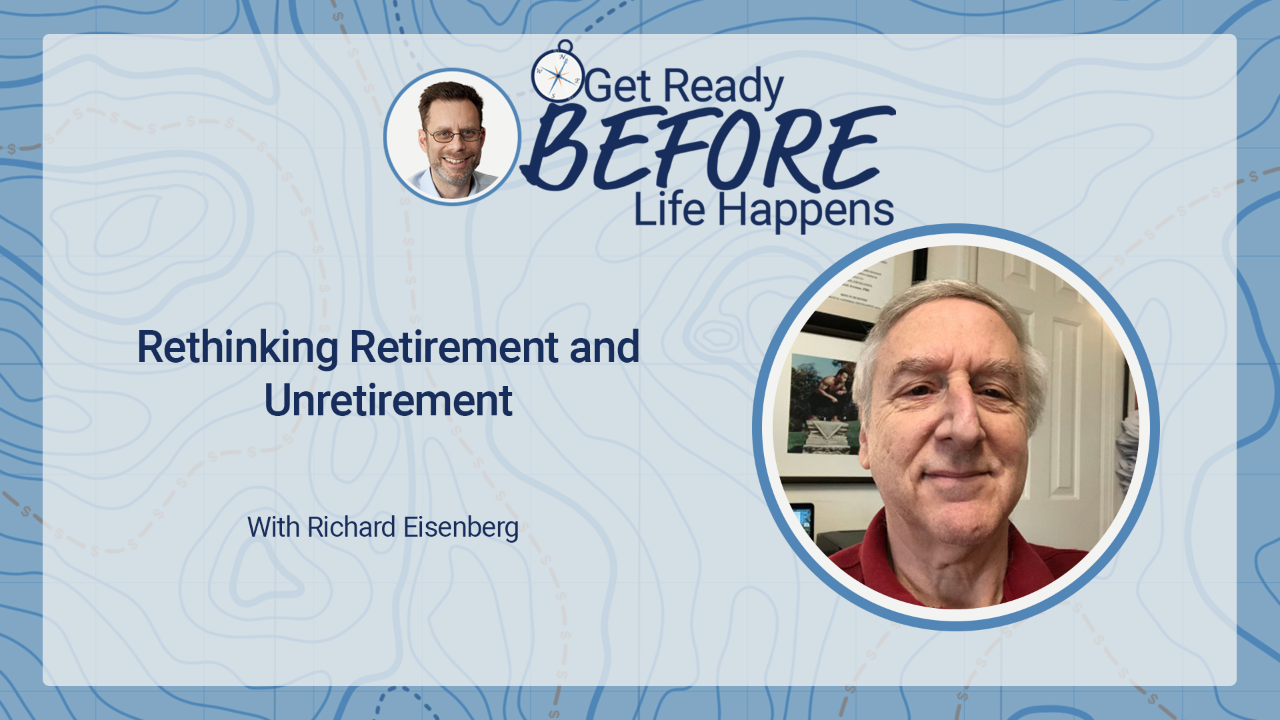
What could retirement make possible in the next chapter of your life?
Richard Eisenberg, co-host of the Friends Talk Money podcast and writer of The View From Unretirement column for MarketWatch joined me on the Get Ready Before Life Happens podcast to talk about about unretirement, the connection between work and identity, and why everyone’s vision of retirement is different.
What Stood Out:
- Spend less time thinking about what you are retiring from and more time imagining what you are retiring to.
- Talk with the important people in your life about what each of you envisions for retirement.
- Prepare for the shift in identity, structure, and relationships that can follow leaving full-time work.
- Consider how work, volunteering, learning, and other activities can provide meaning and purpose.
- Give yourself permission to try new things and allow your retirement plans to evolve.
- View an open calendar as an opportunity to intentionally build the life you want.
The Bottom Line: Retirement planning works best when it connects the financial pieces with how you want to live.
🎥 Watch this episode below:
🎧 Listen to the podcast below or on your favorite podcast app.
Connect with Richard Eisenberg:
- LinkedIn: https://www.linkedin.com/in/richardeisenberg/
- Facebook: https://www.facebook.com/reisenberg1
- X/Twitter: https://x.com/richeis315
- Marketwatch: The View From Unretirement Column (here)
Podcast:
- Friends Talk Money Podcast (here)
Resources mentioned:
- How to Retire: 20 lessons for a happy, successful, and wealthy retirement by Christine Benz (Amazon)
- Retirement Stepping Stones: Find Meaning, Live with Purpose, and Leave a Legacy by Tony Hixon (Amazon)
- Stanford Center on Longevity (here)
- Maximize My Social Security website from Laurence Kotlikoff (here)
- "What is the '4% Rule'? How does it work? Should I use it for my retirement?" By Bill Bengen (here)
- Thinking Positively About Aging Extends Life More than Exercise and Not Smoking from Yale News (here)
Bio:
Richard Eisenberg is an "unretired" journalist and podcaster. He writes The View From Unretirement column for MarketWatch, freelances for Kiplinger, The Stanford Center on Longevity Magazine, AARP and People and is co-host of the Friends Talk Money personal finance podcast for people over 50. In 2022, at age 65, he left his job as Managing Editor and Editor of the Money and Work Channels at Next Avenue, the PBS site for people over 50, to begin his unretirement. Previously, he was Executive Editor of Money Magazine, Front Page Finance Editor at Yahoo! and Special Projects Director/Money Editor at Good Housekeeping. He is author of "The Money Book of Personal Finance" and "How to Avoid a Midlife Financial Crisis," winner of the SABEW Award for Best Personal Finance Article/Small Media Outlet and recipient of the Coming Of Age Impact Award for Leadership in Positive Aging and recipient of the 2025 Retirement Coaches Association Retirement Pioneer Award. He is a graduate of Northwestern University's Medill School of Journalism and lives in New Jersey.
👉 Start Your Financial Readiness Plan: A free, practical plan that helps you create your in-case-of-emergency Financial First Aid Kit, organize what matters, and prepare before life happens. Start Your Free Financial Readiness Plan https://www.tonysteuer.com
👉 Support Get Ready. Become a Get Ready Insider and help keep the Financial Readiness Plan free, support the podcast, trusted resources, and consumer-first financial education. You’ll receive access to the Get Ready Library. Support Get Ready here. www.tonysteuer.com/support
Transcript
Tony Steuer: What if we thought about retirement as a next chapter rather than a finish line?
Welcome to Get Ready: Before Life Happens. I'm your host, Tony Steuer.
Today, I'm joined by Richard Eisenberg, co-host of the Friends Talk Money podcast and writer of The View From Unretirement column for MarketWatch.
Richard, welcome to Get Ready: Before Life Happens.
Richard Eisenberg: Thank you, Tony. It's great to be here.
Tony: I'm excited to get into this conversation.
Tell us a little bit about what led you to focus on unretirement.
Richard: I guess it was personal.
I had been the managing editor of a website called Next Avenue, a PBS website for people over 50.
I'd been there for 10 years, and I was about to turn 65. This was in 2022.
As much as I enjoyed that job, there were other things I wanted to have time to do that I couldn't do while working full time.
So I decided to start what I call my unretirement.
That basically means working as much as I want, when I want, with whom I want, and where I want.
Once I started doing that, an editor I knew at MarketWatch asked whether I'd be interested in writing about it.
I said I'd love to.
So I started a column called The View From Unretirement, and I've been doing that ever since.
Tony: Fantastic. I love this concept because there's often an assumption that you reach 65 and you're done.
But most people seem to have their own retirement journey.
Is that part of what unretirement really means?
Richard: It is, although I would say the definition of retirement is different for everybody.
Some people retire at 65 or earlier, and retirement for them is what it traditionally meant.
They're no longer working.
They want to enjoy themselves, travel, play golf or pickleball, or spend more time on leisure activities.
And that's great for some people.
But there are others who think, "That's not exactly how I want to spend my days."
They may want to continue doing some paid work, volunteer, travel, or spend more time with friends and family.
It's a very individual decision.
And sometimes people don't think enough about that decision before they retire.
Tony: Let's jump into that.
What's the problem with not thinking about it beforehand?
Richard: So many people spend a lot of time thinking, "I can't wait until I retire."
Maybe they don't like their boss.
Maybe they've been doing the same work for a long time.
Or maybe they just don't enjoy the job anymore.
But they're mostly thinking about what they're leaving.
They don't spend nearly as much time thinking about what retirement will actually look like.
Who will they be?
How will they spend their time?
Where will they live?
How will the people in their lives react to this change?
Those are all things I'd like to see people think about more.
Tony: I think that's what I was getting at with the age of 65.
People say, "I'm going to retire at 65."
Then they get there and think, "Okay, now what?"
Maybe they travel for six months or play golf.
And eventually they realize they need something else.
Is that what you're talking about?
Richard: Absolutely.
And I think identity is a big part of it.
For many people, their identity is closely tied to what they've done for a living.
That may be particularly true for men, although it affects women too.
For others, their identity may have been tied to raising children.
Then the children leave home, or they leave their full-time job, and they aren't sure who they are anymore.
That can be a big problem.
Some people become depressed.
Some become bored.
Some spend most of their time sitting on the couch.
And a lot of people become unhappy because they don't feel they have a reason to get up in the morning.
I've written about a Japanese concept called ikigai, which is loosely translated as a reason to get up in the morning.
It might be one thing or a combination of things.
But if your reason for getting up has always been your job or raising your family, you need to think about what that will be in retirement.
And that purpose may change over time.
It may take a while to figure out.
But I think it's an important question to answer.
Tony: And studies have shown that having purpose is connected to mental and physical health.
Doesn't your outlook on aging also affect longevity?
Richard: There's a fascinating study by a Yale University professor named Becca Levy.
Her research found that people with positive views about aging lived, on average, seven and a half years longer than people with negative views.
There are people who leave their full-time jobs and essentially think, "My life is over. I'm just going to wait it out."
Some become depressed or sedentary.
That can affect their mental and physical health.
People with a more positive view of aging tend to be more engaged and excited about everyday life.
I don't mean to minimize the challenges of aging.
Things happen physically, psychologically, and emotionally.
But trying to maintain a positive outlook can make a meaningful difference.
Tony: We're an aging society, and more people are approaching retirement.
That makes this an especially timely subject.
In your column, do you offer recommendations for how people can begin making that transition?
Richard: I do.
I write about it in The View From Unretirement for MarketWatch.
We also discuss it on Friends Talk Money, and I write about it for other publications.
One of the first things I recommend is having conversations before leaving your full-time job.
If you have a spouse or partner, talk about what each of you envisions retirement being.
What does retirement look like for you?
What does it look like for them?
How will those plans fit together?
You may also want to meet with a financial advisor.
Can you afford to leave your full-time job?
How much income will you have?
Where will it come from?
Will you need to continue working?
And if so, how much do you need to earn?
You want to think through those questions and run some numbers before telling your boss, "Thanks very much. I'm out of here."
Have some kind of plan.
Tony: That's something I've heard from many guests.
We spend so much time working toward retirement that we don't always think about what happens once we get there.
Having a purpose for the next chapter is really important.
Richard: And there aren't that many role models for this.
We're all figuring it out.
There are plenty of books about retirement, but many focus almost entirely on the financial side.
That's important, but it's only part of retirement.
I'd encourage people to read, talk with others, and learn about the different aspects of retirement.
Christine Benz from Morningstar wrote an excellent book called How to Retire.
She interviewed experts from a variety of fields, including financial advisors and a hospice doctor.
I thought it offered some really interesting perspectives.
Another book I liked is Retirement Stepping Stones by financial advisor Tony Hixon.
He wrote it partly because of what happened to his mother.
She had been a hospice nurse and loved her work.
She decided to retire.
Tony reviewed her finances and told her she could afford it.
But she hadn't thought much about what she would do next.
She struggled with losing that sense of purpose, became deeply depressed, and tragically took her own life.
Tony wrote the book to help people think more carefully about the emotional and psychological side of retirement.
Where will you find meaning and purpose if you're no longer doing your full-time job?
I think people should give that serious consideration.
Tony: When you meet someone at a social gathering, one of the first questions is usually, "What do you do?"
And when you're retired, suddenly the answer changes.
Richard: Exactly.
You might say, "Well, here's what I used to do."
But it would be nice to have an answer about what you're doing now.
It could be several things.
It could be one thing.
Or you might say, "I'm retired and really enjoying it."
And that's perfectly fine too.
I don't mean to suggest there's anything wrong with traditional retirement if that's what someone wants and can afford.
Although, of course, not everybody can afford to stop working entirely.
Tony: That's a whole other issue.
But retirement can open up opportunities.
You may be able to volunteer, travel, or spend your time differently.
And I agree with your recommendation of Christine Benz's book. It does a great job of exploring the different facets of retirement.
Let's talk about your podcast, Friends Talk Money.
What's the show about?
Richard: It's a personal finance podcast for people over 50.
I do it with two wonderful co-hosts.
One is Pam Krueger, who founded Wealthramp, a company that helps people find vetted fiduciary financial advisors.
The other is Terry Savage, a personal finance journalist and author who has been writing about money for many years.
We get together remotely every few weeks because we all live in different places.
Sometimes we bring in guests.
Each episode focuses on a particular topic.
It might be Social Security, Medicare, meaning and purpose, or working after 50.
We try to be timely.
During tax season, we'll discuss taxes.
During Medicare open enrollment, we'll talk about Medicare.
But we also cover subjects we think are generally important for people over 50.
We've been doing it for several years now, and we really enjoy it.
Tony: What's been one of your favorite topics?
Richard: There have been so many.
One that comes up every year is Medicare open enrollment.
There's always something new to discuss.
For people who are 65 or approaching that age, Medicare can be incredibly confusing.
People don't necessarily want to spend a lot of time learning about it, but they also don't want to make the wrong decisions.
If we can help them understand their choices, that's valuable.
We also talk about Social Security quite a bit.
One of my favorite guests is Larry Kotlikoff, an economics professor at Boston University and an expert on Social Security.
He's particularly knowledgeable about claiming strategies.
When should you claim?
A lot of financial advisors and economists recommend delaying benefits until age 70 if you can.
Financially, there's a good reason for that.
Your monthly benefit generally increases for each year you delay beyond full retirement age, up to age 70.
For someone whose full retirement age is 67, delayed retirement credits increase the benefit by 8% per year between 67 and 70.
That higher monthly benefit continues for the rest of your life.
But plenty of people can't afford to wait until 70.
Others simply don't want to.
If you can wait and it makes sense for you, that's great.
But you shouldn't feel terrible if you can't.
I would generally encourage people to think carefully before claiming as early as age 62, because that's when your monthly benefit will be at its lowest.
Sometimes you need to claim early, and that's understandable.
Tony: Social Security really is its own complicated subject.
And Medicare is confusing too.
I want to give Larry Kotlikoff a shout-out because he has a website and software for helping people evaluate Social Security claiming strategies.
I believe it's called Maximize My Social Security.
I'll include the correct link in the show notes.
Richard, do you have any thoughts about the future of Social Security?
Richard: The Social Security trustees have projected that the system's trust funds will face a shortfall in the coming years.
At that point, the program would still have enough ongoing revenue to pay most scheduled benefits, but not all of them.
So something will need to change if we want Social Security to continue paying 100% of scheduled benefits.
Exactly what Congress will do, and when, I don't know.
Congress often waits until the last minute.
I hope they'll address the issue sooner rather than later because that would give people more certainty.
There are several proposals.
One would raise the amount of earnings subject to Social Security payroll taxes.
Another would raise the full retirement age.
The retirement age has already been raised gradually from 65 to 67 for younger generations.
I can understand the argument for increasing it further because people are living longer.
On the other hand, many people are already struggling financially.
Requiring people to wait even longer for full benefits could create real hardship.
Personally, I hope they find other solutions.
There may also be changes to how benefits are calculated.
For people already receiving Social Security, I don't think they should be overly concerned.
For Generation X and younger people, there's a reasonable chance the system will look different in the future.
It's too soon to know exactly how.
Another concern I have is staffing at the Social Security Administration.
With staffing reductions, people may have a harder time getting questions answered or receiving assistance.
So give yourself plenty of time.
If you need help with Social Security, start early rather than waiting until the last minute.
Tony: Basically, don't be like Congress!
But that's good advice for financial decisions generally.
Give yourself time.
Whether you're deciding when to claim Social Security or reviewing Medicare options, you want to understand the choices before a deadline arrives.
And I want to emphasize something you said.
When people hear that Social Security is running out of money, they sometimes assume that means benefits will disappear.
That's not what the projections mean.
Even if Congress made no changes, ongoing payroll tax revenue would still support a substantial portion of scheduled benefits.
Richard: Exactly.
There would still be benefits paid.
Current projections suggest something in the neighborhood of 80% of scheduled benefits could be supported, although those projections change over time.
I would hope that Congress finds a solution that allows the system to pay the full amount.
But even without changes, Social Security wouldn't simply disappear.
Tony: That's an important distinction.
And it reinforces why people need to prepare for retirement using all the resources available to them.
Richard: Absolutely.
If you can save more for retirement, that's worth considering.
Not everyone can afford to do that.
But for people who can, one of my favorite approaches is automating savings.
Have money transferred regularly from your bank account into an investment account.
That might be an IRA.
It might be through a workplace 401(k).
You could be investing in mutual funds or ETFs.
The important thing is setting up a system so you don't have to remember to do it every month.
We all have things we know we should do but never quite get around to doing.
Automation helps with that.
Tony: That's such an important point.
If you've been putting off creating a retirement plan, starting a budget, or setting up savings, you're certainly not alone.
We're all human.
And automation can make those decisions easier to follow through on.
Richard: One of the things that worries people most as they approach retirement is the opposite of saving.
It's what we call decumulation, or withdrawing money from retirement savings.
None of us knows how long we're going to live.
And nobody wants to outlive their money.
So people can become very nervous about withdrawing money from their retirement accounts.
There have been studies suggesting that some retirees spend less than they can actually afford to spend.
That's another reason I think meeting with a financial advisor can be useful.
Look at your income sources.
How much money is coming in reliably?
What assets do you have?
What might happen if the market performs better or worse than expected?
How much can you reasonably afford to withdraw each month or each year?
There's the familiar 4% rule, which suggests a starting point for retirement withdrawals.
But that's a rule of thumb.
It isn't necessarily going to work for everybody.
Some years you'll need more money.
Some years you'll need less.
Some years the market won't perform particularly well.
So I wouldn't assume one simple rule will answer every retirement spending question.
I think it's helpful to review your plan with a financial advisor at least annually, and perhaps more often.
Ask whether you're still on track.
Can you afford to spend more?
Should you be spending less?
Do you need to continue doing some paid work?
You may also decide that you don't need two cars or that you want to take fewer vacations.
Those are personal decisions.
But you want to have enough information to make them thoughtfully.
Tony: That's great advice.
Just as you need a plan for accumulating money, you need a plan for spending it.
The fear of running out of money is very real.
It's about finding a balance where you can enjoy your retirement while feeling comfortable with your financial resources.
And as you pointed out, the 4% rule is a guideline.
William Bengen, who developed the original research behind that rule, has talked about how withdrawal strategies can vary depending on circumstances.
Christine Benz has also written extensively about retirement spending.
There are some excellent resources available.
As we start to wrap up, Richard, what are three things you wish people understood about retirement?
Richard: The first is to try not to get overly worried about it.
It's a new chapter.
And because it's something new, it can feel unsettling.
But there's no single right answer.
Your thinking about retirement will evolve over time.
When I started my unretirement in 2022, I had an idea of how much I wanted to work and whom I wanted to work for.
That's changed.
Today, I think I'd like to work a little less than I initially planned.
Some publications I used to write for are no longer accepting assignments or have gone out of business.
So some of the work I thought I'd be doing isn't available anymore.
You have to be flexible.
Sometimes your preferences change.
Sometimes the world changes around you.
Either way, you adjust.
The second thing I'd say is to try new things.
One of the great opportunities retirement provides is having more time to experiment.
Maybe you've always wanted to learn a musical instrument.
Maybe you'd like to paint.
Try it.
You might discover you love it.
Or you might find that it's not for you.
That's okay too.
When I started my own unretirement, I thought I might enjoy doing voiceover work.
I took classes.
I bought some equipment.
I imagined reading audiobooks or recording museum guides.
But I discovered that a lot of the work involved being a sound engineer.
And I'm not particularly good at that.
So I decided not to pursue it.
Initially, I was disappointed.
Then I realized there was no reason to feel bad.
I'd tried something I thought I might enjoy.
It turned out not to be what I wanted.
And that was perfectly fine.
Tony: That's wonderful advice.
I actually took a voiceover class a long time ago, and I remember how difficult it was.
Trying new things is also a great way to keep learning.
And for many of us, retirement is a huge transition.
We've been working since we were 15 or 16 years old.
Then suddenly we don't have to go to work anymore.
That freedom can feel strange.
Richard: It can.
I find it very freeing, but it was also a little scary initially.
One of the things that struck me when I first started unretirement was looking at a blank calendar.
When you have a full-time job, you generally know what your day is going to look like.
You have meetings.
You have assignments.
You have responsibilities.
Then suddenly, that's gone.
You have this calendar with nothing on it.
And you have to decide what to put there.
Of course, there are always things you need to do.
Doctor's appointments.
Grocery shopping.
Everyday responsibilities.
But there's also a lot of time you get to decide how to use.
I hope people consider volunteering or mentoring.
I've done quite a bit of both during my unretirement, and I've found them very rewarding.
You might also want to continue working.
Then you have to figure out what kind of work you'd like to do.
Would you prefer to work for someone else?
Would you like to be your own boss?
Unfortunately, age discrimination can make it difficult for people in their 60s and 70s to find employment, even when they want to keep working.
So don't let the blank calendar scare you.
Start experimenting with how you want to fill it.
Over time, you'll find a rhythm.
Maybe you'll realize you're too busy.
Maybe you'll want more activities.
It's an ongoing process.
Tony: Exactly. It's an opportunity to experiment.
Richard, let's close with the Get Ready Hot Take Trio.
These are three quick questions I ask all my guests.
What's one myth about retirement or unretirement that you'd like to break?
Richard: I think the myth is that you're the only person having a hard time with it.
When people begin this chapter of life, they often feel they're on their own.
They may not be talking about retirement with many other people.
So if they're frustrated, confused, bored, or depressed, they think:
"Maybe it's just me."
"I must be the only one who feels this way."
But the truth is that many people are going through similar experiences.
You just may not know it because people don't talk about it that much.
Tony: That's an important reminder.
And another reason for people to check out your View From Unretirement column in MarketWatch.
Let's get out the time machine for a minute.
What advice would you give your younger self, knowing what you know now about retirement and unretirement?
Richard: I would tell my younger self to make time to try new things and volunteer.
It's so easy when you're working full time to say:
"I'm too busy."
"I'm too exhausted."
"I don't have time to volunteer or learn an instrument or study a language."
But if you can start doing some of those things while you're still working, the transition into retirement becomes easier.
You already have activities you enjoy.
You already have connections.
Maybe you've been volunteering with an organization, and now you can spend more time helping them.
Or perhaps you've started a hobby and can devote more time to it.
I have a friend who became a birder after retiring from his career as a lawyer.
He loves it.
If there's something you've been thinking about doing, I'd encourage you to start exploring it before retirement.
Tony: I love that advice.
Volunteering can also make a real difference.
Nonprofit organizations need people who can serve in leadership roles, work directly with communities, or simply help with everyday tasks.
It's a way to contribute to something you care about.
So here's the last question.
What's your number-one tip to change the way people think about their next chapter?
Richard: I'd encourage people to spend more time thinking about what they want to retire to.
What would you like your next chapter to look like?
Where will you find joy?
Where will you find meaning and purpose?
Where do you want to live?
How do you want to spend your time?
Who do you want to spend it with?
One of the things I've really enjoyed about unretirement is being able to choose whom I work with.
When you're employed full time, you may have bosses or colleagues you don't particularly enjoy working with.
But you don't necessarily have much choice.
At this stage of life, I can politely say:
"Thank you, but I don't think that's something I want to take on."
And if I can recommend someone else who might be a good fit, even better.
Life is short.
If you have the freedom to choose how you spend your time and whom you spend it with, take advantage of that.
Tony: That's great advice.
And it comes back to the freedom you've been talking about.
The freedom to spend time with people who support and inspire you.
Richard, where can people learn more about you?
We've talked about your MarketWatch column, but where can people listen to Friends Talk Money?
Richard: Friends Talk Money is available pretty much anywhere you listen to podcasts.
You can also connect with me on LinkedIn.
My MarketWatch column, The View From Unretirement, appears in the retirement section of MarketWatch.
I hope people will check it out.
I'm also active on X, formerly Twitter, where I share things I've learned that I think other people might find useful.
I do the same on LinkedIn.
I'm writing for the Stanford Center on Longevity's magazine as well.
And I contribute to Kiplinger, which is a terrific personal finance publication.
So there are several places people can find my work.
Tony: Fantastic.
For everyone watching and listening, we'll include links to Richard's column, podcast, and other resources in the show notes.
Richard, thanks for joining me on Get Ready: Before Life Happens.
Richard: Thank you, Tony. It's been a lot of fun.
Tony: It was a pleasure.
And thank you, everyone, for tuning in to Get Ready: Before Life Happens.
If something today changed the way you think about retirement and your next chapter, please share this episode and subscribe.
You can also visit tonysteuer.com to learn more about the Financial Readiness Plan and start preparing for life's important financial decisions.
And if you'd like to support the podcast, you can become a Get Ready Insider.