
Why Financial Confidence Takes More Than Just Money
Aug 11, 2026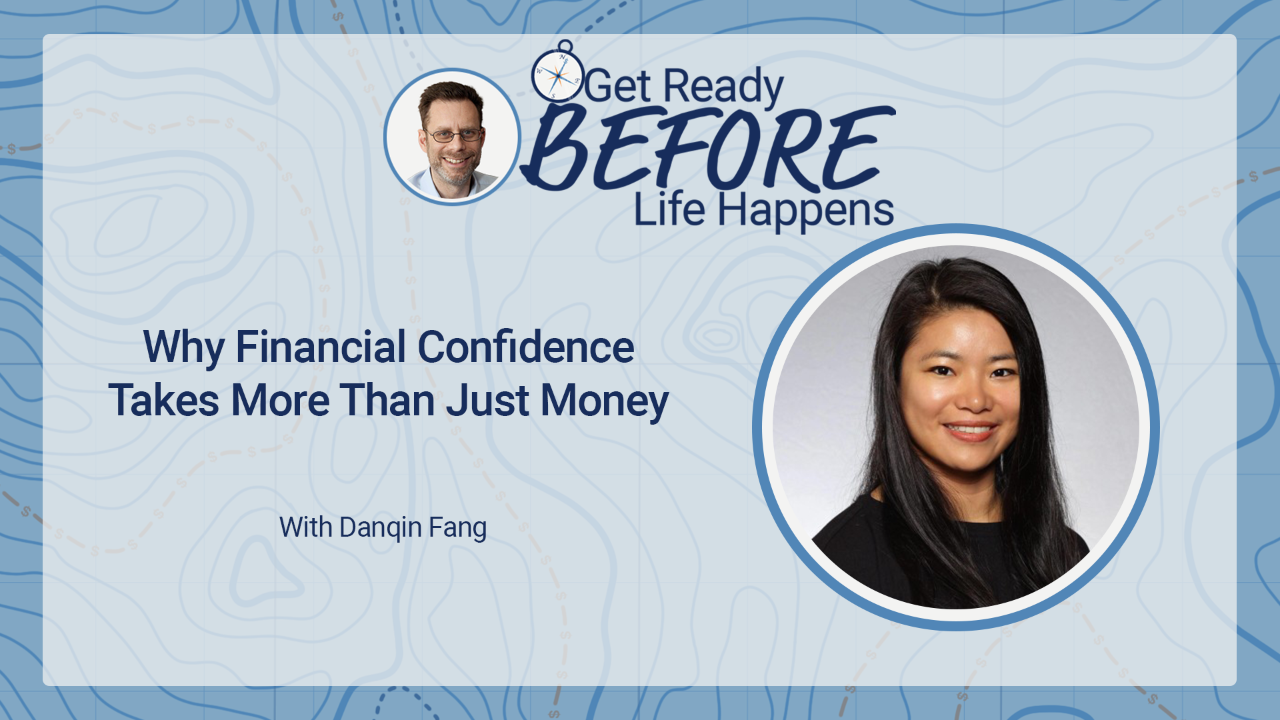
Financial success grows when your money aligns with the life you truly want.
Danqin Fang, CFP®, CFA, RLP®, founder and CEO of Wealth Beyond Math joined Tony on this episode of Get Ready Before Life Happens to talk about how holistic financial planning evolves through a process of awareness, clarity, and alignment. Even people who appear to have everything in place often feel held back by fear, scarcity, or limiting beliefs.
This conversation explores how understanding your relationship with money helps you make more intentional decisions and build a more meaningful life.
Key Takeaways
- Holistic financial planning is an ongoing process, not a one-time plan.
- People who “have it all” can still feel stuck or unfulfilled.
- Scarcity and fear often shape financial decisions.
- Core beliefs about money serve a purpose and can evolve over time.
- Clarity about priorities helps you make more intentional choices.
- Awareness creates space to pause and choose differently.
- Money is a tool to support experiences, impact, and quality of life.
🧠 Tony’s Take: Financial readiness grows from awareness and alignment. When people understand their money patterns, gain clarity on what matters, and give themselves permission to act, they begin to build a life that feels both intentional and fulfilling.
🎥 Watch this episode below:
🎧 Listen to the podcast below or on your favorite podcast app.
Connect with Danqin Fang, CFP, CFA, RLP:
- Website: https://www.wealthbeyondmath.com
- LinkedIn: https://www.linkedin.com/in/danqinfang/
Bio:
Danqin Fang, CFP®, CFA, RLP®, is the founder and CEO of Wealth Beyond Math, a modern, virtual, fee-only fiduciary financial planning firm based in Austin, Texas. A first-generation immigrant from China, Danqin came to the U.S. to earn a master’s degree in financial planning from Texas Tech University and spent more than 15 years working with fiduciary registered investment advisory firms before launching Wealth Beyond Math. Having advised 200+ families and over $500 million in assets, Danqin combines rigorous financial planning and investment expertise with a deeply human, life-centered approach to helping people align their money with the life they truly want to live.
Danqin’s work integrates the technical discipline of comprehensive financial planning, investment strategy, and fiduciary advice with George Kinder’s life planning methodology. As a Registered Life Planner®, Danqin helps clients move beyond scarcity, guilt, and autopilot money decisions while grounding every recommendation in sound financial analysis. Danqin believes financial planning should start with life—not just numbers—so money becomes a tool for clarity, confidence, and meaningful impact, rather than an end in itself.
👉 Start Your Financial Readiness Plan: A free, practical plan that helps you create your in-case-of-emergency Financial First Aid Kit, organize what matters, and prepare before life happens. Start Your Free Financial Readiness Plan
👉 Support the Mission: Become a Get Ready Insider and receive access to the Get Ready Library while helping support my mission to help people prepare before life happens. Become a Get Ready Insider
Episode Transcript
This transcript has been lightly edited for clarity.
Tony: True financial success is about aligning your money with the life you actually want to live.
Welcome to Get Ready: Before Life Happens. Today, I’m joined by Danqin Fang.
Danqin, welcome to the podcast.
Danqin: Hi, Tony. Thank you. I’m so excited and honored to be here.
Tony: I’m excited to have you. You’ve got a great story, and I’m glad to share it with my audience.
Tell us a little bit about yourself. What is your origin story, and how did it lead you to becoming a more holistic financial planner?
Danqin: Thank you for asking.
I was born and raised in China, and I came to Texas Tech University for a master’s degree in financial planning.
After I graduated, I started working in fee-only fiduciary registered investment advisory firms throughout the country.
I started in a very entry-level role and worked my way up to becoming an advisor. I now have almost 15 or 16 years of experience, and I’m very excited that I chose this career.
I also made a life here as a first-generation immigrant, and now I have my own business in this country.
I guess I can call myself someone living the American dream.
The reason I got into a very holistic approach to financial planning is not an overnight story. It was a process.
As an advisor working with so many clients over more than a decade, I realized that clients who I thought might have it all were not necessarily living the dream life I imagined they would be.
They were retired. They had time. They had money because they had accumulated a lot of wealth through diligent saving and investing.
They still had their health.
So I thought, “You get to live the best life now. What would be holding you back?”
The truth is, from my observation of the clients I’ve worked with, many of them were not living the dream life I thought they would be.
They still had a lot of concerns and worries in those meetings, despite the fact that I could show them beautiful charts demonstrating how solid and bulletproof their financial plan was under all kinds of market conditions or outlier events that might never happen in their lifetime.
They still were not living the life they truly desired.
That got me really interested in the behavioral side of financial planning and made me curious about how to solve this.
At the same time, I was going through my own journey with my relationship with money.
As a first-generation immigrant, I definitely fall into some of the stereotypes when it comes to my relationship with money.
I over-prioritized savings and security because of the fear of having no one to fall back on. I felt that I had to make it and didn’t have another choice.
That took precedence in a lot of the daily money decisions I made.
As I observed my own journey and my clients’ journeys, despite how different their backgrounds were and how different their life experiences had been, I started to see some similarities.
One thing led to the next, and I came across a book called The Seven Stages of Money Maturity by George Kinder.
It was one of the very few books I didn’t put down until I had finished the whole thing within a matter of hours.
That was the moment I realized, “I need to look up more about this.”
It started making sense to me why people behave the way they do when it comes to financial decisions.
I looked up what George Kinder had done, and to my surprise, I felt that so much of his work explained the answers I had been looking for.
I went to his EVOKE training, and then I went through his mentorship program after EVOKE.
I became a Registered Life Planner, and I started working with clients in this very holistic way.
We start with the true priorities of people’s lives first, and then from that lens, we look at their finances and align those finances with what motivates them and what is really important to them.
That allows people to start living a more intentional and fulfilled life, using money as a tool to empower them to move forward and step into their ideal way of living.
That’s how I got here.
That clarity, along with going through my own personal journey, also gave me the motivation to work through my limiting beliefs and the hurdles of entrepreneurship.
I started my own business in late 2024, and I couldn’t be happier to see where I am.
Tony: That is an awesome story, and there’s so much in there we could talk about.
One, I’m a huge fan of George Kinder. If I were starting over, I would definitely become a Registered Life Planner.
What he has done and his approach are just incredible.
It really reshapes how we think about money.
For people watching and listening, George has been on the podcast a couple of times, so I’ll link to those episodes so you can check out our conversations.
Danqin, one of the things you talked about is that clients who seem to be living the dream life really aren’t.
Can you go into that?
For so many of us, we look at somebody like you were talking about. They’ve saved enough in their 401(k). They have a home.
What’s missing from that?
Danqin: That was a big puzzle in my head for a very long time.
Even today, I’m still searching for answers, but I have seen a lot of different perspectives over the years.
From my observation, there are a few patterns that I think I can probably categorize.
Some come from a scarcity mindset.
It doesn’t matter what their experiences were in the past. In their subconscious programming, they have this sense of fear of not having enough.
There is a very strong emotional resistance to ever being in a situation where they will not have enough.
That programming deeply prevents them from enjoying the fruits of their labor when they transition from accumulating to decumulating.
We all understand logically that money is a means of exchange. It represents our time, health, energy, and talents.
But when it comes to how we actually feel about money, our decisions don’t always come from that logical understanding.
They are run by a different system in our brain.
Sometimes we may not be aware of it, and we’re operating on autopilot, making decisions again and again from the place of that programming.
Scarcity mindset is one example, and it often manifests as a fear of not having enough.
Another way this can show up, particularly for people who have “made it,” is a sense of guilt.
They may feel they don’t deserve what they have.
That can really prevent them from enjoying their money and living the way they want to live.
That might mean making more impact in the community, creating experiences and memories with people they care about, family and friends, or even increasing their quality of life and convenience.
Money can be exchanged for time and more freedom to focus on what they truly want to focus on.
Those are two very common patterns I’ve seen in my experience working with clients.
There can also be a mix of many different things.
But those two are primary drivers I’ve seen that prevent clients from living a life that is truly aligned.
A lot of times, they also don’t have crystal clarity about what is really important to them, which makes it difficult to overcome the money programming they have been living with.
Tony: That’s so interesting.
I know that I have a scarcity mindset and a fear of running out of money.
My grandfather went broke during the Great Depression.
Obviously, I wasn’t alive back then, but I heard stories about it.
I think there is still a generation of people like myself who had somebody in their lives who lived through the Great Depression.
We have that very real sense of, “Okay, what really happened? People really lost their money.”
It’s hard to move through that because it’s there.
Speaking of that, what advice would you give somebody like me to start thinking differently about scarcity mindset?
Danqin: That’s a great question. I’m going to give it a try.
Tony: That’s okay. Just give it a try.
Danqin: I don’t think I’m in a place to change the way you think.
But I think the process I’ve learned from integrating life planning, helping clients get clarity first, does help people feel connected with the possibility of living the life they truly desire.
It’s not so much about helping you change the way you think.
It’s really about facilitating you to see and feel what you truly want in life and creating a space of nonjudgmental and empathetic listening that allows you to explore that for yourself.
Only once you see and feel it for yourself can you have a new perspective.
Then you can explore the programming you already have.
In your case, that might be the belief that people can lose everything.
You can look at that core belief and say, “This belief has served me. It has helped me diligently invest and save, so I’m able to afford retirement if I want to. Thank you for serving me and helping me get to where I am today.”
But then you can ask, “Are there other possibilities around this core belief? Am I open to seeing them? Can I see them?”
Through this process, clients get to experience what it feels like to look at things from a slightly different perspective and really feel it in their body.
Once they feel the power of their dream becoming real and the possibility that it could become a true reality for them, there is no way to unsee that.
Once you see something, you can’t pretend that you haven’t seen it.
That’s how I feel this approach can have such a profound impact on clients.
That’s how I want to work with clients.
Not because I want to be a hero or think I can change their life.
I’m not that capable.
But I would love to inspire them and invite them into an opportunity to see a different possibility for their life based on where they are and what they already have in their head.
For clients who are seeking that, it gives me immense joy to work with them and to be a resource for them.
Tony: I love that.
I love that it’s not about changing someone else’s mind, because I firmly believe you can’t really change someone else’s mind.
Like you said, you can help them explore different ways of looking at something, but you can’t change their mind.
As much as we like to think we can change someone else’s mind, they have to change their own mind.
I love that.
In my personal situation, one way I’m partially getting around it is that we’re going to have an annuity in retirement, some fixed income that doesn’t matter if the stock market goes up or down.
Granted, the insurance company could go out of business, but that’s my way of dealing with uncertainty.
I’m saying, “Okay, I’m going to put as much certainty into this as I can.”
I think that would qualify as what you’re talking about, a different way of looking at it while still honoring that feeling.
No matter what, I’m probably always going to have that feeling because it’s visceral.
I learned it at an early age.
It’s there. It’s part of who I am.
So you can’t just fight it.
Danqin: That’s totally okay.
That’s how we operate as human beings.
We may not change our core beliefs completely, and that’s okay.
Every coin has two sides.
Whatever core belief you have about money has probably served you well in certain situations.
What we need to be mindful of is that in some other situations, we may want to have the flexibility to choose differently, respond differently, and decide differently for ourselves.
That has to come from clarity about what is important to you in life.
Once you see that clarity, you have the motivation to move toward it and get as close as possible, even if it doesn’t happen right away.
You can still live a very fulfilled life without having to dramatically change what you think.
But a lot of times, people are not connected with their most fulfilling priorities in life because they are not seeing them yet in a crystal-clear way.
When we talk about things we’re observing in client behavior, it really comes down to two things: lack of clarity and lack of motivation.
That’s how I see why approaching financial planning in a very holistic way makes more sense.
You have more understanding of where clients are and what their limitations are.
Then you can have more compassion for them as they explore for themselves along this journey and make those money decisions.
That level of collaborative approach also gives them more space and freedom to work through the things they want to work through.
That’s why I see it as a very meaningful and powerful way to work with clients compared with a traditional, more numbers-focused approach.
Tony: I love that.
I want to emphasize what you said about having a collaborative approach.
I think that is so important.
That’s what I learned when I was consulting. You have to collaborate.
As we talk about AI and whether AI is going to replace financial advisors or other advisors, I think the advisors with more of a collaborative approach are the ones who are going to succeed.
They’re working with their clients, as you said.
You also talked about compassion.
Maybe AI will have compassion, maybe it won’t.
I don’t think it will have human compassion because it’s not human, but it may become human-like.
Danqin: Yeah. It’s very interesting how that is going to unfold.
It’s already a very powerful tool.
I’m looking forward to seeing what we can leverage more and more to create more beneficial outcomes for everyone, not only the people working in the industry, but also the customers and clients who benefit from it.
Tony: I think AI is going to be a great leverage tool.
It’s hard to say how it’s going to turn out.
I want to make sure we talk a little bit about your background as a first-generation immigrant because I think that’s really important.
There are immigrants all around the world, and some of them actually listen to the show.
How does your background as a first-generation immigrant impact your relationship with money and your approach to financial planning?
You came to the U.S. and had to learn so many things besides just learning about money, which is hard enough no matter where in the world you are.
You also had to learn how money works in the U.S., and how that may differ from your own cultural background.
What is that like for a first-generation immigrant, and what advice would you give somebody?
Danqin: Thank you for asking.
My experience definitely still shows up in my daily life, even today.
I’m a little bit different now than I was a few years ago, and that started with developing awareness of my own relationship with money.
A few years ago, I realized that as I started to get promoted and save more and accumulate more, my way of living had never really changed.
I was still prioritizing saving over almost anything else.
That came from this deep, profound fear that I had nobody to fall back on.
I had to make it here for myself.
I had to build safety for myself.
Realizing that this programming was running my day-to-day actions gave me an opportunity to explore the possibility of living a little differently.
That helped me start examining my beliefs in a more conscious way.
I’m also a financial planner, so I run my own financial plan.
The logical part of my brain is just like my clients.
They reach out to me because they want to see the numbers.
That’s often the first layer of information.
So I crunched the numbers for myself and realized, “Okay, I can afford a trip to Europe. I can spoil myself a little bit more for an experience I really want. I can be a little bit more generous.”
Seeing the numbers and having that evidence for myself started to give me the confidence to explore living a little differently and making different decisions.
It still shows up.
Every time I decide on a trip for the year, I automatically understand what the numbers behind it look like.
But because of that level of awareness, understanding what programming I’m running from, and also knowing with clarity that this trip is meaningful to the richness of my life experience, I’m able to pause and make a different decision.
Instead of automatically operating from the place I’ve been programmed to come from, I can allow myself to say, “I would like to exchange money for that experience. Exchange money for the time. Exchange money for the memory.”
That’s how I started my own journey after I went through this program.
I started doing it on myself.
Once I saw my own progress, I started seeing progress in my clients as well when they were given the space to explore a different possibility with each financial decision, big or small.
It’s just like going to the gym and exercising those muscles.
The more we practice, the more naturally we can create new neural pathways.
A new way of living can start to feel less awkward, less resistant, and more like a natural option available to us.
That is how I have gone through my own journey and what I’ve learned as a first-generation immigrant.
That doesn’t mean I don’t give grace to my automatic beliefs, my fear, or my tendency to prioritize savings.
Knowing where I come from creates more self-compassion.
That allows me to have the space and awareness to choose differently and to make a decision from a place of clarity about what is truly aligned with my priorities in life.
Then I have the motivation to experience that and pull myself forward.
Tony: That’s amazing.
You’ve said something a couple of times that I think is really important, about aligning yourself with your priorities and values.
You’ve also mentioned impact a couple of times, but we haven’t gone too far into that.
As we start to wrap up, how can people have impact with their money?
We hear that term “impact,” but a lot of people don’t know what that means.
How can we think about having impact with our money?
Danqin: That’s a very good question.
I feel like this really depends on each person.
There’s a saying that if a thousand people read Hamlet, there are a thousand ways to interpret it.
I’m paraphrasing, but I think impact is really defined by each person’s own values and their own way of understanding the world.
I can’t define that for everyone.
From my observation of some of the clients I’ve worked with, sometimes the impact that money brings is that people feel they are in an empowered position.
Money can become this superpower or tool that magnifies their intentions if they are mindful of how they use it.
Some people might value travel because it creates memories with family and friends.
Of course, travel costs money.
But when they have a good understanding that they are using their money, or this “superpower” they have in their hands, to create memories with family and friends, then they can really see the impact they’re having.
Maybe the family gets together at Thanksgiving and can’t stop talking about the trip they went on last year.
Those memories and experiences can bring a family closer together, create intimacy, and create opportunities for families and friends to strengthen their bonds.
Those are all forms of impact if that is something this person values and chooses to use their money for.
For others, impact could mean creating something to help the community.
We see that a lot as well.
When people truly see that others are better off because of something they did, they feel happy.
That can be their way of understanding that they are making an impact with their money.
Even improving quality of life or convenience can be impact.
If they are creating comfort and quality for themselves and the people around them, that is also impact.
It’s making other people’s lives more comfortable and higher quality.
So it really depends on what the person values.
That’s the impact they can bring with their money when it’s used in a way that is aligned with their intentions.
Tony: That’s awesome.
I think that gives it a lot of scope for people to think about the impact they have.
As you point out, sometimes sponsoring a family trip can have impact.
Helping out a local nonprofit can also have impact.
There are many ways to have impact with your money, and that’s part of thinking about your core beliefs and what matters to you.
Danqin, to wrap up, I have what’s called the Get Ready Hot Take Trio.
These are three quick questions I ask all my guests.
The first one is: What’s one money myth you’re trying to break?
Danqin: The money myth I’m trying to break is: “I can’t have the life I want because I don’t have enough money.”
I think that’s what I’m trying to break.
I can definitely see that in myself too.
The way I’m exploring it and seeing other people do that is just to invite them to examine that belief.
Is that absolutely true?
Tony: I love that.
Examine that belief.
A lot of times, it’s because we hear that this is the life we think we should be living, rather than the life we actually want to live ourselves.
There’s a lot of power in what you’re suggesting.
Let’s get out the time machine for a minute.
If you could go back in time, knowing what you know now about money, what advice would you give your younger self?
Maybe your younger self just getting here to the U.S.
Danqin: I think I would say that it’s important to be financially responsible for tomorrow, but it’s equally important to live today financially as well, within your own comfort boundaries of being responsible.
That is something I would give my younger self because I did not choose to have some of those experiences when I was younger.
I gave them up for the priority of saving and creating my safety net.
To be more specific, one of the regrets I sometimes have when I think about my younger self is that I didn’t travel enough when I was younger.
I would have loved to take a gap year after college, but I didn’t.
Instead, I did all kinds of internships.
I have always been an overachiever, doing everything I could to build up my résumé, find a good job, get on the immigration path, and then save and invest to create a financial safety net for myself.
I’m deeply grateful for the younger version of myself who did everything responsibly to help me get where I am today.
It even allowed me to become an entrepreneur because of the financial safety net I had built.
But that came at the expense of some unlived life in my 20s.
If I could do it all over again, I would like to sprinkle in some fun time and money on experiences too.
I would really embrace what each stage of my life has to offer and take the full experience.
Tony: That’s beautiful.
Embrace what each stage of life has to offer.
I think that’s something I’ve heard from a lot of people, especially people who’ve been part of the FIRE movement.
Some regret giving up experiences to save for the future.
It is about finding that balance, and it’s tough.
It even gets back to what we were talking about with scarcity.
You retire at 65 and think, “I don’t know if I want to take that trip because I want to make sure I’m going to have enough money when I’m 95.”
No matter what age you are, it’s about finding that balance between what you can spend and what you need to save.
Danqin: Exactly.
It also comes down to the notion of urgency.
A lot of times, if we live unconsciously, we lose that sense of urgency.
Technically speaking, I’m glad I’m healthy and young at this age, but there’s no guarantee that I’m going to make it to the future age I hope to reach.
If I had the opportunity to do it all over again, I would like to be responsible and plan for the future while at the same time leaving no regrets behind if today were the day.
Tony: That’s wonderful.
I love how you put that.
Definitely something to think about.
Last question: What’s your number one tip to change the way we think about money?
Danqin: Wow, that’s really hard.
Tony: It can be anything.
Danqin: I can’t speak for others.
From my own experience, the number one tip I would give myself to change the way I think about money is really to study money, be aware of money, and be curious about it.
What is money?
What does money mean to me?
Really explore that.
Tony: I love that.
Be curious about what money means to me.
I think that is important.
I’ve heard people talking more about thinking about your relationship with money.
I think that is such a great tip.
Danqin, where can people learn more about you and your work? Are you active anywhere online?
Danqin: Sure.
I have my website, WealthBeyondMath.com.
The name reflects my holistic approach to wealth management beyond the numbers or the math.
Math is important, but there’s more.
That’s the main way to connect with me.
I’m also active on social media.
I’m on LinkedIn and Facebook.
I’m also active with the Kinder Institute of Life Planning as part of their trainer and leadership team, helping the community of advisors who feel called to approach client work in a more holistic way.
Tony: That’s awesome.
For everybody watching and listening, if you have access to the show notes, you’ll find links to Danqin’s website and social media profiles there as well.
There will also be links to my conversations with George Kinder.
If you’re curious about learning more about Registered Life Planning and the Kinder Institute, you’ll be able to find that information there as well.
I’ll give a huge shout-out again to the Kinder Institute and the work that George Kinder has done because it’s fantastic.
Danqin, thanks again for coming on the podcast and sharing your insights.
Danqin: Thank you so much, Tony, for having me. It’s really a pleasure to share with your audience today.
Tony: It was awesome. I appreciate all your insights.
Thank you, everyone, as always, for tuning in to this episode of Get Ready: Before Life Happens.
If you learned something today that changed the way you think about money, please be sure to subscribe and share this episode with a friend.
You can go to my website at TonySteuer.com to join the Get Ready Movement and get access to my newsletter.
If you want to support the podcast, you can now do so at Buy Me a Coffee.
Because when life happens, the way you think about money matters.