
Why Human Connection Matters in the Age of AI
Oct 08, 2026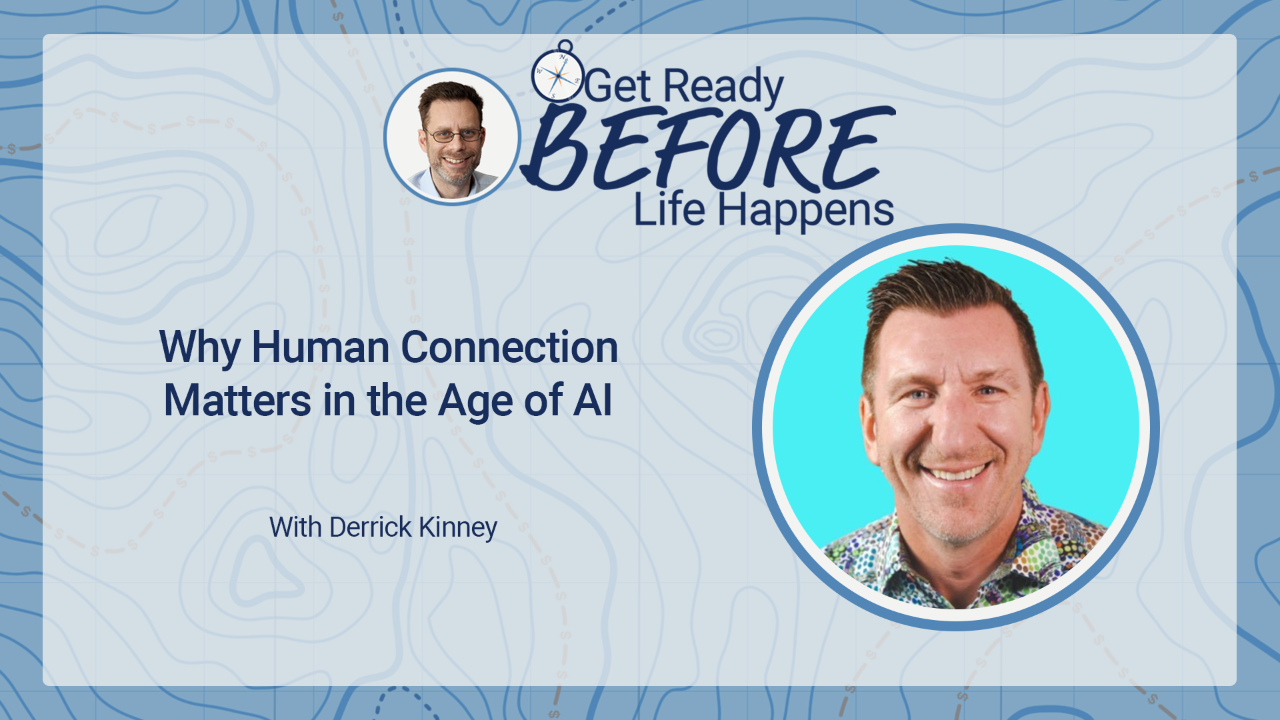
How can AI create more time for the human connections that help businesses grow?
Derrick Kinney joined me on this episode of Get Ready Before Life Happens to talk about using technology to create more time for clients and customers and focusing that time on the problems they want help solving. While AI can make businesses more efficient, human connection helps people feel understood.
While the conversation centers on financial advisors, the lessons apply to anyone who serves others: understand the problem, communicate simply, and become the person who truly gets them.
Key takeaways
- Use AI to create more time for people.
- Ask clients and customers about their comfort level with AI.
- Lead with the problem you solve, not your products or services.
- Explain your value in clear, relatable language.
- Reflect on why your best clients chose to work with you.
- Be human. People connect with people who feel real.
Tony’s Take: AI can provide information and improve efficiency. The opportunity for anyone serving clients or customers is to add context, understand what matters, and become a trusted voice who walks alongside them.
🎥 Watch this episode below:
🎧 Listen to the podcast below or on your favorite podcast app.
Connect with Derrick Kinney:
- Website: SuccessForAdvisors.com
- Website: www.derrickkinney.com
- LinkedIn: https://www.linkedin.com/in/derrickkinney/
- Instagram: https://www.instagram.com/derricktkinney
Books:
- Good Money Revolution: How to Make More Money to Do More Good (Amazon)
- Master the Media to Attract Your Ideal Clients: A Personal Marketing System for Financial Professionals (Amazon)
Bio:
Derrick Kinney is changing how you feel about money. He believes money is not bad and good people should have more of it. Derrick is the author of the Wall Street Journal and USA TODAY national bestseller, Good Money Revolution.
After applying these proven principles with thousands of clients, Derrick sold his multimillion-dollar financial advisory business to teach these success principles to all financial advisors. As CEO of Success for Advisors, Derrick and his team teach independent financial advisors a 5-step marketing framework to build 7-figure businesses that impact the world.
Known for making complex financial and business topics easy to understand, Derrick has been interviewed on CNBC, FOX News, CNN, FOX Business, Yahoo Finance!, PBS, Wall Street Journal, among others. As host of the top-rated Good Money podcast, he inspires business owners and entrepreneurs to make more money to do more good. His guests include Matthew McConaughey, Mel Robbins, Ed Mylett, Jon Gordon, Daymond John, and Sharon McMahon.
Recently Derrick set a big goal to positively impact one-million teens by giving them money, business, and life skills that aren’t taught in schools. As a passion project, he founded SimpleTeenSuccess.com, a new online program for teens to become money and business smart, build trust with adults, and stand out for the best opportunities.
👉 Start Your Financial Readiness Plan: A free, practical plan that helps you create your in-case-of-emergency Financial First Aid Kit, organize what matters, and prepare before life happens. Start Your Free Financial Readiness Plan https://www.tonysteuer.com
👉 Support Get Ready. Become a Get Ready Insider and help keep the Financial Readiness Plan free, support the podcast, trusted resources, and consumer-first financial education. You’ll receive access to the Get Ready Library. Support Get Ready here. www.tonysteuer.com/support
Transcript
Tony Steuer:
Making your dreams come true often comes down to how well you communicate your value.
I’m pleased to welcome Derrick Kinney back to Get Ready: Before Life Happens.
Derrick, thanks for joining me again.
Derrick Kinney:
My pleasure, Tony. It’s great to be with you.
Tony:
I’m excited to bring everybody up to date on what you’re working on because you have some really interesting things going on.
We were talking before the show about AI, which is top of mind for almost everybody right now.
How should people start thinking about AI in their daily and professional lives?
How do the human side and the AI side fit together?
Derrick:
One mistake I see advisors making is treating AI like the enemy.
They say things like:
“Don’t use ChatGPT. Just call me.”
It sounds good as a one-liner, but it positions the advisor as though the client has to choose between AI and the advisor.
What we’re already seeing is that many higher-net-worth clients are adopting technology early.
They’re bringing ChatGPT prompts, Claude responses, and AI-generated stress tests into meetings with their advisors.
The advisor then has a choice.
They can push back and say:
“I can’t believe you did that. AI doesn’t understand the human side.”
Or they can say:
“Great. Bring it in. We’re going to go through this together. Think of me as the voice of reason walking alongside you as you make these decisions.”
That second advisor becomes more attractive, more relatable, and probably more referable.
The message is:
“Bring all the AI you want. We’ll use it together as one of the resources in our relationship.”
Tony:
I love that idea of becoming more relatable.
We can either resist the technology or acknowledge that it’s here.
Consumers are already using AI.
The question is how professionals incorporate it into their work.
Do you still see a lot of advisors who are slow to adopt?
Derrick:
I think advisors often fall into two broad groups.
You have growth-oriented advisors and lifestyle-oriented advisors.
Neither one is wrong.
The growth advisor wants to move faster.
They’re like a Lamborghini stuck in city traffic.
They’re saying:
“Give me more gas so I can reach my goals faster.”
The lifestyle advisor looks at technology and thinks:
“If I can save more time, maybe I can spend more time with my family, play golf, or create a more flexible business.”
Both can benefit from AI.
But there’s one thing neither group should miss:
AI does not replace eye to eye.
You still need human connection.
Some advisors think AI means they’ll never have to prospect again or ask for referrals.
Yes, you may get more inbound leads.
You may have better websites.
You may have better automation.
But there’s still a moment when you need to connect with a problem that matters deeply to another person.
They need to think:
“You get me.”
I like to say:
If you want to make it rain, connect with pain.
When you connect with the pain point a prospect is already thinking about, you become much more relevant.
Tony:
And I think that applies well beyond financial advisors.
It applies to attorneys, accountants, insurance professionals, coaches, and really anyone working with clients.
You have to understand the problem the other person is trying to solve.
Derrick:
Exactly.
Advisors often ask me:
“Why am I not growing faster?”
“I know I’m better than my current revenue numbers suggest.”
“What do top advisors know that I don’t?”
One of the biggest mistakes is assuming that prospects are going to connect with features and benefits.
An advisor recently told me:
“I feel overlooked. Other advisors are getting the clients I want, and I know I’m better.”
So I asked him to walk me through how he talked with prospective clients.
He told me about the investment opportunities, services, features, and benefits.
I asked:
“Do you talk about the problems they’re trying to solve?”
He looked at me almost like I’d asked something strange.
He said:
“No.”
So I told him to start there.
Think about your ideal prospect sitting on the patio Friday night with the person they love most, talking about the week.
What are they saying?
Maybe:
“We make good money. Why do we still feel like we’re falling behind?”
“We’ve worked hard to build this. What if one bad financial move messes everything up?”
“We’ve done well financially, but why does my brain still feel chained to the office when I want to be with the kids?”
Those are real problems.
When you start talking about those concerns, the prospect thinks:
“That’s exactly what I’m worried about.”
Now you’ve connected with them.
This advisor came back within a month and told me he had picked up three new clients.
His mindset had shifted from pushing products to connecting with problems.
That changed everything.
Tony:
That really is a mic-drop point.
You have to connect with the problem your client is trying to solve.
When I worked as a fee-based insurance consultant, that was always my first question.
I would be brought in to analyze an insurance policy, and before I could say whether it was good or bad, I needed to know:
“What are you trying to accomplish?”
You can’t evaluate the solution until you understand the goal.
So how do you help advisors identify those problems more clearly?
Derrick:
I have a simple exercise called the Five and Five Exercise.
After listening to this, write down the names of your five most recent clients.
Then, to the best of your ability, write down the problem, worry, or concern that brought each of them to you.
Two things may happen.
First, you’ll start seeing the problems you’re actually solving today.
Second, you may realize that some of those clients aren’t your ideal clients.
Maybe you’ve been so focused on growing that you haven’t been intentional about who you really want to serve.
Then write down your five favorite clients.
These are the people whose names make you smile.
They appreciate you.
They take your advice.
They pay you well.
Maybe you even socialize with them.
Then write down the problem each of those clients originally came to you to solve.
Now you have a 10-person focus group sitting right in front of you.
They’re telling you what problems you’re solving.
Then you get to choose.
Do you like the problems you’re currently solving?
Do you want to go deeper?
Or do you want to move into a different niche or work with a different type of client?
You don’t necessarily need years of experience in a new niche.
You need a deeper understanding of the problems those people have.
Tony:
And that ties into how people describe what they do.
Titles usually don’t mean very much to the person on the other side.
Derrick:
Exactly.
I call this the You-Know-How Framework.
I was a financial advisor for 25 years before selling my business and moving into coaching, consulting, and speaking.
One of my biggest cringe moments was when someone asked:
“So, what do you do?”
If I said:
“I’m a financial advisor,”
I could almost see their eyes glaze over.
They’d say:
“I already have an advisor.”
I was defending my title instead of communicating my value.
Our practice specialized in people five to 10 years from retirement or already retired.
Their biggest fear was running out of money.
So one day, someone asked me what I did and I said:
“You know how so many people worry about running out of money in retirement? We help them fix that.”
Everything changed.
The person immediately said:
“That’s exactly what I’m worried about.”
Then I could explain:
“We have a five-step process where we build a strategy designed to help people create retirement income and feel more confident.”
Within a few seconds, they understood the problem we solved.
That’s the key.
When you tell people something new, they may not know what to do with it.
When you tell them something true about a problem they already recognize, they lean in.
Tony:
That’s exactly what happened in my own career.
If I told people I was a fee-based life insurance analyst, that didn’t mean much.
If I said:
“I help people review and monitor existing life insurance policies,”
financial planners immediately understood the problem I solved.
People want to know what you can help them do, not simply what your professional title is.
Derrick:
Exactly.
And it applies to almost anything.
Even if a plumber is listening right now, imagine someone asks:
“What do you do?”
Instead of simply saying:
“I’m a plumber,”
you could say:
“You know how when a pipe breaks you worry about getting ripped off? We help fix that.”
Now you’re speaking directly to a concern the customer already has.
The goal is to communicate as simply as possible.
Think about it like you’re talking to a third grader.
You want somebody to understand instantly.
You might say:
“You know how hardworking professionals make good money but still feel like they’re falling behind? We help fix that.”
Or:
“You know how doctors are great with their patients, but their own finances sometimes need a prescription? We help fix that.”
Or:
“You know how female executives can feel stuck financially after the death of a spouse, a divorce, or a job loss? We help fix that.”
Or:
“You know how business owners worry about making a huge mistake when they sell their company? We help fix that.”
Keep it simple.
Advisors are intelligent people, and sometimes we use too many words.
Tony:
That really is the heart of it.
Whenever someone hires another person, they’re trying to solve something.
If there’s nothing to solve, there’s no reason to hire anyone.
Even when you go to a restaurant, you’re choosing to have somebody else fix dinner.
So let’s circle back to AI.
We agree that AI shouldn’t be the enemy.
How should professionals go beyond simply using ChatGPT for occasional questions and start integrating AI into the business?
Derrick:
There are two sides to this.
An advisor recently told me:
“Derrick, because of my technology stack, I feel like I have an extra 10 hours a week.”
He asked what he should do with that time.
He had choices.
He could take more time off.
He could go play golf.
Or he could take even three of those hours and dedicate them to the most productive activities that would grow his business.
So I asked him:
“What are the three highest-value things you could do to grow?”
We identified those activities and blocked one hour for each of them on his calendar every week.
That way, when the time came, he didn’t have to decide what to do.
His calendar told him.
That’s one way AI can help.
Technology gives you time.
Then you decide how to use that time.
The other side goes back to human behavior.
You can fight human behavior or join it.
One of those is going to make life a lot easier.
Instead of telling clients:
“Don’t use AI,”
ask them:
“On a scale of one to 10, how comfortable are you using AI in your daily life?”
Let the client tell you.
If somebody says they’re a 10 and they love AI, then integrate AI into your planning process and tell them what you’re doing.
They’ll probably find that interesting.
Think of it as matching your client’s AI personality in the same way you might adapt to someone’s communication style.
The message should never be:
“Me versus AI.”
It should be:
“Us together, eye to eye.”
Tony:
That’s going to become increasingly important because AI is being placed directly into everyday search.
People are going to show up with AI-generated information whether professionals like it or not.
So the question becomes:
How do you work with it?
How do you partner with it?
And that brings us back to the human side.
If AI can increasingly handle some of the technical pieces, how do advisors strengthen the human part of what they do?
Derrick:
I was always more of an introvert living in an extroverted profession.
I realized that if I was going to succeed as an advisor, there were going to be moments when I had to interact with people and do it well.
Some advisors are energized by being around people all day.
Others find that draining.
Understand who you are.
But here’s what’s especially important right now:
Perfection is overrated.
People like real.
They like raw.
They like human.
This is actually a great time for advisors to simply be themselves.
I was always a suit-and-tie advisor.
One afternoon, I left the office early because my daughter had a volleyball game.
I changed into a T-shirt, shorts, and flip-flops.
I went to the gym and saw a lot of clients there.
Several of them came up and said:
“Derrick, it’s so nice to see you relaxed.”
That was like a bucket of cold water over my head.
I realized I needed to be more relatable.
I had thought:
“I have to look like an advisor.”
“I have to act like an advisor.”
“I have to talk like an advisor.”
And I never wanted to let my guard down.
But people wanted to see the human being.
I also used to tell new clients:
“I need to be honest with you. I’m not perfect, and neither is my team. Occasionally a number may get transposed or something might look wrong. If you see anything, call us and we’ll take care of it.”
I was telling them upfront:
Mistakes can happen.
Here’s how we’ll handle them.
That creates trust.
The other phrase I like is:
We’re here to walk alongside you.
Even though AI can be incredibly helpful, it’s also new and uncertain for a lot of people.
The advisor can be the voice of reason.
You’re not competing with technology.
You’re complementing it.
If you do that well, in an era when people are predicting the death of the human advisor, clients may actually want more human connection.
Tony:
I completely agree.
The most successful advisors I’ve known almost always have real relationships with their clients.
Their clients know them.
They talk to them.
They trust them.
That becomes even more important as the technical tools become easier to access.
Derrick:
Exactly.
If your mindset is:
“AI is here to replace me,”
that attitude is going to show up in how you communicate with clients and your team.
Instead, position yourself as someone who helps clients make the most of technology.
Maybe you help them think about how to use AI responsibly.
Maybe you educate them about scams and fraud.
Maybe you ask questions about their concerns around technology.
You do not need to become the ultimate AI expert.
You need to listen well enough that the client feels understood.
That alone can elevate your role.
Tony:
And ultimately it comes back to helping people.
People like working with people who are there to help.
If you stay focused on that, a lot of this becomes much simpler.
You’re there to guide the client.
You’re walking alongside them.
If they get off track, you help them get back on track.
Before we close, tell us a little about your book, The Good Money Revolution.
Derrick:
The book is built around something I hear from advisors and entrepreneurs all the time.
People work incredibly hard to build the business.
They want the big bank account.
They want two commas in their net worth.
They want the kind of success people respect.
Then they reach those goals and sometimes look around and realize there’s nobody there to share it with.
Or the success doesn’t provide the meaning they expected.
The message of The Good Money Revolution is that money isn’t bad.
Good people should have more of it.
The book gives people a practical roadmap for making more money and then doing more good with it.
Tie a cause to your cash.
Tie meaning to your money.
Tie purpose to your profits.
Then when you put your head on the pillow at night, you can say:
“I lived a day with purpose, meaning, and impact.”
That’s what the book is about.
Tony:
I love that.
Do good with your money.
When people get older, they rarely say:
“I wish I had spent more time at the office.”
They think about the impact they had.
And that also brings us back to client relationships.
Clients want you to have a positive impact on their financial lives.
If you’re not doing that, the relationship probably isn’t going to last.
Derrick:
Exactly.
Technology can improve efficiency.
And the best use of that efficiency may be creating more opportunities for human connection.
I believe the advisors, coaches, consultants, and entrepreneurs of the future will take the time technology gives them and reinvest some of it into people.
Face to face wins the race, and voice to voice is always the best choice.
Tony:
I love that.
Derrick, where can people learn more about you, your work, and pick up a copy of The Good Money Revolution?
Derrick:
LinkedIn is our biggest content channel.
I share free daily advice around attracting clients, improving your messaging, and identifying the problem you solve.
Advisors can also go to SuccessForAdvisors.com.
And they can join our weekly Words Equal Wealth newsletter, where we share practical strategies around what to say and do so your ideal clients choose you.
Tony:
Fantastic.
Derrick, thanks for joining me again on Get Ready: Before Life Happens.
Derrick:
My pleasure, Tony. I really enjoyed it.
Tony:
It’s always a pleasure talking with you.
And thank you, everyone, for tuning in to Get Ready: Before Life Happens.
If something today changed the way you think about communication, AI, or the value of human connection, please share the episode and subscribe.
Start your free Financial Readiness Plan at tonysteuer.com. It is a practical way to begin building your in-case-of-emergency plan before life happens.
You can also help keep the Plan free and support this podcast by becoming a Get Ready Insider for $5 a month.
Because when life happens, the way you think about money matters.