Get Ready

Insights, conversations, and trusted resources to help you ask better questions, make confident decisions, and become financially ready before life happens.

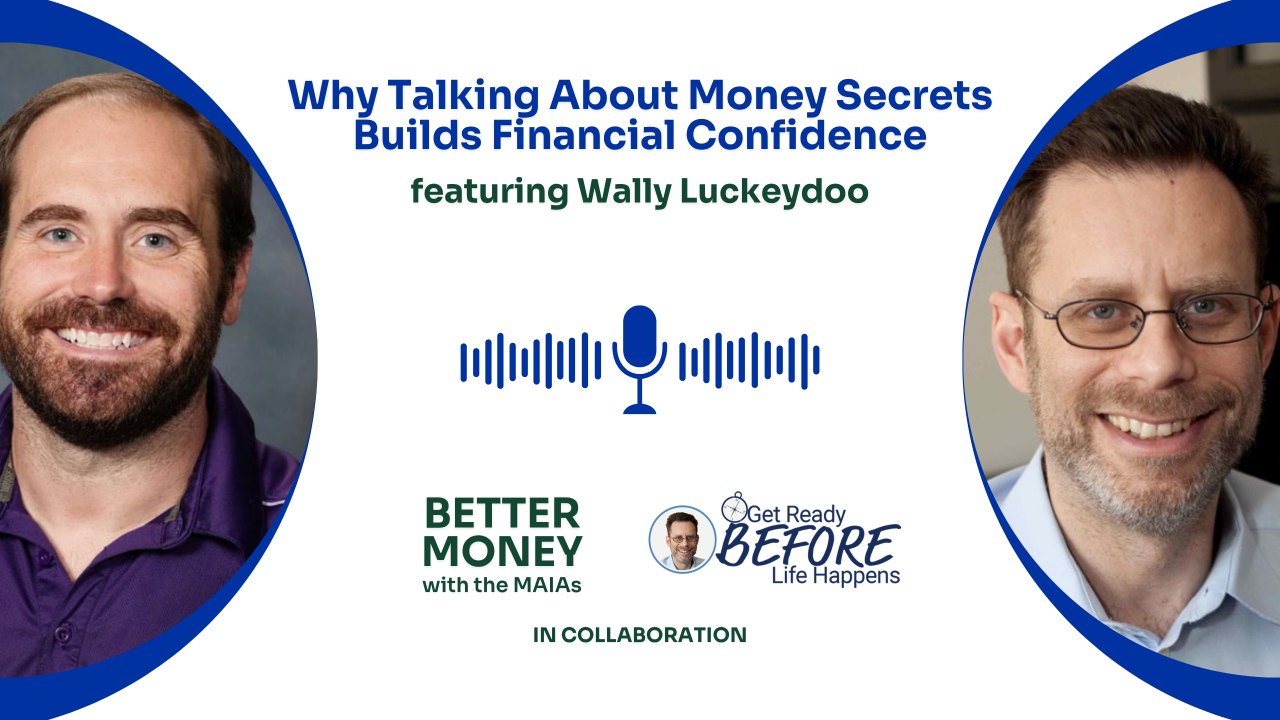
Why Talking About Money Secrets Builds Financial Confidence

kids financial literacy podcast episode Sep 15, 2026

Money shapes our choices, relationships, and confidence. 

 Wally Luckeydoo, educator and founder of Money Secret joined me on the Get Ready Before Life Happens podcast to explore why money conversations matter, how anonymous money secrets help people feel less alone, and why financial literacy works best when it includes emotions, behavior, and real life.

 Key Takeaways 

  • Money conversations build trust and confidence
  • Money secrets reveal the emotions behind financial decisions
  • Sharing money stories helps people feel less alone
  • Financial literacy depends on both content and delivery
  • Sports gambling is an important conversation for students and families
  • Partners benefit from talking openly about money habits and expectations
  • Money mistakes can become learning moments

 Tony’s Take: Money secrets are money stories. Financial literacy is more than information. It is also about emotions, behavior, trust, and communication. When we talk more openly about money, we help people learn, connect, and make better decisions before life happens.


 đźŽĄ Watch this episode below: 


🎧 Listen to the podcast below or on your favorite podcast app. 


Connect with Wally Luckeydoo, Ed.D. 


Resources mentioned: 


Bio: 


Dr. Wally T. Luckeydoo holds multiple professional degrees and is an award-winning educator and leader in financial literacy with a strong commitment to experiential learning. He teaches Work-Based Learning and Personal Finance at Smyrna High School, where he prepares students with practical, career-ready skills through hands-on experiences. He also serves as an adjunct professor, teaching Sports Management courses at Abilene Christian University and Cumberland University, as well as Dual Enrollment Personal Finance at Bethel University.


Dr. Luckeydoo is the creator of MoneySecret.net, a platform that uncovers real, anonymous financial stories to spark meaningful conversations and deeper understanding of personal finance. His work has earned him numerous recognitions, including the 2026 Excellence in Financial Literacy Education Educator of the Year Award, the 2026 Jump$tart Corey Carlisle Public Policy Award, the 2025 Tennessee Educational Technology Association Outstanding Teacher of the Year Award, the 2024 Tennessee Jump$tart Educator of the Year Award, and honors from Next Gen Personal Finance as a Distinguished Educator and Extra Mile Award winner. He is dedicated to equipping students with the knowledge and skills needed to succeed in school, career, and life.

In collaboration with The Money Awareness and Inclusion Awards (the MAIAs) which celebrate the increasingly important work being done to help people understand money better. Learn more: https://www.maiawards.org.  

👉 Start Your Financial Readiness Plan: A free, practical plan that helps you create your in-case-of-emergency Financial First Aid Kit, organize what matters, and prepare before life happens. Start Your Free Financial Readiness Plan  


👉 Support Get Ready. Become a Get Ready Insider and help keep the Financial Readiness Plan free, support the podcast, trusted resources, and consumer-first financial education. You’ll receive access to the Get Ready Library. Support Get Ready here


Transcript

Tony Steuer:
Financial clarity starts with understanding what’s really driving your decisions.

Today I’m joined by Wally Luckeydoo.

Wally, welcome to Get Ready: Before Life Happens.

Wally Luckeydoo:
Thank you. I appreciate you having me on the podcast today.

Tony:
I appreciate you being here. I love what you’re building with Money Secret. It’s a great program, and I can’t wait to let everybody know more about it.

Tell us a little bit about yourself. What is your origin story, and how did it lead you to create Money Secret?

Wally:
I’m a personal finance teacher at the high school level. I also teach dual-enrollment personal finance.

I never really thought about being a teacher to begin with, much less a personal finance teacher.

I found myself at a high school for my first job, teaching marketing and hospitality. There were some safety concerns there, so I left that position.

Then another high school was hiring a personal finance teacher. I applied and ended up getting hired.

At the time, I didn’t really know what I was doing with my own finances.

So I started teaching personal finance, got really involved with it, and saw the difference it was making with students, the community, and the questions the kids were asking.

It became a passion of mine over time.

That basically led to Money Secret this past school year.

There aren’t a lot of lessons out there about behavioral finance.

You hear about the math and all the different financial problems people have, but we don’t always talk about the emotions behind money.

That’s where Money Secret came into play.

It started as a lesson I created that multiple groups could participate in. High school students can participate. College students can participate. Adults can participate.

Money Secret was inspired by PostSecret.

People can anonymously send in their money secret at MoneySecret.net.

They can either send a postcard through the mail or submit it online.

If they send it through the website, I’m the only person who sees the original submission.

I put an AI image with the secret, but I never change any of the words because those are people’s personal thoughts, and I don’t want to change that.

It also gets conversations about money going.

I like talking about money.

People think money is taboo, and we need to start talking about it because money influences pretty much every aspect of our lives from the time we’re born until the time we die, and even after we die.

We should be talking about money.

Some people have a lot of fear and anxiety around money and the decisions they’ve made.

I have plenty of money secrets and things I regret doing.

They don’t all have to be negative. They can be positive too.

You could say you have a lot of money saved somewhere or that you’re doing great things with money.

Or you could say you had a negative experience.

It’s simply a way for people to express themselves.

It’s basically a money secret postcard.

Tony:
It’s such an interesting project because it gets people to open up about things they might not normally talk about.

I want to walk back quickly to what you were saying about the classroom.

I’ve seen something similar in my son’s school district.

They had a financial literacy course, and it was broken up between, I think, the history teacher, the math teacher, and the social science teacher.

I was on the school board, so I knew all the teachers.

None of them really felt comfortable teaching the class because they didn’t necessarily feel confident about their own personal finances.

Is your situation, and what I saw in my son’s school, unique? Or is this a broader trend you’re seeing?

Wally:
I teach in Tennessee, where personal finance is a standalone course and is required for graduation.

Students have to take it for a semester.

But it really depends on the school and school district who actually teaches the course.

Some people are qualified to teach it, and others are just thrown into the course because the kids have to have it to graduate.

There has been a major push around Tennessee and in other states for people to really know what they’re talking about when they teach personal finance.

In Tennessee, educators can attend the Tennessee Jump$tart Conference to work toward their personal finance certification.

They can also take a two-day course online to be able to teach the class.

I’d really like it if teachers had to pass something like the W!se certification or a practice exam before teaching the course.

We’re not there yet.

Hopefully we’ll start moving in that direction so more teachers are qualified to teach the course rather than simply being placed in it.

You also have people who aren’t comfortable teaching personal finance and want to become more comfortable but don’t know how.

That’s one thing I try to do.

I try to help teachers and show people what I’m doing.

Tony:
That’s awesome.

I have some knowledge of Jump$tart. It’s a great organization.

It helps educators and educational organizations.

Jump$tart has coalitions in many states, and there’s also the national organization.

Do you know whether this teacher training is something that’s been rolled out nationwide or whether it’s unique to Tennessee?

Wally:
Some states have their own coalitions, and there’s also the national Jump$tart organization.

In Tennessee, we have the Tennessee Jump$tart Conference, where personal finance educators and aspiring personal finance educators can attend in Gatlinburg, Tennessee.

It’s usually the first week of June.

At the national level, there’s also a National Educator Conference.

Educators can apply for scholarships, and generous donors provide funding through Jump$tart so teachers can attend.

Their hotel and food can be covered, and a lot of times teachers are encouraged to talk to local businesses or banks to see if they’ll cover travel.

The National Educator Conference is probably the best conference I’ve ever been to.

The people who run the organization are very supportive of teachers and personal finance education.

We’re basically like a family there.

Tony:
That’s awesome.

Jump$tart is a great organization.

For everybody watching and listening, there’ll be links in the show notes to the National Jump$tart Coalition and its state resources.

I think what we’re getting at is that when we talk about financial literacy, we often talk about the subject rather than the implementation.

That’s one of the reasons we don’t always see financial literacy making the difference we expect.

We need to think about implementation, delivery, and how the information is actually consumed.

That brings us back to Money Secret because something like Money Secret gets students interested.

What has the response been from your students?

Wally:
Let me explain how the lesson runs in my classroom.

When students come in, there’s a bell-ringer question on the board that gets them thinking about deeper issues.

These can be pretty tough questions.

Even adults sometimes struggle with them. I’ve used them in conference presentations.

After we discuss that, I give the students paper and colored pencils, crayons, markers, or whatever they want to use.

The first thing they do is think of a money secret that someone else might have.

There’s no pressure involved because they aren’t talking about themselves.

They might have heard the secret from a friend or family member, or it may be something they’ve seen or can relate to.

They draw the money secret someone else might have, put their name on the back, and then we do a gallery walk around the classroom.

We post the pictures and students work in pairs or groups.

They go around the room and talk about what’s going on in each person’s money secret.

One person might have a trust fund.

Another might be struggling with sports gambling.

Someone might have a shopping addiction.

There’s a lot of addiction behind some of the secrets.

After they’ve discussed them, we sit down as a group and talk about the secrets that caught their attention the most.

The conversations just keep going.

It’s probably my favorite lesson of the year because we’re talking about money and everybody is comfortable because they’re talking about other people rather than themselves.

At the end of the lesson, they have an exit ticket where they reflect on what they learned.

Then they’re given time to write down their own money secret.

I give them postcards.

I tell them not to put their names on them.

There’s a box on the opposite side of the room from my desk, and students can put their money secret into the box as they leave.

They can color it, draw something, or express themselves however they want.

There’s no real requirement.

They could simply write one line and put it in the box.

After they leave, I go through the secrets.

They help me look at the lessons I’ll be teaching throughout the semester.

They give me things I can address.

I can talk about sports gambling.

I can talk about Amazon shopping or other spending behaviors.

Aside from what I already have to teach, it gives me a way to address things that are actually happening in their lives.

Tony:
I’m curious.

Have you seen an improvement in students’ grades, comprehension, or performance after doing Money Secret?

Wally:
I think it helps develop the relationship and trust between me and the students.

With those relationships being built, I think that also helps with test scores and with the things we do in class.

For example, all of my dual-enrollment classes had a 100% W!se certification pass rate this year.

We do the certification at the end of the year and Money Secret near the beginning, so it all builds on itself.

Students are able to express themselves.

They also talk to me more.

And they listen to my experiences because I’m not afraid to share some of my own money secrets.

I’ll tell them, “Don’t do what I did.”

That gives them a head start in life.

Tony:
Communication is one of the most important aspects of our personal financial lives.

Wally alluded to this earlier.

We often don’t talk about money, and keeping those feelings buried can make things harder.

There’s something about secrets that many of us learn.

Sometimes the secret becomes bigger in our minds the longer we hold onto it.

Once you put it out there, you may realize the reaction isn’t as bad as you expected.

And everybody has something.

Talking about money secrets can be an important step.

Wally:
A lot of people have the same secret as you.

If you were actually talking about it, you could help each other out.

That’s one thing I realized during a recent presentation.

A lot of people have the same issues.

It helps to release that and then move forward and try to be better with our money.

Tony:
That makes a lot of sense.

What are some of the most common secrets you’re seeing?

What are some of the biggest struggles?

Wally:
With teenagers, definitely sports gambling.

I don’t know how many DraftKings, BetMGM, and other sports betting references I see.

It’s crazy to think that kids are already dealing with that.

With adults, I see a lot of overspending because of emotions.

When they’re feeling bad, they’re shopping or trying to do something to fill whatever void they might have.

Those are probably the two biggest ones.

With adults, it’s emotional overspending.

With teenagers, it’s sports gambling.

Tony:
That’s pretty remarkable.

I’ve heard a lot about sports gambling, and it’s hard for me to completely wrap my head around because it wasn’t something I could easily have done as a student.

I didn’t have an iPhone.

I didn’t have a casino in my pocket.

Wally:
A casino in your pocket. Exactly.

Tony:
It’s hard for people in my generation to say, “I would never do this,” because we never had the same opportunity to do it.

A lot of parents may be thinking, “This is an issue I’m not even aware of.”

What steps can parents take to understand whether this is an issue and then deal with it?

Wally:
As a culture, we’re immersed in the sports gambling world.

You drive down the road and see billboards for DraftKings or FanDuel.

Then you go to a game and see advertisements for sports betting everywhere.

I address it in my personal finance class because Money Secret shows me students are dealing with it.

I try to be open about what could potentially happen.

I show them a TED Talk from a gentleman here in Nashville who struggled with sports gambling addiction so they can see how serious it can become.

Some kids use parents’ accounts or information from an uncle or brother.

Parents need to talk about what’s going on because they may have no idea.

If I were the parent of a teenager, I would tell them to talk to their child about what’s happening in their life, especially anything involving money.

These things can have major repercussions, including addiction.

Tony:
We ran into something related with my son.

He was buying loot boxes in a couple of games, and the account was connected to my wife’s Apple account.

Then suddenly we got a credit card bill that was really high.

We thought, “What is going on?”

These things can happen in any family.

If you think it couldn’t happen to your kid, it can.

Kids are exposed to these things, and many of them don’t yet have the tools or experience to recognize what can happen.

I think one of the big values of Money Secret is that students can say, “I’m not alone.”

Do you think they’re getting that from the program?

Wally:
Yes.

I think they realize other kids are going through the same things they are.

When they’re doing the prompt about somebody else’s secret, they start talking about what they’re drawing before we even do the gallery walk.

Someone will say, “Here’s a money secret I experienced with my cousin.”

Then another person will say, “My cousin does that too.”

It’s an awesome thing to hear as a teacher because you’re hearing engagement and conversations about things that really matter.

That’s why I really like the Money Secret work.

Tony:
I love the whole concept because it creates those conversations.

Adults don’t always talk about money either.

What would you recommend adults do to kick-start money conversations, whether it’s with a spouse, partner, or their kids?

Wally:
Put a money secret out there.

Go to MoneySecret.net and look at what other people are experiencing.

I have two different sections on the website.

One is basically adult secrets, and the other is student secrets.

You can see what other adults are going through.

You also need to talk to your partner about their experiences with money.

One of the major lessons I teach is about who your partner is going to be.

That person can have a major influence on how you deal with money because their behavior influences your behavior, and their past financial decisions can influence your future.

For example, maybe someone has a lot of student loan debt and the two of you want to buy a nice house.

If you’re not on the same page, there can be a struggle making that decision.

It’s very important to talk about money before things get serious.

Tony:
I love that because talking to a partner or potential partner about money is something people often overlook.

One of the things I’ve noticed with financial literacy programs aimed at students is that sometimes the students actually help their parents become more financially literate.

Are you seeing that as a side benefit?

Wally:
Absolutely.

They’ll go home and talk to their parents about what we did in class.

Then I’ll hear about the conversation the next day.

The things I’m teaching are going home with these kids.

They’re asking questions.

They’re talking with their parents.

Then they come back into the classroom and talk about those conversations.

Sometimes parents even email me asking questions about financial literacy topics.

I think that’s a really neat thing.

Tony:
That’s awesome.

It’s another way to think about financial education.

There’s a ripple effect.

For those of us talking about financial literacy, writing books, creating podcasts, running programs, or leading nonprofits, the work can travel beyond the person we’re directly serving.

You may be changing the lives of the people around them too.

Wally, to wrap up, I have what I call the Get Ready Hot Take Trio.

These are three quick questions I ask all my guests.

What is one money myth you’re trying to break?

Wally:
That money is taboo.

We need to talk about it.

If we don’t talk about it, how are we going to get ahead as a society, community, and nation?

Tony:
I love it.

Talking about money is incredibly important because money is part of so much of our lives.

It’s a tool and a skill.

Wally, let’s get out the time machine.

If you could go back to the start of your teaching career, what advice would you give your younger self knowing what you know now about money?

Wally:
Knowing what I know now, I would have started teaching earlier.

I haven’t always been a career educator.

I’ve only been teaching for about eight years.

Had I started earlier, I would be further along toward retirement.

I also wish I would have taught personal finance my first year.

But you don’t know what you don’t know.

Tony:
I love that: you don’t know what you don’t know.

Especially with personal finance.

It’s easy to look back and think maybe I should have done this or maybe I should have done that.

The important part is learning.

If you’re a parent, start talking to your kids about money.

Kids can begin learning basic money concepts very young.

And if you’re an adult and you don’t feel comfortable with money yet, it’s never too late to learn.

So to wrap up, what’s your number one tip for changing the way we think about money?

Wally:
I would say learn as much as you can.

I’m a lifelong learner, and I love learning things.

The things I learn change the way I think about money, deal with money, and behave with money.

The more I learn, the more I know personally.

And the more influence I can have on other people, like my students.

If you make a mistake, it’s just a mistake.

Sometimes it might not be easy to get past it, but we all learn from our mistakes.

Use whatever mistake you’ve made, try to turn it around, and keep learning.

Tony:
I love that.

If you make a mistake, it’s just a mistake.

People who have watched or listened to this podcast have heard me reference Michael Jordan quite a bit.

He talked about all the times he failed and how those failures helped him succeed.

I’m in the MJ-as-GOAT camp. Sorry, LeBron fans.

This show is pro-MJ.

You can’t argue with his success.

And it’s interesting that someone as successful as he was could be so open about mistakes and failure.

Wally:
That’s my life in general.

I tell the kids I serve, “These are all my mistakes. Please don’t make the same ones I did.”

I can learn from my mistakes and correct them.

Then everybody gets to succeed.

Tony:
I bet you weren’t expecting to be compared to Michael Jordan today.

Wally:
First time ever.

Tony:
I’m going to need to see your jumper.

Wally, where can people learn more about you and Money Secret?

Wally:
Go to MoneySecret.net.

You can see the money secrets or submit your own online.

You can also send a money secret to P.O. Box 158, Smyrna, Tennessee 37167.

You can find me on LinkedIn. I have a big presence there under Wally Luckeydoo.

And you can find me as Dr. Luckeydoo on Facebook.

Tony:
Fantastic.

For everybody watching and listening, you’ll find links in the show notes.

Wally, thanks for coming on Get Ready: Before Life Happens.

Wally:
Thank you for having me.

Tony:
This was a lot of fun.

We’ve known each other for a while, so I’m glad we were finally able to do this.

Start your free Financial Readiness Plan at tonysteuer.com. It is a practical way to begin building your in-case-of-emergency plan before life happens.

You can also help keep the Plan free and support this podcast by becoming a Get Ready Insider for $5 a month.

Because when life happens, the way you think about money matters. 


Start Preparing  Before Life Happens 

Your Financial Readiness Plan will help you organize what matters, ask better questions, and prepare for life's curveballs.

It’s free, practical, and designed to be completed at your own pace.

Start Your Free Financial Readiness Plan