
Women, Money, Reinvention, and the Next Chapter
Nov 03, 2026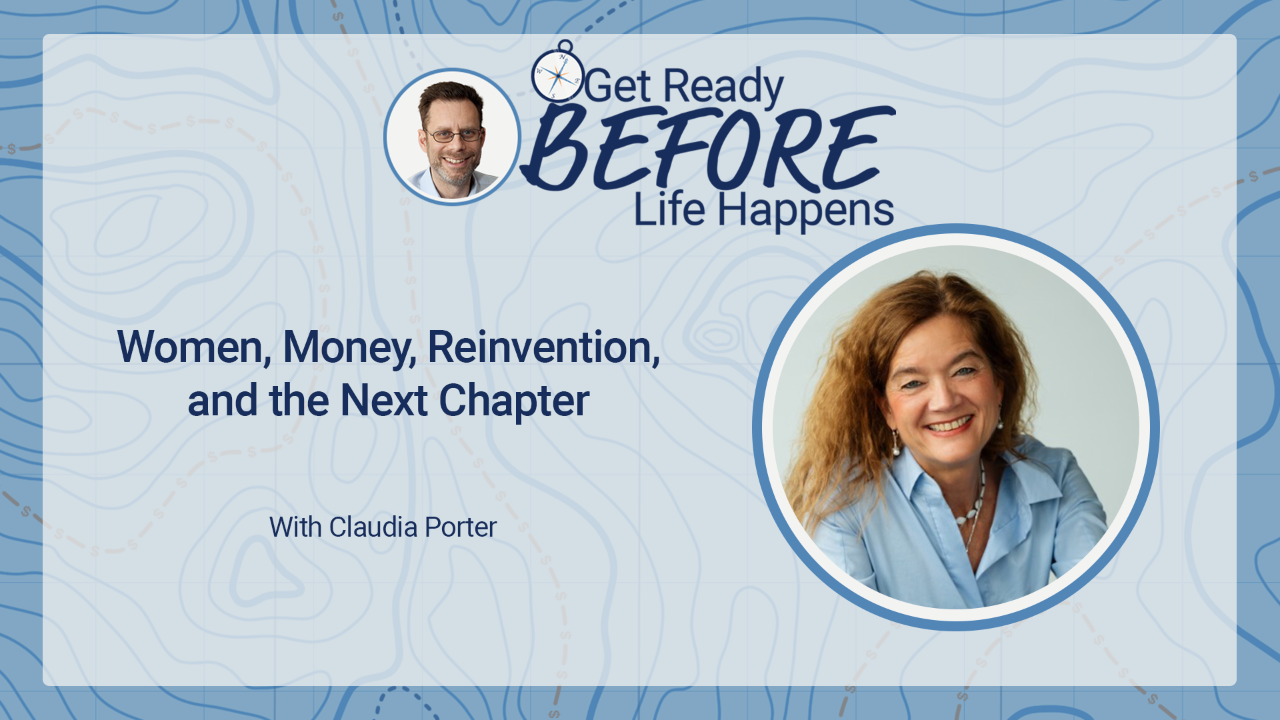
Understanding your financial picture helps you make informed decisions about your next chapter.
Claudia Porter joined me on the Get Ready Before Life Happens Podcast to talk about how women can take ownership of their finances, build wealth beyond their businesses, and prepare for life's transitions.
What Stood Out
- Women need to understand their finances and know how to access their money.
- Building personal wealth beyond a business creates more financial options.
- Retirement savings and succession planning help prepare business owners for transitions.
- Taking one practical step can make financial decisions feel more manageable.
The Bottom Line: Financial ownership gives women more choices as they navigate life's transitions and new opportunities.
🎥 Watch this episode below:
🎧 Listen to the podcast below or on your favorite podcast app.
Connect with Claudia Porter, CFP®, CDFA®:
- Website: https://rfgadvisorywealth.com/claudiaporter/
- LinkedIn: https://www.linkedin.com/in/claudia-porter-cfp/
- LinkedIn Newsletter: Next Chapter Finance: https://www.linkedin.com/newsletters/next-chapter-finance-7294447966138875904/
Books:
- On the Other Side: A Woman’s Guide to Rediscovering Strength and Success Beyond Adversity (Amazon)
- Women, Wealth and Winning: Essential Strategies Female Business Owners Should Know to Master Your Money, Cultivate Success, and Build a Solid Financial Future (Amazon)
Women & Money: The Sh*t We Don’t Talk About Podcast from Purse Strings episodes:
- The Wake-Up Call We Can’t Ignore with Candy Wolff, Claudia Porter, and Amy Salo: https://www.youtube.com/watch?v=nzIak1V4WWo
- Overcoming Financial Abuse: https://www.youtube.com/watch?v=egRKuzgO5Mk
Bio:
Claudia Porter is a Certified Financial Planner® and has been in the financial industry for 11 years and partnered with RFG Advisory in March, 2025 to build her own wealth management firm.
She has a Master's Degree in Teaching English and French from the University of Göttingen and a Ph.D. in Linguistics from Braunschweig Technical University. In 2014, she left academia to return to her earlier passion for financial planning and wealth management to make a more significant impact in people’s lives. For Claudia, “Success is not what you get, but the positive impact you make in other people’s lives.”
She is the author of 2 books, “Women, Wealth, and Winning” and “On The Other Side: A Woman’s Guide to Rediscovering Strength and Success Beyond Adversity”.
👉 Start Your Financial Readiness Plan: A free, practical plan that helps you create your in-case-of-emergency Financial First Aid Kit, organize what matters, and prepare before life happens. Start Your Free Financial Readiness Plan https://www.tonysteuer.com
👉 Support Get Ready. Become a Get Ready Insider and help keep the Financial Readiness Plan free, support the podcast, trusted resources, and consumer-first financial education. You’ll receive access to the Get Ready Library. Support Get Ready here. www.tonysteuer.com/support
Transcript
Tony Steuer: What happens when a woman has to rebuild her money, her confidence, and her next chapter at the same time?
Welcome to Get Ready: Before Life Happens. I'm your host, Tony Steuer.
Today, I'm joined by Claudia Porter.
Claudia, welcome to Get Ready: Before Life Happens.
Claudia Porter: Hey, Tony. Thanks so much for having me on your podcast today.
Tony: I'm excited to talk with you and share your book, Women, Wealth, and Winning.
To start, what led you to focus on helping women navigate money, life transitions, and reinvention? I'm particularly interested in the transitions and reinvention component.
Claudia: This focus is deeply personal to me because my own life led me here.
I've gone through several transitions. The biggest was a major divorce.
It forced me to confront everything: my finances, my identity, and my future.
At the time, I was a linguistics professor. I realized that if I, as an educated professional, was feeling so overwhelmed by the financial side of this transition, countless other women must feel the same way.
Interestingly, I'd wanted to become a financial advisor when I graduated from high school in Germany.
But at the time, I was told that because I was a woman, I could be a bank teller. I was going to get married and have children, and the financial services industry really wasn't for me.
So I didn't see a way into the industry.
Then, while I was going through my divorce, I remembered that message I'd received so many years earlier.
Thinking about that experience and how I was feeling really lit a fire in me.
I left academia and decided to become a financial planner.
Eventually, I started my own wealth management firm focused on serving women navigating the kinds of transitions I'd experienced myself.
So this work is very deeply personal to me.
Tony: Unfortunately, it's becoming increasingly necessary with the rise in gray divorce and the number of women experiencing widowhood and other major life changes.
And sometimes women haven't been actively involved in their financial lives.
That's something I regularly emphasize on this show. Women need to get involved with their finances as early as possible.
Even if it's just understanding what's going on, it's incredibly important.
When you went through your divorce, did you feel that you didn't know enough about the family finances?
Claudia: Before I got married, I was fairly independent.
Then I got married, and we had four boys in four and a half years.
I became very financially dependent. I taught sporadically just to keep my foot in the door professionally.
But I wasn't really included in the conversations with our financial advisor.
I wanted to understand what was going on so that if something happened to my husband, I would know how to access money and continue supporting our four boys.
But I wasn't included in those conversations, and it didn't feel good.
That became one of the points of contention in our marriage.
I trusted that my husband would take care of me because that was the message I'd received from my father when I was growing up.
My father had always taken care of my mother and me.
But at the same time, something didn't feel right.
I kept thinking, "What if something happened? How would I access money? I don't know where anything is. How would I continue taking care of the children?"
Tony: That's such an important issue.
Being able to access money is critical.
There's the question of how bank accounts are titled and whether both spouses have access to them.
But beyond that, it's simply knowing where the money is and how to access it.
If someone becomes a widow, they may need access to cash immediately.
So having that working knowledge is essential.
And as you mentioned, many of us grew up in households where women didn't have much involvement in managing money.
In the United States, women also faced significant barriers to obtaining credit and mortgages until legal changes in the 1970s.
So some of these financial rights are relatively recent.
And circumstances are different in other countries and cultures.
But wherever someone lives, it's important to be involved in their financial life as much as possible.
Claudia, tell us a little about your book.
What inspired you to write Women, Wealth, and Winning?
Claudia: I kept having the same conversations with women, particularly business owners and entrepreneurs.
These were brilliant, driven women who had built incredible businesses.
But many had never been given a clear framework for turning their business success into lasting personal wealth.
So I wrote Women, Wealth, and Winning to help fill that gap.
The book walks women through how to think about their businesses as wealth-building engines.
It's about making informed financial decisions and understanding how to make money work for them.
It's also about participating in financial conversations rather than allowing someone else, even a spouse, to make all the decisions.
I saw the same issue with professional women who weren't business owners.
Even some young women in their 20s were quick to hand over financial decisions to their significant others.
That surprised me.
I wanted to encourage women to become active participants in their financial lives and take responsibility for their decisions.
When you have a plan and life changes, you have something to build on.
You don't have to start from scratch.
I've seen what happens when someone relies entirely on a significant other and then experiences a divorce, illness, or loss.
Suddenly, they can't access money.
They don't know where anything is.
They don't know where to begin.
They have the emotional stress of the transition, and then they have additional financial stress.
It compounds everything.
Another issue I frequently see with business owners, both men and women, is that they don't necessarily build personal wealth outside their businesses.
They put everything back into the business because they want to keep growing it.
But if something goes wrong and they have to step away, they may not have much to fall back on.
Maybe they become ill and can't continue working.
Maybe they need to sell the business.
If all their wealth is tied up in that one business, they're vulnerable.
The book helps people think about their businesses and wealth differently.
It offers ideas for building personal wealth while continuing to grow a business.
That way, they have financial resources available if life changes.
It's the book I wish I'd had when I was reinventing my career and, really, my entire life.
Tony: You've raised several important points.
First, women need to participate actively in financial conversations, including meetings with financial planners.
And being deliberately excluded from those conversations can sometimes be a warning sign of financial abuse or control.
Financial abuse can happen in different types of relationships, but the important thing is recognizing when someone is restricting your access to financial information or resources.
Your point about business owners reinvesting everything in their businesses is also interesting.
It's something we haven't discussed very often on this podcast.
There's a natural tendency to keep putting money back into a business because you want it to grow.
But as you've said, business owners also need liquidity and personal wealth outside the business.
What are a couple of practical steps you recommend to help business owners start addressing that?
Claudia: First, I'd encourage people to have a retirement plan.
But I'd also encourage them to think about what happens if they need to step away from their business before retirement.
Maybe there's an illness or another major life change.
I wouldn't put everything into retirement accounts because there can be restrictions, taxes, or penalties associated with accessing that money before retirement age.
I'd also consider building assets in a brokerage account, whether that's an individual account or a joint account with a partner.
That gives you resources you may be able to access if something happens before you're ready to retire.
I look at it this way.
Business owners love their businesses. They're attached to them, and they want to keep growing them.
But imagine telling a business owner, "I think you should put all your money into one particular stock."
They'd probably say, "That's too much concentration."
And I'd say, "Exactly."
That's what you're doing when all your wealth is tied up in your business.
If everything depends on one thing, that's a significant risk.
So I encourage people to build different financial buckets outside the business.
That gives them more options if something changes.
Tony: That's an excellent way to look at it.
It's concentration risk.
You're putting all your eggs in one basket.
Things can happen to a business.
My grandfather lost his business during the Great Depression.
I'm dating myself a little by saying I had a grandfather who was alive during the Great Depression!
But all his money was tied up in that business.
So the risk is real.
Hopefully, we'll never experience another Great Depression, but businesses can run into serious trouble even during ordinary economic conditions.
And right now, things are changing so quickly that it's difficult to predict what the next few years will look like.
Your point applies beyond business ownership.
Even if you don't own a business, diversification is important.
And we're talking about more than diversifying a stock portfolio.
We're talking about diversifying your overall financial resources.
What issues do women business owners most often face when they come to you?
Claudia: One of the most common things I hear is, "I've built this business, but I don't feel financially secure."
They may be generating substantial revenue, but they haven't separated their personal wealth from their business finances.
That's one major challenge.
Many are also approaching a crossroads.
Maybe they're thinking about scaling the business.
Maybe they want to step back and work less.
Or they're considering selling.
But they don't have a succession plan.
They haven't decided who will take over the business or what will happen when they leave.
And they may not have a plan for their next chapter.
They're focused on scaling back or selling, but they haven't thought through what life will look like afterward.
Others are navigating personal transitions while continuing to run their businesses.
That compounds the stress.
Many women are managing children and households while also managing their businesses.
Some are dealing with major life changes at the same time.
Time constraints are one of the biggest issues I hear about.
They don't have enough time to focus on their personal finances because they're running the business, managing the household, caring for children, or dealing with another transition.
They're overwhelmed by the number of things they have to do.
It's like sitting at a computer with 15 browser tabs open and not knowing which one to look at first.
Another issue I see frequently is a confidence gap.
These are incredibly capable, intelligent, professional women.
Yet many have been conditioned to feel uncertain about making major financial decisions themselves.
They doubt their abilities.
Those are some of the biggest challenges I see.
Tony: I want to come back to that feeling of overwhelm because it's very real.
And there's another factor we haven't mentioned yet: caregiving.
Women are often the primary caregivers for aging parents.
Many are part of the sandwich generation, caring for children and older relatives at the same time.
When someone comes to you and says, "I'm overwhelmed," how do you help them move forward?
Because when people feel overwhelmed, they can freeze up.
Claudia: I've walked that path myself.
When I left my marriage, my four boys were between the ages of three and seven.
I was raising them while reinventing my career.
It was incredibly overwhelming.
So I understand what that feels like.
When women come to me, they sometimes feel bad because they believe they should already have done certain things or know more about money.
The first thing I do is create a space where there's no judgment.
I tell them there are no stupid questions.
They can ask me anything.
And I let them talk.
I let them explain everything that's going on.
Usually, that creates some calm because they feel safe enough to share what they're experiencing.
Then we start prioritizing.
What's the first best step we can take?
What's the most pressing thing we need to address right now?
Going back to that image of 15 browser tabs, which one do we need to look at today?
We start with that one.
Then we address the other things later.
Bit by bit, we create a path forward, and the overwhelm begins to decrease.
I also emphasize that it's important to acknowledge what happened without getting stuck there.
You can recognize the experience and understand why you're feeling overwhelmed.
But progress comes from focusing on what you can do next.
That's what we work on together.
Tony: I love that.
I used to work in whitewater rescue and as a first responder.
A friend of mine even had a business called Foster Calm.
That's an important principle in emergency response.
When first responders arrive at a scene, they assess the situation and make a plan.
They identify what needs attention first.
It's called triage.
You can't do everything at once.
We sometimes think we can multitask effectively, but research suggests we're often not as good at it as we believe.
Claudia: I've read those studies too.
Tony: So I think your approach creates calm in itself.
First, you give someone the opportunity to talk about everything that's happening.
Then you identify one priority.
Once you have a clear first step, you can act on it.
And taking that step can help build confidence.
You also mentioned a confidence gap among women.
That's something I've heard from many guests.
How do you help women start building confidence in their financial decisions?
Claudia: It begins with creating an environment where they feel comfortable asking questions.
As I mentioned, women sometimes come in saying, "I'm not good with money. I should already know this. I should have done that."
The first thing I tell them is that showing up is a step toward making progress.
I let them know they can ask me anything.
But there's one thing I ask them to stop doing: putting themselves down.
That isn't helpful.
We're here to work on their finances now.
So I encourage them to ask questions, and I answer them.
As they begin getting answers, they become more comfortable.
They realize there isn't a question they're afraid to ask.
Over time, they start asking more complex questions.
They're following along, learning, and understanding more.
And that builds confidence.
I provide a lot of financial education around the things they want to know, as well as the things they need to understand.
That includes explaining why we're taking certain steps and why I may recommend a particular strategy.
Tony: You just said something important: the things they want to know.
I think that's sometimes overlooked in financial services.
We launch into a presentation about what we think clients should understand instead of listening to their concerns and answering their questions.
That's a powerful distinction.
What are three things women should know about building wealth and creating their next chapter?
Claudia: The first is that your next chapter starts with clarity, and courage follows.
You don't have to be fearless.
You can acknowledge that you have concerns about money or uncertainty about what to do.
But first, you need to understand what you want your next chapter to look like.
What matters to you?
What are your numbers?
What are your values?
What are your non-negotiables?
When you understand those things, courage follows.
Second, wealth is about more than accumulation. It's about alignment.
The goal isn't simply to build a bigger portfolio.
It's to create a financial life that supports the life you want to live in your next chapter.
And third, you're not starting over. You're starting from experience.
Many women going through transitions feel like they're behind.
They think they should have accomplished certain things already.
But they have skills, assets, knowledge, and wisdom from everything they've experienced.
We can organize those resources and build a plan around them.
They have more to work with than they sometimes realize.
Tony: I'm making notes because you've shared so many valuable ideas.
First, developing a plan and working through it helps build confidence.
And I like your point about acknowledging fear.
We all have financial concerns.
For me, one of those concerns is outliving my money.
Going back to my grandfather's experience, I sometimes wonder, "Am I going to run out of money?"
Is that a legitimate concern for me? I don't know. But it's something I think about.
I also love what you said about alignment.
With social media, particularly Instagram, it's easy to start comparing our lives with other people's.
We can become focused on what someone else has instead of thinking about the life we want to create.
And your final point is powerful.
We're always starting from a place of experience.
That experience can help us build confidence.
I hope the women listening, and even the men who haven't been actively involved in their family finances, will take that message to heart.
Start asking questions and learning about your money.
That brings me to something I've been discussing quite a bit lately.
I think curiosity is one of the most important parts of financial literacy.
Would you agree?
Claudia: I think it's the most important part.
If I'm working with a client and I'm not curious about what really matters to them, I won't be able to develop a plan that's aligned with the life they envision.
I have to stay curious to help them get there.
Many women come to me without a clear picture of what they want their next chapter to look like.
My curiosity helps us explore that together.
I ask questions that encourage them to think about what truly matters.
We often have long conversations about values and what they want their lives to look like.
I might ask, "If you could wave a magic wand and wake up tomorrow with the life you wanted, what would that look like?"
We have those conversations before we even get to the numbers.
Because the numbers don't mean much until we know where we're going.
Understanding that destination helps us build the roadmap.
And asking questions is how I get there with clients.
The same is true for them.
When clients stay curious and ask questions, they build confidence because they're getting answers and understanding more.
When you're curious, you build confidence.
Tony: I love that.
Outside the financial world, we naturally ask questions when we're learning something new.
If you want to learn how to play chess, for example, you start by learning the rules.
But with money, people sometimes rush into decisions without understanding what's happening.
So your point about curiosity is important.
And I also want to emphasize what you said about values.
I'm hearing that from many guests.
Aligning financial decisions with personal values is such an important part of creating a satisfying life.
Claudia: Absolutely.
Tony: Claudia, let's wrap up with the Get Ready Hot Take Trio.
These are three quick questions I ask all my guests.
What's one myth about women and life transitions that you'd like to break?
Claudia: One myth is that women need to find themselves or fully understand everything that happened in their previous chapter before they can make a smart financial decision.
I've seen the opposite happen many times.
Women can transform their confidence and sense of identity by taking control of their finances first.
You don't have to have everything figured out before you start building wealth.
In fact, taking financial ownership and responsibility can be the catalyst for reinvention.
Tony: That's powerful.
I think many people feel they need to know everything before making financial decisions.
But you can start with small actions.
And I'm sure picking up a copy of Women, Wealth, and Winning would be a helpful place to begin!
Claudia: Yes!
Tony: Let's get out the time machine for a minute.
If you could go back in time, knowing what you know now about money and rebuilding your life, what advice would you give your younger self?
Claudia: I'd say, "Stop waiting for permission, and don't let yourself be dissuaded."
I spent years in academia before realizing I wasn't getting what I'd hoped from that career.
When I went through my divorce, I couldn't support myself and my family financially the way I needed to.
And academia wasn't what I truly wanted to do.
I'd allowed myself to be discouraged when I was younger because I'd been told that, as a woman, I could become a bank teller at most.
I didn't know how to enter the financial services industry, so I pursued a different path.
But when I finally gave myself permission to leave academia and create something of my own, everything changed.
I'd tell my younger self to trust what she knows.
I'd also encourage her to talk with successful people in the field she wants to enter.
Learn from their experience.
Ask how they built their careers.
You don't have to figure everything out on your own.
Find people you trust, learn from them, and trust yourself.
Tony: I love that. Trust yourself.
And it's particularly relevant to the financial services industry.
Women still represent a minority of CFP professionals.
We've made progress, but there's more work to do.
I'm also seeing more women enter financial coaching rather than traditional financial planning.
I think that raises interesting questions for the industry about how it attracts and supports women.
For anyone involved in recruiting financial professionals, that's something worth considering.
Claudia, here's our final question.
What's your number-one tip to change the way we think about money?
Claudia: Stop treating money as a scorecard and start treating it as a tool.
Money isn't a measure of your worth.
It's a resource that gives you options and choices.
When you shift from asking, "How much do I have?" to asking, "What can this money do for me?" your relationship with money changes.
I've seen that transformation happen with clients.
And it was a game changer for me personally.
Tony: That's valuable advice.
Money is a tool that helps us accomplish the things that matter to us.
And it comes back to what we've been discussing about values and creating the life we want.
Claudia, where can people learn more about you, your work, and your book, Women, Wealth, and Winning?
Claudia: I'm on LinkedIn, and I enjoy connecting with people and learning about their experiences.
People can reach out and connect with me there.
I've also appeared on other podcasts, and some of those conversations are featured on my LinkedIn profile.
I publish a weekly LinkedIn newsletter about navigating major life changes.
I also have a website through RFG Advisory Wealth.
And my book is available on Amazon.
Tony: Fantastic.
For everyone watching and listening, we'll include links to Claudia's work, book, and social media profiles in the show notes.
Claudia, thank you for joining me on Get Ready: Before Life Happens.
Claudia: Thanks for having me, Tony. This was great.
Tony: And for everyone watching and listening, a quick disclosure:
Claudia Porter, RFG Advisory, and the Get Ready: Before Life Happens podcast are separate and unaffiliated entities and are not responsible for one another's policies, services, or opinions.
Advisory services are offered by investment advisory representatives of RFG Advisory, LLC, a registered investment adviser.
The views and opinions expressed by Claudia Porter may not necessarily reflect those of RFG Advisory, its clients, or its employees.
And thank you, as always, for listening to Get Ready: Before Life Happens.
If something today changed the way you think about money and life transitions, please share this episode with a friend and subscribe.
You can also visit tonysteuer.com to learn more about the Get Ready Method and Financial Readiness Plan.
Because when life happens, the way you think about money matters.