
Every Money Decision You Make Sends a Signal
Aug 14, 2026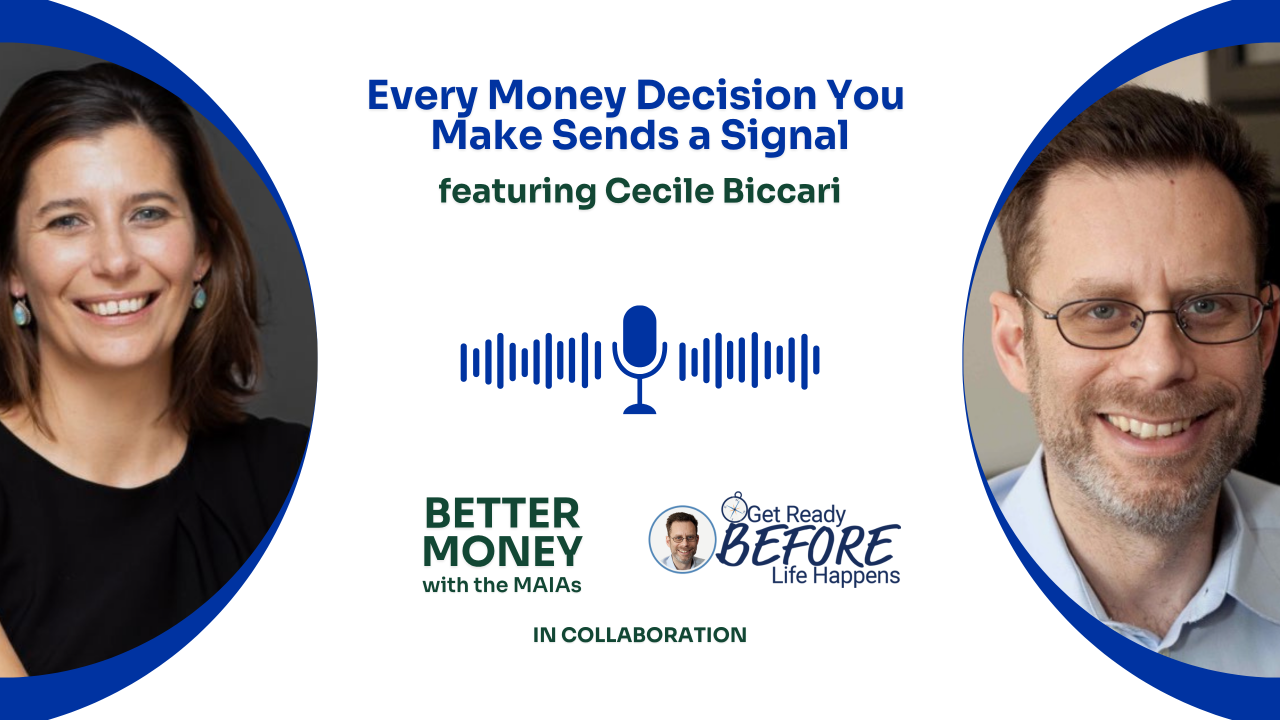
Your money decisions show what matters most to you.
Cecile Biccari, sustainable finance specialist and author of Your Money and the World, joins me on the Get Ready: Before Life Happens Podcast to talk about sustainable finance, impact investing, and how everyday choices about spending, saving, investing, and giving can influence the world around us.
Cecile shares how sustainable finance connects everyday financial decisions with real-world impact. We also explore how to align money with your values, how environmental, social, and governance factors shape investment decisions, and why early money conversations can influence lifelong beliefs.
Key Takeaways
-
Sustainable finance applies to everyday financial decisions.
-
Your spending and investing reflect what you value.
-
Investment choices influence real-world outcomes.
-
Sustainability includes environmental, social, and governance factors.
-
Impact can come from money, time, and attention.
-
Early money conversations help shape lifelong beliefs.
-
You can align your money with your goals and values.
🧠 Tony’s Take: What stood out is that money is more than a financial tool. It’s a signal. When we align our decisions with what matters most, we create impact in our own lives and in the world around us.
This episode is a collaboration with The Money Awareness and Inclusion Awards (the MAIAs) which celebrate the increasingly important work being done to help people understand money better. Learn more: https://www.maiawards.org.
🎥 Watch this episode below:
🎧 Listen to the podcast below or on your favorite podcast app.
Connect with Cecile Biccari:
- LinkedIn: https://www.linkedin.com/in/cecilebiccari/
- Your Money, Your World / Nora’s Treasure Website: https://www.norastreasure.com
- Ethos education platform focuses on sustainable finance: https://ethos.hiveq-cloud.com/ch/en-GB/Home
Book:
- Your Money and the World: How to Spend, Save, Donate and Invest Sustainably by Cecile Biccari (Amazon) (Bookshop)
Resources mentioned:
- Impact Philanthropy Advisor from Daylight Advisors (here)
- Invest for Better website (here). Check out my conversation with Invest For Better Founder: Janine Firpo on the Get Ready Before Life Happens podcast: Invest In Alignment With Your Values (here)
- Morningstar - Sustainable Investing (here)
Bio:
Cecile Biccari has worked in sustainable finance for more than 20 years. She started her career at the World Business Council for Sustainable Development (WBCSD) in early 2000s and then worked in the finance industry, helping investors to understand the social and environmental challenges we face, and how to incorporate these factors in their financial decisions. Along the way, she helped develop a number of training courses for investment professionals.
When her children, aged 7 and 5 at the time, started asking her questions about money, she decided to write a story to explain to them the basics of sustainable finance. Illustrated by Naiade Lacolomb and published by HELVETIQ, a Swiss publishing company, at the beginning of 2024, her book combines a comic strip story and a documentary explaining the connections between money, happiness, impact and responsibility. Cecile currently works at the Ethos Foundation to develop education programs on responsible investment for Swiss pension funds.
In collaboration with The Money Awareness and Inclusion Awards (the MAIAs) which celebrate the increasingly important work being done to help people understand money better. Learn more: https://www.maiawards.org.
👉 Start Your Financial Readiness Plan: A free, practical plan that helps you create your in-case-of-emergency Financial First Aid Kit, organize what matters, and prepare before life happens. Start Your Free Financial Readiness Plan https://www.tonysteuer.com
👉 Support the Mission: Become a Get Ready Insider and receive access to the Get Ready Library while helping support my mission to help people prepare before life happens. Become a Get Ready Insider https://www.tonysteuer.com/get-ready-insider
Episode Transcript
This transcript has been lightly edited for clarity.
Tony: Get Ready: Before Life Happens, the podcast helping you navigate life’s what-ifs.
Money can do more than grow wealth. It can help shape the future we want to live in.
Welcome to Get Ready: Before Life Happens. Today, I’m joined by Cecile Biccari.
Cecile, welcome to the show.
Cecile: Thanks, Tony.
Tony: It’s great to have you on. Tell us a little bit about yourself. What’s your origin story, and how did it lead you into sustainable finance and focusing on impact?
Cecile: The story started right at the very beginning of my professional career. My first job, pretty much back in 2000, was working in human rights at the UN as an intern.
Right from the get-go, I was interested in having a positive impact on the world. That story quickly developed and took me to the concept of sustainable development, which back in 2000 or 2001 was still a bit of a new term, maybe not something everyone was as aware of as they are today.
I started working in sustainability more on the corporate side. After a couple of years of doing that, I realized there’s only so much we can do with businesses if we don’t get investors on board with this topic, because money is the oil of the economy.
If we align the thinking of investors to care about long-term impacts and long-term challenges, then companies will also have a license to invest in long-term strategies and not just be focused on short-term profits.
That’s how I ended up going into finance with impact in mind. It wasn’t because I had a love of finance to start with or because I knew anything about finance, to be honest. But I saw it as a very important transmission mechanism and channel to deliver impact, and I wanted to be a part of that transformation.
That was 2001, 2002, 2003, 2004, 2005, 2006. And now, 25 years later, I’m still in that space and still trying to drive change from within.
Tony: That’s fantastic. I am a firm believer that you can have impact with your money. And I think with your background, having worked in the UN and in sustainable development, that brings a slightly different lens than people who grew up in the financial services industry.
One of the things you hear is that sustainable finance is just for wealthy people. Why do you feel sustainable finance is for everyone?
Cecile: It affects all of us. It’s not a question of how much money you have. It’s a question of what you’re doing with that money.
There are questions around how you use your money for purchasing decisions. That has an impact on the world: how you spend your money and what you choose to buy.
There is, of course, the dimension of investing as well. How do you choose to invest if you choose to invest? Investment is not reserved for people who have a lot of money. It’s something that is accessible and should be something everyone engages with to manage their money for the long term and, if possible, starts as young as they can.
That also has an impact from a sustainability perspective.
And even if you’re not investing yourself, even if you’re not comfortable and haven’t made those first steps into investments, you’re probably saving for your pension somewhere, and your pension fund is investing on your behalf until you get to retirement.
Knowing how that money is invested on your behalf and what sort of world it’s contributing to create concerns all of us. It’s all of our money.
That’s why it’s important that everyone understands that this isn’t reserved for people who have a lot of money. It concerns us all, and we can all have an influence on how this money is being invested and steered for us.
Tony: That’s fantastic. Just to make sure everybody who’s watching and listening understands, can you define what sustainable finance is?
Cecile: Sustainable finance is essentially thinking about long-term environmental, social, economic, and governance issues and how they can affect investment returns, investment risks, and generally your investment strategy.
It’s looking a little bit beyond the traditional financial lens of the annual statements of companies, their revenues and costs, and looking at how they’re managing other aspects of their business operations that are a little more intangible: their environmental impact and their social impact, and how this can, over time, affect their ability to be successful in the long run, to be competitive, to be resilient, to continue to have a license to operate, and to create great products and services.
Sustainable finance is really about expanding our lens from looking at narrow financial performance to understanding that creating value is much broader than just the bottom line.
We need to look at these other aspects of environmental and social impact that are not necessarily always priced into the economy or financial markets but deliver value. If we don’t care for them, then we also deplete them, and that will come back and affect us over time.
We see that with conversations around climate change and other aspects as well.
That’s what sustainable finance is. It’s having a holistic approach to understanding risks and opportunities.
Tony: I love that. I think that’s so important because it is our money, and we do have choices about where we invest it and where we spend it.
Sometimes people say, “I’m not going to buy from a certain company,” or “I’m not going to invest in tobacco stocks,” or what are sometimes called “sin stocks” in the U.S.
It’s good to recognize that you do have some power with your money. Sometimes it’s not even a lot of money, but you can still have that impact.
How do you feel money can become a practical tool for driving positive change? What are some practical tips for people to actually start using their money for good?
Cecile: I think we’ve touched on a couple of things already. In the same way that we vote with our feet, we vote with our wallets.
Every single financial decision we make sends a signal into the system about what we actually value and what we value less.
In the book I wrote for children to explain this concept, we’re trying to explain to kids from a young age these notions of sustainable finance and that they apply to every option for what you can do with your money, every type of financial decision, whether you spend, save, invest, or donate.
Very practically, if you’re spending, it means taking into account where things are coming from, how they’ve been made, and what their environmental and social impacts have been.
If you know that a toy has been produced somewhere where there may be materials that are not good for the environment, or people have been producing it under bad working conditions, this might be something you care about sufficiently to say, “I’m prepared to factor that into my decision.”
You might spend less on those types of objects and save and spend a little more on something that you think is higher value and ticks all the boxes that you care about.
That’s on the spending side.
On the saving side, if you’re just saving money in your piggy bank, that doesn’t have much sustainability effect. But the minute you start saving with a bank account, you can think about what sort of banking partner you’re choosing to look after that money for you.
How are they aligned with your preferences on sustainability? What are they doing with all of those savings, and how are they lending the money? What sort of ethical guidelines do they have? Are they happy to lend to the “sin stocks” that you talked about earlier, or do they have criteria that guide their lending practices?
With children, we often talk about just spending and saving. But I think investing and donating are things we can start talking about very young as well.
That’s where a lot of the sustainability impacts are very clear, particularly with donating.
You don’t have to wait to be rich or very old. In the same way that you have the joy of receiving or the joy of buying something for yourself, you can have the joy of donating and supporting causes that are close to your heart.
Investment is where you’re also financing things in the real world. What do you choose to finance with this money? Are you financing economic activities that deliver positive change or ones that tend to have a negative effect on people and the environment?
You can ask yourself these questions for every single financial decision and add this sustainability lens to the lens of, “What will happen with my money? How does that affect my personal goals?”
That helps you navigate this space.
Tony: That’s great. As a follow-up before we get into your book, how can the average person start to think about some of these things?
With some investing funds, I don’t know if “misleading” is the right word, but they may say they’re an environmental, social, and governance fund when they’re not really what you might expect.
How can the average person think about applying that sustainable lens?
Cecile: The industry has gone through a lot of developments over the last five, 10, or 15 years.
No one talked about it much when I started. It was very niche. Then came a phase more recently when people became aware and clients started asking about these topics.
We also had some big global agreements around climate change that put a framework around our global ambition to tackle this topic.
The industry then started innovating and producing a lot of products and funds. Of course, that led us to the situation now of greenwashing, where maybe some claims have been a little stretched.
There’s a lot of criticism now that it’s a lot of hot air, and we’ve also experienced a lot of what we call the ESG backlash. Particularly in the U.S., it’s even stronger than maybe it is for us here in Europe.
People feel that maybe the industry got a little bit ahead of itself and a lot of branding and marketing started to become associated with the idea of sustainability and green, but how were the products fundamentally different?
Regulators are now coming into it. At least in Europe, we’re seeing a lot of that to try to clarify all of this and put some rules around it so consumers can see a little bit more clearly what is and what is not sustainable.
The reality is that it’s also not black and white. There are a lot of shades of green.
The idea of sustainability is a transition toward something better. We’re always trying to be better in terms of our environmental and social impacts, but it doesn’t mean there are no negative impacts overnight.
It depends a little bit on what topics you care about. Are you more interested in environmental impacts? Are you more interested in social impacts? Or are they equally weighted in your mind?
Are you more interested in real solution providers, companies that are bringing new products and services that are solving these problems? Or are you interested in plain-vanilla companies that are transitioning their processes to be more sustainable, even if their products and services might not have been great to start with?
I admit that it’s not necessarily always easy to navigate. You shouldn’t always trust the label. It’s not completely black and white.
But I think what’s important is to know, “I care about these topics.” If I see a fund that seems to have a reasonably robust and disciplined process for looking at these factors in the way it selects companies and builds its portfolio, and it can explain and articulate that process and it seems robust enough, then that’s something I can probably get behind.
Tony: That’s great. For people who are looking at investing in funds, exchange-traded funds can sometimes be a little more challenging because some of them have hundreds of stocks, especially if they’re tracking an index.
But there are funds where you can see the stocks that are invested in. As you say, it’s not always an easy answer.
Unfortunately, in the U.S. right now, we’re moving away from some of these things, or at least from helping people understand some of these tools and providing some of the consumer education that we had.
For people out there, as always, do some research. There are some great tools to help you with these things. Unfortunately, I can’t think of any on air, but I’ll do some research and add some sustainability tools to the show notes.
Cecile, do you have any?
Cecile: For stock-specific information that can be helpful, Morningstar provides ESG ratings for large companies, and that’s available on their website.
If you’re investing in individual stocks rather than funds, or if you want to look at the top 10 holdings of a fund you’re considering, or if it discloses all of its holdings, you can do a quick search on Morningstar’s ESG ratings to see how these companies are rated on the three pillars of environmental, social, and governance issues.
It won’t give you all the underlying research, but there’s a solid methodology behind these ratings. They’re all a little bit different and have their own emphasis on specific things, but generally they give you a good overall picture compared to industry peers.
How is this company rated? That can be a useful starting point to get a sense of the portfolio.
Tony: Fantastic. For everybody watching and listening, if you’re not familiar with Morningstar, it’s a fantastic resource for researching investments. There will be a link to the Morningstar website.
Cecile, let’s talk a little bit about your book. What inspired you to write Your Money and the World?
Cecile: I can show it to you briefly. That’s the English version of the book.
I wrote it first in French because originally I’m French, and my children were asking me questions about what I do in my daytime when I’m not looking after them.
I was trying to explain to them my job, money, and sustainability. I always like to pick up books when we try to talk about a topic, so I looked around and I couldn’t find any good books on this topic.
I found some books that explain a little bit about money. There are more in the U.S. and the U.K., interestingly, than in some of the other European markets, where it’s a little bit taboo to speak about money with children that young.
My kids were about five and seven years old when they started asking me those questions.
I could find some books, but none that really brought the sustainability dimension into the discussion. I wanted something that combined those two mindsets because I think when we start to teach people about finance and money and don’t talk about impact, it becomes a conversation we’ll have to have later on.
But for kids, it’s completely intuitive if, from the get-go, you explain these concepts hand in hand.
So I decided to write the story for them. I wrote it in French and then found a Swiss publisher who was happy to publish the book.
Because we’re in Switzerland, we decided right away that it would come out in French, German, and English. So it exists in those three languages.
Tony: Fantastic. I think it’s great because so often we don’t think about the impact we can have with our money or about aligning our money with our values.
Could you talk a little bit about the format? It’s a very unique format and approach to the book.
Cecile: It has two parts.
The first half is a comic strip. It’s a little story. That was my original story when I went to the publisher with my manuscript.
I wanted something that was really like a bedtime story, a little adventure where you find a treasure. Usually, you find a treasure at the end of the book and never really know what happens with it.
I wanted the treasure to be the starting point of the book.
This little girl finds this treasure and doesn’t know what to do with it, but she meets a little mouse who’s an expert in finance and sustainable finance. She calls herself a treasure management expert.
This little mouse gives her insights into all these different options by jumping into different worlds. She gets to try different scenarios around spending, saving, investing, and donating.
She learns from these different experiences to think in three dimensions: What will happen with the money? How is that going to make me feel, in terms of my personal goals and well-being? And what’s the impact on the world, people, and the environment?
That was the nugget of the story.
My idea was that it would be a nice way for parents and kids to learn together about this topic and discuss it. It would be an introduction to the topic.
The publisher then asked me to add a second half to the book, which is more educational and goes into more of a Q&A discussion around money in our lives and money in the world.
We go through these different options in more detail and provide more explanation about what investment looks like, where money comes from, and other topics.
There are also some philosophical aspects about money and happiness, as well as Bitcoin, carbon credits, and all sorts of interesting things.
Tony: That’s fantastic. What I love about this book, and about so many other kids’ books on financial literacy, is that quite often parents don’t know much more than their kids about money.
It’s a great way for parents to learn at the same time because it can lower their barriers to learning about money, including feelings of shame or judgment.
Why is childhood such an important time to have these conversations about money and impact?
Cecile: My kids were not unique in asking me those questions around age seven.
That’s also what the research shows: it’s around the age of seven that children start forming their money beliefs. They start to understand that money is an important part of their lives. They see their parents shopping, they see that it has an effect, and they start asking questions.
The problem is that conversations are not always taking place in families or schools around money because money is still a little bit of a taboo.
If the conversation is taking place, it’s not necessarily a structured, informed, balanced discussion.
Parents may have inherited their own money beliefs, often because we didn’t have books like these available to us growing up. They may not necessarily feel comfortable having the discussion, but they will pass their own money beliefs on to their children anyway.
You can avoid having the conversation at that age, but children will start forming their relationship with money subconsciously, and that’s going to influence them for the rest of their lives.
They may think money is good and you need loads of it, or they may think money is bad and it’s a source of stress. That’s when it starts.
What I was trying to do with the book was give everyone a tool to have the conversation in a neutral way.
Money isn’t good or bad. It’s just a tool, and it depends on what you want to do with it.
As you said before, parents don’t necessarily always feel comfortable, so it was something for them as well, to be able to have this conversation.
Tony: That’s fantastic.
Before I close out, I want to mention the fact that you’re including donating as one of the pillars of the book. Your whole emphasis is on impact, and I think that’s something that is often missing when we talk about our money.
Maybe before we close out, tell people how they can think about impact with their money. We’ve talked about sustainable finance, but there’s also the value and the positive feelings you can have when you know you’re having an impact with your money.
Cecile: The way I cover donating in the book is that it’s not just about donating your money.
There are millions of different ways you can donate. You can donate your time, your energy, or things you don’t need. All of that has a positive impact.
In fact, wealth is not just a concept that’s linked to money. You can be wealthy from your connections, your friendships, and your experiences. It’s not limited to money.
It comes back to this idea of value. Value is something different than just price. It’s much broader.
We can contribute in so many different ways, and making small donations is one aspect.
Personally, I decided that all the royalties I receive from the book, which is not a lot, will be used to donate to organizations working in financial education and other NGOs working on humanitarian issues.
It’s also my way of making sure I can have an impact with the book, by using those royalties to pay it forward to causes that I care about.
So by buying the book, you can have an impact.
Tony: That is awesome. I’m so glad you’re talking about this.
Recently, I became an Impact Philanthropic Advisor, which is a new certification in the States.
For advisors around the world who are listening to this, as well as financial coaches, you can learn about the different ways people can have an impact.
When you’re guiding your clients and community, there are the six Ts, including time, treasure, and talent. I can’t remember all six offhand, but through the Impact Philanthropic Advisor program, you can learn how to help your community and clients have impact because there are so many different ways to do it and so many tools available.
Cecile: Absolutely.
One of the things I also try to cover in the book for kids is the difference between direct impact and more systemic impact.
You can choose to support a cause where you can really see the impact on the ground right away. It’s very close to the beneficiaries.
We talk about plastic pollution in the book as an example. You can support NGOs that are helping pick up plastic from the beach so turtles can nest again. That’s very concrete.
Or you can decide to support organizations that are negotiating the big global treaty to prevent plastic pollution. That doesn’t have the same direct impact, but it can have a global impact if we can push this forward.
I think it’s also about showing that you can act at many different levels, and it all adds up. It’s always worthwhile.
Tony: I love that.
For everybody watching and listening, there will also be a link to the Impact Philanthropy Advisor program. If you want to learn more, you can reach out to me through my website or LinkedIn.
Cecile, to wrap up, I have what’s called the Get Ready Hot Take Trio. These are three quick questions I ask all of my guests.
The first one is: What’s one money myth you’re trying to break?
Cecile: The one that personally resonates with me the most is this idea that you have to be good at math to be good with money management.
I think we tend to associate finance with mathematics, and we probably underestimate that money and finance have a lot to do with emotional intelligence as well.
That’s one thing I’m trying to get across to people: it’s not about being a math genius or wizard to be able to manage your finances properly.
It’s about knowing your goals and your North Star, and understanding enough that you can navigate the space.
This is completely understandable once you strip all the jargon out of the industry.
Then it’s about being consistent and accepting that you’re on a learning curve. No math PhD required.
Tony: That’s fantastic. I think that’s wonderful advice.
It is a continuous journey. Everybody I’ve had on the show and everybody I know in personal finance is always still learning. If you’re not still learning, you’re stuck.
Let’s get out the time machine next. If you could go back in time, knowing what you know now about money, what advice would you give your younger self?
Cecile: Definitely, I would have advised myself to start investing earlier.
Investing is something that can feel a little bit scary. I see it now when I do workshops with young people, and especially with girls.
For some reason, boys don’t seem to be as concerned. Maybe they’re more risk-takers and tend to be more inclined to invest.
Girls tend to hold back more. They have this attitude, and I think my younger self had this attitude, of, “As long as I don’t understand it fully, I’m not going to go there.”
I think that attitude stayed with me for a long time.
It took me a long time, even working in finance, to acknowledge that I could make my first step and dip my own toes in the water. It didn’t have to be with huge amounts, and whatever I knew was already good enough to start. I could always learn more.
Especially if you have long-term convictions about certain things, if you think, “This is the way forward and these trends will play out over the next 10 or 20 years, no doubt about it,” there are going to be some ups and downs in the meantime, but you can feel reasonably comfortable investing a little bit in those trends and being patient enough to see them play out.
Tony: Fantastic.
Studies show that women can be better investors than men over the long term. Part of that may be that men can be overconfident in their abilities, while women tend to take more time and be a little more thoughtful with their investing.
Cecile: Yes, that’s right. I’ve seen those studies.
Tony: For the women out there, you can do it.
There’s a great resource, at least in the States, called Invest for Better. I’ll put a link in the show notes. It’s a nonprofit that has investing circles and educational resources for women.
I’ll also link to my episode with the founder of Invest for Better, Janine Firpo.
For women who want to learn more about investing, it’s a great way to start learning and investing with other women.
Cecile, to wrap up, what is your number one tip to change the way we think about money?
Cecile: I think we need to talk about it more and break these taboos a bit.
If we had more conversations around money with friends and family, we would demystify it a little bit and it would become a little less scary.
We would realize that we’re all struggling with the same questions and concepts, and we’re all having our own experiences and learning along the way.
I think by sharing that, we would change the way we think about money and see it as something that’s a little less scary and more accessible to everyone.
Tony: Fantastic. That’s great advice for anything.
Bringing things out and talking about them tends to reduce the fear around them. Having something out in the open, you often find, “Well, this isn’t quite as scary as I thought it was.”
Cecile: Exactly.
Tony: Cecile, where can people learn more about you, your work, and pick up a copy of Your Money and the World?
Cecile: LinkedIn is the best place to find me and connect with me.
I’m glad to connect with anyone who’s interested in this topic and who wants to follow some of the work I’m doing in this space and with pension funds.
The book is available in bookstores in the U.S., Europe, Canada, and other places. You can also find it online through your usual online bookstore platforms.
The book has its own website as well, called Nora’s Treasure. Nora is the little girl at the beginning of the story. Nora’s Treasure gives you more information about the book and the story behind the book as well.
Tony: Fantastic. For everybody watching and listening, there will be links to the Nora’s Treasure website and Cecile’s LinkedIn profile so you can get in touch with her and follow her work.
Cecile, thanks for joining us.
Cecile: I could mention, actually...
Tony: Oh, sure. Sorry.
Cecile: On the website, you’ll find some activities to do at home with your kids around this topic of money.
It’s a bit of a companion to the book as well. You can download a couple of exercise sheets. They’re available there for free, and there are little exercises you can do to have a conversation with your kids about these concepts.
Tony: Fantastic. That’s a great resource. Definitely check out the Nora’s Treasure website.
Cecile, thanks again for joining us on Get Ready: Before Life Happens.
Cecile: Thanks a lot, Tony. It was a pleasure.
Tony: Thank you, everyone, as always, for tuning in to this episode of Get Ready: Before Life Happens.
If you learned something today that changed the way you think about money, please be sure to subscribe and share it with a friend.
You can go to my website at TonySteuer.com to join the Get Ready Movement and receive my newsletter and other resources.
If you’d like to support the podcast, you can now do so at Buy Me a Coffee.
Until next time, let’s change the way we think about money.