
How to Create Your Forever Paycheck
Oct 02, 2026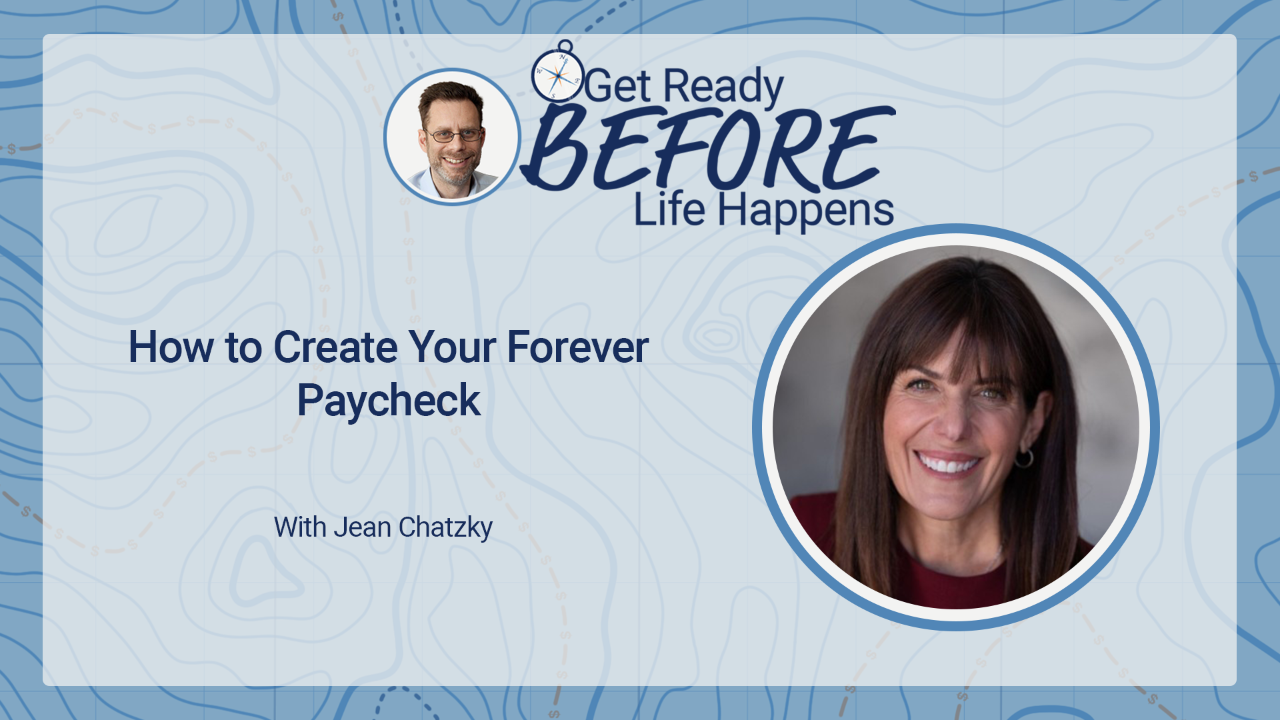
Retirement confidence grows when your savings become reliable income.
Jean Chatzky joined me on the Get Ready Before Life Happens Podcast to talk about her new book, The Forever Paycheck. Jean explains why retirement planning needs to move beyond accumulation and focus on turning savings into income that can last for life. This conversation is about decumulation, annuities, spending confidence, women and retirement, values, and creating more freedom in the years ahead.
Key Takeaways
- Retirement planning should help turn savings into reliable income.
- Running out of money is one of the biggest retirement fears.
- Switching to spending after a lifetime of savings can feel uncomfortable.
- Retirement income often comes from a maze of accounts.
- A forever paycheck can help simplify decumulation.
- Annuities can provide guarantees through risk pooling.
- Retirement decisions should reflect personal values and shared conversations.
- Women need to be engaged in retirement planning today.
Tony’s Take
After years of saving, spending can feel like the hardest part. A forever paycheck helps reframe the question: How can my money support the life I want for as long as I live?
🎥 Watch this episode below:
🎧 Listen to the podcast below or on your favorite podcast app.
Connect with Jean Chatzky:
Website: https://jeanchatzky.com/
LinkedIn: https://www.linkedin.com/in/jeanchatzky/
Instagram: https://www.instagram.com/jeanchatzky/
Facebook: https://www.facebook.com/JeanChatzky/
Connect with Her Money:
- Website: www.hermoney.com
- Instagram: https://www.instagram.com/hermoneymedia/
- TikTok: https://www.tiktok.com/@hermoneymedia
Books:
- The Forever Paycheck: The New Retirement Strategy to Spend More, Worry Less, and Never Run Out of Money (Amazon)
- How to Money: Your Ultimate Visual Guide to the Basics of Finance (Amazon)
- Women with Money: The Judgment-Free Guide to Creating the Joyful, Less Stressed, Purposeful (and, Yes, Rich) Life You Deserve (Amazon)
- Money Rules: The Simple Path to Lifelong Security (Amazon)
- Talking Money: Everything You Need to Know About Your Finances and Your Future (Amazon)
- Pay It Down!: Debt-Free on $10 a Day (Amazon)
- AgeProof: Living Longer Without Running Out of Money or Breaking a Hip (Amazon)
- Money 911: Your Most Pressing Money Questions Answered, Your Money Emergencies Solved – A Lifesaving Guide to Managing Life-Altering Financial Events (Amazon)
- Not Your Parents' Money Book: Making, Saving, and Spending Your Money (Amazon)
- Make Money, Not Excuses: Wake Up, Take Charge, and Overcome Your Financial Fears Forever (Amazon)
- The Difference: How Anyone Can Prosper in Even The Toughest Times (Amazon)
- The Ten Commandments of Financial Happiness: Feel Richer with What You've Got (Amazon)
Podcast:
- Her Money Podcast: https://hermoney.com/t/podcasts/
Resources mentioned:
- Invest for Better website (here). Check out my conversation with Invest For Better Founder: Janine Firpo on the Get Ready Before Life Happens podcast: Invest In Alignment With Your Values (here)
Bio:
Jean Chatzky is the founder and CEO of HerMoney and the host of “HerMoney With Jean Chatzky.” Jean is a columnist for AARP, a coach on the PBS TV show Opportunity Knocks and a research fellow with the LIMRA Retirement Income Institute. Previously, she spent 25 years as the Financial Editor on NBC's Today Show and was a contributor to Oprah. Jean is an award-winning journalist and broadcaster, a New York Times and Wall Street Journal best-selling author, and a fierce advocate for financial literacy. Her latest book is The Forever Paycheck: The New Retirement Strategy to Spend More, Worry Less and Never Run Out Of Money.
👉 Start Your Financial Readiness Plan: A free, practical plan that helps you create your in-case-of-emergency Financial First Aid Kit, organize what matters, and prepare before life happens. Start Your Free Financial Readiness Plan https://www.tonysteuer.com
👉 Support Get Ready. Become a Get Ready Insider and help keep the Financial Readiness Plan free, support the podcast, trusted resources, and consumer-first financial education. You’ll receive access to the Get Ready Library. Support Get Ready here. www.tonysteuer.com/support
Transcript
Tony Steuer:
A Forever Paycheck can help turn retirement savings into reliable income and create more flexibility in retirement.
Welcome to Get Ready: Before Life Happens. I’m Tony Steuer.
Today, I’m pleased to be joined by Jean Chatzky, author of The Forever Paycheck.
Jean, welcome to Get Ready: Before Life Happens.
Jean Chatzky:
Thank you so much. Thanks for having me.
Tony:
I’m excited to have you here.
What inspired you to write The Forever Paycheck?
Jean:
I’m 61, so retirement isn’t right around the corner, but it’s certainly a lot closer than it used to be.
Like so many people, I’ve struggled with the question of how much I’ll be able to spend, at what pace, and from which accounts.
A couple of years ago, I turned my research skills toward figuring out the best way to make your money last.
The Forever Paycheck is the result.
Tony:
I’ve spent a lot of time thinking about this too.
The financial services industry has focused so heavily on accumulation:
Accumulate. Accumulate. Accumulate.
Then you reach the goal and ask:
What do I do now?
I really like how you lay out the different pieces people need to think about.
One thing that has changed dramatically for our generation is that many of our parents had pensions.
How has retirement changed as we moved from pensions to 401(k)s and other self-directed plans?
Jean:
Generation X, and I’m right on the line between the Boomers and Gen X, is the first generation to largely live without traditional pensions.
401(k)s have now been around for about 40 years.
They came into play just as I was entering the workforce.
At first, many people didn’t understand them or know how to manage them.
Then the Pension Protection Act of 2006 brought in things like automatic enrollment and automatic contribution escalation.
As a result, we now have a lot of people with significant wealth in retirement accounts.
But they also understand that they’re going to have to make that money last for the rest of their lives.
They have to combine those savings with Social Security and figure out how to create an income stream that works for them.
You’re absolutely right that the financial services industry spent a lot of time getting people to accumulate.
So did the media.
I worked at personal finance magazines and spent 25 years on the Today show.
A lot of the message was:
You have to save for yourself.
Retirement is on your shoulders.
You’re responsible.
We got that message out loudly.
What we didn’t spend enough time on was:
What happens the day you stop earning?
What happens when you have this pile of money and need to make it last?
That’s a complicated math problem.
It’s also a complicated emotional problem.
Tony:
Exactly.
We’re people.
And one of the biggest fears I hear from consumers, and something I’ve thought about myself, is:
What if I run out of money?
My grandfather went bankrupt during the Great Depression, so that fear has always been somewhere in the background for me.
Jean:
And some of the solutions we relied on in the past have let us down.
There have been so many headlines about the 4% rule and whether it still holds up.
Morningstar now publishes a different suggested withdrawal rate depending on the year.
Sometimes it’s 3.2%.
Sometimes 3.8%.
Sometimes 4%.
It can be head-spinning.
That’s one of the reasons I started looking for another solution.
Then there’s the math.
By the time people reach retirement, many of them have money spread across tax-deferred retirement accounts, Roth accounts, and taxable brokerage accounts.
Figuring out how to draw money from those accounts without pushing yourself into a higher tax bracket or triggering additional Medicare costs can be very complicated.
Then there’s the emotional side.
You’ve spent decades watching the balances in your 401(k) and other accounts go up.
Suddenly you’re supposed to start spending that money and watch the balance go down.
That can feel really uncomfortable.
A lot of retirees simply aren’t doing it.
Research has found that some retirees still have most of their money many years into retirement.
That tells me they may be leaving a lot of life on the table.
Experiences.
Joy.
Helping children or aging parents.
People can become paralyzed around spending.
We need to help them get beyond that.
Tony:
That’s such an important point.
And to come back to the 4% rule, William Bengen himself has said it was a guideline, not something he expected everyone to follow rigidly.
It has become much more complicated than that.
Jean:
Exactly.
He now talks about flexibility and how much more complicated it is.
I went through with him how he manages spending in his own retirement.
He uses computers, calculators, and different pots of money.
It’s incredibly complicated.
Personally, I couldn’t do that.
I wanted something much simpler.
That’s what I was trying to get to with The Forever Paycheck.
Tony:
And I think you got there.
So let’s come back to the emotional side.
How do people shift from a lifetime of saving to feeling comfortable spending?
Jean:
I think the best way is to create a pool of money specifically for spending.
In the book, I suggest starting with your likely cost of living.
Not every want or wish.
Start with your needs and the wants you really don’t want to compromise on.
For me, my gym membership is going on that list.
That’s important to me.
Then figure out:
What does that total cost?
How much will Social Security cover?
What’s the gap?
Then you either buy or create a paycheck that will last for the rest of your life to cover that gap.
That’s your spending money.
You’ve designated it for spending, just like the paycheck you receive today.
The rest of your money can stay invested.
And once those needs and primary wants are covered, you may actually be able to invest the rest more aggressively for the future, for healthcare, or for legacy goals.
Tony:
That’s something people sometimes overlook.
If you retire at 60 or 65, you may still have 30 or more years ahead of you.
So some of that money still has a long time horizon.
You also talk about different ways to create that paycheck.
Jean:
Yes.
The bucket method is one approach.
You can have short-, medium-, and long-term buckets.
There’s also a total-return approach for people who want more of their money invested in the markets.
And there’s the option of creating a paycheck through an annuity.
That’s insurance that can provide income for the rest of your life.
Tony:
Let’s talk about annuities for a minute.
My background is in insurance consulting, and I’ve worked on litigation and with the California Department of Insurance.
Annuities have had a bad reputation for a long time, and in many ways the industry created that reputation through complex products and poor sales practices.
How do you help people think about annuities today?
Jean:
I think the stereotype has been changing for the last six or seven years.
Like you, I grew up in a financial media environment where we didn’t really talk about annuities or think very highly of them.
My view has shifted.
I’m not a fan of every annuity on the market.
But I’ve come to understand that they can provide guarantees other products cannot.
Insurance companies can pool risk in a way other financial products can’t.
That allows them to provide income in ways that may compare favorably with other fixed-income options.
Then you combine that with the fact that none of us knows how long we’re going to live.
You want those later years covered.
That has made me a believer.
This is how I plan to build part of my own Forever Paycheck.
I’m going to use a portion of my portfolio to buy an annuity that produces income for as long as I live.
Tony:
I think you said something really important there.
An annuity is an insurance contract issued by an insurance company.
It isn’t simply another investment.
And people need to understand what kind of annuity they’re looking at.
There are simple fixed products designed to provide guaranteed income.
Then there are much more complex products with investment components, surrender charges, and other features.
When something becomes very complex, that’s a good time to slow down and make sure you understand it.
The basic purpose is income protection.
Another thing I think matters here is cognitive decline.
What role does that play?
Jean:
I think there comes a point where you should have other eyes on your financial picture.
We’re learning that cognitive decline can show up in the way people manage money years before they realize it themselves.
You may already be experiencing changes and not know it.
So by the time you’re in your 70s, and certainly by your 80s, it can be helpful to have a financial advisor or another trusted person involved.
Someone who can make sure you’re still following the plan you created.
A Forever Paycheck can reduce some of that pressure.
It means you don’t have to keep pulling financial levers all the time.
Think about how we put our 401(k)s on automatic pilot during accumulation.
A Forever Paycheck can provide something similar during decumulation.
The money continues to come in.
Bills can continue to get paid.
You don’t have to micromanage every decision.
Tony:
That’s a really important benefit.
We often think cognitive decline means dementia, but it can happen gradually.
Having more of the system automated can make things easier later.
You also talk about connecting retirement income decisions to values.
How can people do that?
Jean:
Every financial exercise is, in some way, a values exercise.
When you decide how to use your resources today or in the future, those decisions should reflect what you truly value.
A lot of people haven’t really thought through what those values are.
In the book, I take people through exercises designed to help them figure out:
How do I want to spend my retirement?
How do I want to spend my time?
Where do I want to live?
Who do I want to be with?
How do I want to make an impact?
How do I want to enjoy these next 30 or 40 years?
Those are financial decisions because they determine where your money will be most useful.
We owe it to ourselves to spend time thinking through those questions.
Then, if we have a partner, we need to talk about them.
It’s amazing how many couples aren’t on the same page about retirement simply because they haven’t had the conversation.
Go through the exercises individually.
Then do them together.
Align on your values.
Your values can help direct how you use your money.
Tony:
I love that.
And this connects directly with your HerMoney platform.
I’m a fan of your newsletter, and we’ll have a link in the show notes.
It’s also especially important for women to engage with their money today.
Women tend to live longer.
There’s widowhood.
There’s gray divorce.
There are wealth and caregiving gaps.
What would you say to women who still feel, “I can’t do money”?
Jean:
One reason women need to engage now is that an enormous amount of wealth is going to move into women’s hands.
Depending on which estimates you use, there is a massive wealth transfer underway over the next several decades.
A large share will go to women because women may inherit from both parents and spouses.
That represents a major shift in financial power.
And women need to know how to manage it.
To women who say, “I can’t do money,” I would say:
You already do money every day.
Women make the majority of household purchasing decisions.
That’s step one.
Now start leaning into the other parts.
Maybe you’re already a great budgeter.
Maybe you haven’t paid as much attention to your investments.
Maybe your 401(k) has been running on autopilot.
Start learning.
Dip a toe in.
My newsletter is one place to start.
Talk with your spouse.
Talk with a financial advisor.
Make sure you have a plan.
People who have a plan tend to feel more confident because they know what steps they’re following.
Tony:
I love that.
A plan can create confidence.
And I’ve seen studies suggesting women can be very strong investors.
Jean:
Yes.
Women often do well because we tend to trade less.
We make decisions, do our homework, and then stick with them unless there’s a real reason to change.
Frequent trading can hurt returns.
Women also tend to save slightly more.
The bigger challenge remains earnings.
The wage gap is still very real.
Tony:
And then the caregiving gap compounds that.
Women are more likely to take time away from the workforce to care for children or aging parents.
Jean:
Exactly.
Because women often earn less and take more time away from work, they may reach retirement with significantly smaller balances.
They may also have fewer Social Security credits.
Then they have to make those smaller resources last longer because they tend to live longer.
That’s why these strategies are especially important for women.
Tony:
So Jean, I have the Get Ready Hot Take Trio.
Three quick questions I ask all my guests.
What’s one myth about retirement income you’d like to break?
Jean:
That you can do it with the 4% rule alone.
Tony:
I love that.
Any rule of thumb is just that: a rule of thumb.
Let’s get out the time machine for a minute.
If you could go back in time knowing what you know now about money, what advice would you give your younger self?
Jean:
Start sooner.
I bet every one of your guests says that.
I didn’t really get on the savings train until I was in my mid-30s.
If I had started in my mid-20s, the sky’s the limit.
Tony:
That is definitely one of the most popular answers on the show.
We can’t go back in time, but we can start today.
So to wrap up, what’s your number-one tip to change the way we think about money?
Jean:
Money done well is a series of good habits repeated over time.
It’s not rocket science.
If somebody is making money seem incredibly confusing, there’s a good chance they’re using jargon to sell you something.
It doesn’t need to be that complicated.
Tony:
That’s wonderful advice.
And it connects with something we talk about on this show around scams and financial products.
When something becomes so complex that you don’t understand it, that’s a good reason to slow down.
Even if it isn’t a scam, it may simply be something that isn’t right for you.
Jean, where can people learn more about you, HerMoney, and pick up a copy of The Forever Paycheck?
Jean:
You can find me and The Forever Paycheck at JeanChatzky.com.
And there’s much more at HerMoney.com as well.
Tony:
Fantastic.
For everyone watching and listening, there’ll be links to Jean’s website, HerMoney, and her books in the show notes.
Jean, thanks for joining me on Get Ready: Before Life Happens.
Jean:
Thank you so much for having me.
Tony:
And thank you, everyone, for tuning in to Get Ready: Before Life Happens.
If something today changed the way you think about retirement income, please share the episode and subscribe.
Start your free Financial Readiness Plan at tonysteuer.com. It is a practical way to begin building your in-case-of-emergency plan before life happens.
You can also help keep the Plan free and support this podcast by becoming a Get Ready Insider for $5 a month.
Because when life happens, the way you think about money matters.